The deadline curve
The essay is due in 30 days and the phone pays now. On which day does the essay finally win - and what moves that day?
An essay is due in thirty days and the phone pays now. Each day the essay pulls by how sure you are and what it is worth, shrunk by how far away the deadline is. The panels show the day it first beats the phone, whether the work still fits, and the pull day by day.
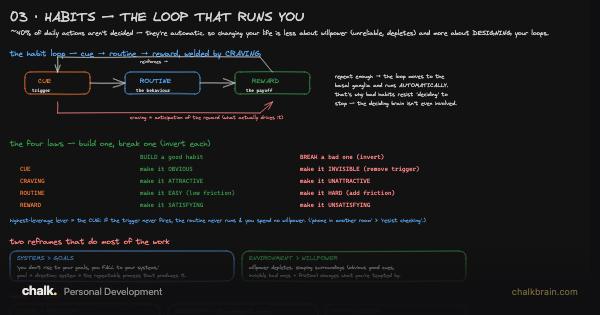 Board: The Loop That Runs You →
On a narrow screen the panels stack below the dials, and the table scrolls sideways.
try this Drag How much later counts less from 0.1 to 4 and watch You start with fall toward the deadline.
The lesson's made-up numbers: you are 80% sure you can write it, the finished essay is worth 10, today's 25-minute session is worth 2, and the essay needs 10 sessions, at most one a day. Each day the task pulls (expectancy × value) ÷ (1 + impulsiveness × days until its reward), and you start on the first day it pulls at least as hard as the rival.
You start with
7 days left
of 30 days on the clock
Does the work fit?
7 / 10
sessions done by the deadline, at one a day
You start with 7 days left and need 10 sessions. 3 of them do not fit, unless you cram 1.43 a day.
The pull, day by day
One bar per day, the day the task is set on the left, the deadline on the right. The line is the rival. Bright bars are the days the task wins.
Every impulsiveness, swept
The same deadline, rival and reward at each notch of the impulsiveness dial. Columns: impulsiveness, the task's pull on the first day, the day you start, sessions done, and sessions a day needed to finish.
| Impulsiveness | Pull on day one | You start with | Sessions done | Needed a day |
|---|---|---|---|---|
| 0.1 | 2.00 | day 1 | 10 / 10 | 0.33 |
| 0.25 | 0.94 | 28 days left | 10 / 10 | 0.36 |
| 0.5 | 0.50 | 14 days left | 10 / 10 | 0.71 |
| 1 | 0.26 | 7 days left | 7 / 10 | 1.43 |
| 2 | 0.13 | 3 days left | 3 / 10 | 3.33 |
| 4 | 0.07 | 1 day left | 1 / 10 | 10.00 |
With impulsiveness 1 and the phone as the rival, a 30-day deadline gets started with 7 days left. Double the deadline to 60 days. When do you start now?
The start is pinned to the deadline, not to the day it was set
The essay ties the phone when 8 ÷ (1 + impulsiveness × days) = 1, which is days = 7 ÷ impulsiveness. Nothing in that line mentions when the essay was set. So once the deadline is further away than that threshold, more time buys nothing: with impulsiveness 1 a two-month essay and a one-month essay both start with a week left. The extra month is spent not starting. Move the deadline dial and watch the start stay put while the bars on the left multiply.
Impulsiveness moves the threshold, in direct proportion: halve it and you start twice as early. The rival moves it too, because a stronger pull needs a shorter delay to beat. Put friends going out (2) against the essay and the threshold drops from 7 ÷ impulsiveness to 3 ÷ impulsiveness.
Today's session: no delay to shrink, and a small reward
Switch to Today's 25 minutes. Its reward arrives tonight, so its delay is zero and the impulsiveness dial stops doing anything: 0.8 × 2 = 1.60 every day. Against the phone at 1 that wins from day one, at every impulsiveness, and the work fits whenever the deadline leaves ten days.
Now raise the rival to 2. The session's 1.60 never wins, and nothing gets started at all, while the finished essay, back on its own tab, does get started near the end. That is the trade: a process reward is close and small, a product reward is large and far. The first beats weak temptations early. Only the second beats strong ones, and only late. Which is why the lesson pairs process with removing the rival.
Limits of this model
Teaching numbers, not yours. Expectancy 0.8, a value of 10, a session worth 2 and rivals from 0.5 to 3 are picked so the arithmetic is easy. Nobody has measured anyone's impulsiveness on this scale. Trust the shape and the ranking, not the day.
One rival, one task, fixed numbers. A real day has several rivals, and dread changes as the deadline gets near and as work gets done. Expectancy also rises once you have started, which this page ignores.
Deadlines as a fix are contested. Splitting a deadline into checkpoints follows from the equation, but the best-known experiment for it (Ariely and Wertenbroch, 2002) did not replicate in 2026. The lesson covers both.