Habits & Behaviour Change (the loop that runs you)
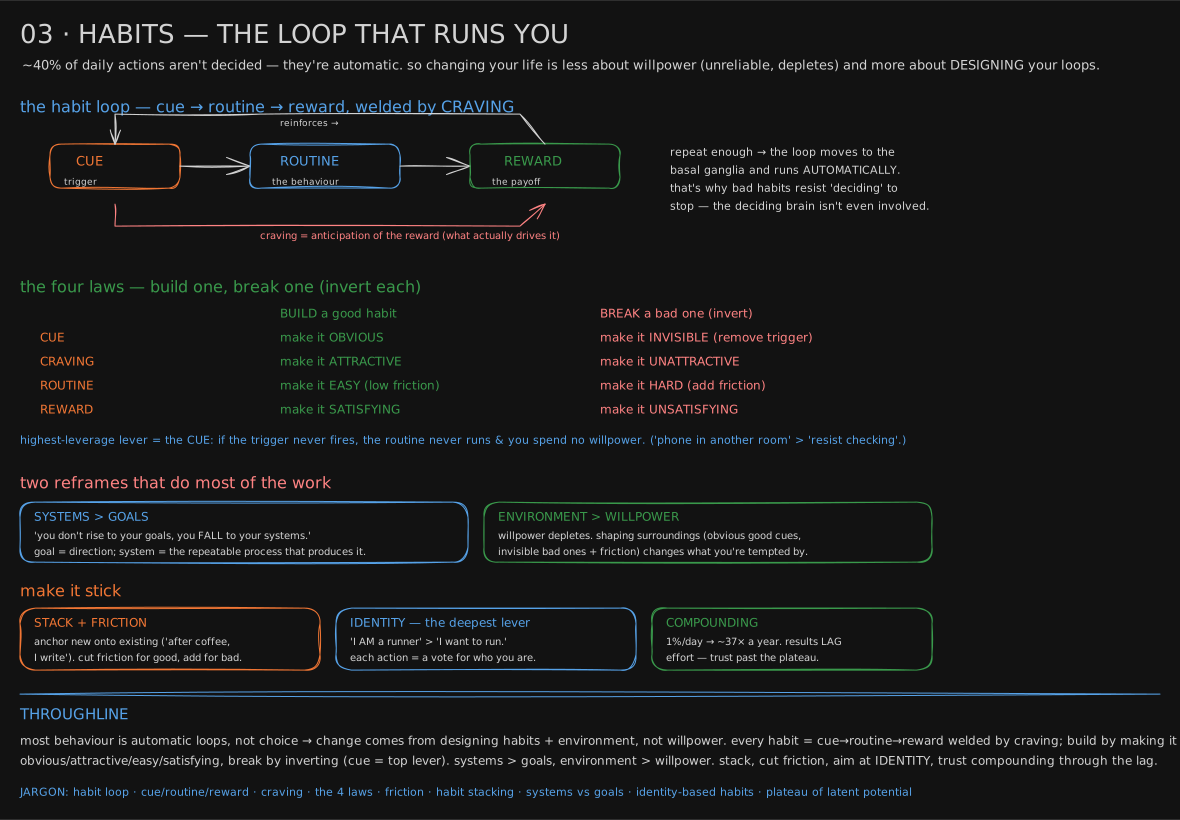
The machine that runs behind almost everything you do without deciding to. Deep Work & Attention (focus is the scarce resource) and Deliberate Practice (how expertise is actually built) both lean on it already; this lesson takes it apart in the open.
Before you start. The last lesson showed that protecting your attention works by removing the thing that distracts you, not by resisting it in the moment - phone in another room, not “I’ll just ignore it.” This lesson explains why that trick works on anything, and hands you the four places you can do the same move to any habit.
One idea from next door helps with the question this lesson leaves open, which is why some habits feel like yours and others feel like a chore. Motivation & Habit covers the reward side of motivation and points to the theory for this part, Edward Deci and Richard Ryan’s self-determination theory: a behaviour sticks more easily when it feels chosen (autonomy), when you can feel yourself getting better at it (competence), and when it connects you to people (relatedness). A habit that gives you none of the three needs much more of the levers below to survive.
The 21-day deadline nobody hits
You have heard it said as a fact: a habit takes 21 days. Somebody tried it - quit sugar, started running, whatever - and by day 20 felt no different, decided it hadn’t worked, and quit right before anything would have changed. That exact story has happened to almost everyone who has ever tried a New Year’s resolution.
The number was never about habits. In 1960 a plastic surgeon named Maxwell Maltz published a book called Psycho-Cybernetics. He had noticed that after a nose job or a scar removed, patients took about three weeks to stop flinching at their own reflection and start seeing the new face as theirs; patients who lost a limb reported the missing arm feeling present for roughly the same stretch. Maltz wrote that it takes “a minimum of about 21 days for an old mental image to dissolve and a new one to jell.” Over six decades of retelling, “a minimum, for a self-image, after surgery” lost the word minimum and the subject, and became “a habit, in exactly 21 days.”
Nobody measured it against an actual habit until 2009, when Phillippa Lally, a psychologist at University College London, gave 96 volunteers one small new habit each - a glass of water with lunch, a piece of fruit, a run - and had each rate, daily for up to twelve weeks, how automatic it was starting to feel. That rating rises then flattens; where it flattens, the habit has formed.
It formed, at the midpoint of the group, in 66 days - three times the myth - and ranged from 18 to 254 days across the 96 people. (The study only ran twelve weeks; the longer figures come from fitting a curve to each person’s daily ratings and reading off where it was heading, not from watching anyone for 254 days straight.) There is no single number, because a habit is not a calendar. It is a loop, and how fast it locks in depends on the loop, not the date.
Cue, craving, routine, reward - the loop that runs itself
Every habit is the same four-part loop, round and round. The solid arrows are the loop; the dashed ones mark where you can push on each stage, to build a habit or to break one (the next section explains them):
flowchart LR
  C[Cue: phone buzzes] --> V[Craving: wants the novelty] --> R[Routine: check the app] --> W[Reward: something new] --> C
  bC[build: make it obvious] -.-> C
  bV[build: make it attractive] -.-> V
  bR[build: make it easy] -.-> R
  bW[build: make it satisfying] -.-> W
  kC[break: make it invisible] -.-> C
  kR[break: make it hard] -.-> R
A cue is the trigger: a time, a place, a feeling, or something someone else did. The phone buzzes. A routine is the behaviour the cue sets off: you check it. A reward is the payoff that tells your brain the routine was worth it: something new to look at. And a craving is what grows between cue and routine the more times you run the loop - not “I want to check the app” the first time, but a felt itch the moment the phone buzzes, before you’ve even thought about it. Craving is what actually drives the behaviour; the cue just switches it on.
Run the loop often enough and it stops needing the thinking part of your brain at all - it moves into the same machinery that lets you tie a shoelace while talking about something else. That is why “just decide not to” fails on an old habit: the part of you that decides is not in the loop any more.
Four levers, one per stage of the loop
If a habit is a loop with four stages, there are exactly four places to push. Push the same way to build a habit, or push in reverse to break one:
              BUILD a good habit          BREAK a bad habit (invert)
 CUE      →   make it OBVIOUS             make it INVISIBLE   (remove the trigger)
 CRAVING  →   make it ATTRACTIVE          make it UNATTRACTIVE
 ROUTINE  →   make it EASY (low friction) make it HARD (add friction)
 REWARD   →   make it SATISFYING          make it UNSATISFYING
The cheapest lever is the first one. If the cue never fires, the routine never runs, and you never have to spend a single ounce of willpower resisting it. That is the whole logic behind “put the phone in another room” (Deep Work & Attention (focus is the scarce resource)): it does not fight the craving, it removes the buzz that starts the loop, so there is nothing left to resist.
Systems beat goals, environment beats willpower
Two shifts in where you put your effort carry most of the weight here. A goal is the direction: write a book. A system is the repeatable process that gets you there: three hundred words every morning. People chasing the same goal often have wildly different systems, and the system decides who gets there - “fall in love with the process,” not “want it more.”
Willpower is not a strategy, because it runs out. It fluctuates through the day and drops under stress, so any plan that depends on resisting an urge every single time will eventually meet a bad day and lose. Designing your environment - fruit on the counter, cookies in a cupboard you never open, the guitar left out, the phone left in a drawer - changes what tempts you before the moment arrives. You are not more disciplined. Your kitchen is doing the work.
Make it stick: friction, stacking, identity
Three more moves, on top of the four levers:
- Friction. Every step between you and a behaviour is friction you can add or remove: lay tomorrow’s gym clothes out tonight, or log out of the app so a habit has to survive one extra click.
- Habit stacking. Anchor a new routine to one you already run without thinking: “after I pour my coffee, I write for ten minutes.” The old habit supplies the cue.
- Identity. The deepest lever is not the outcome but who you think you are. “I want to run a marathon” is a wish; “I am a runner” is an identity, and every run votes for it. A behaviour that fights your self-image gets dropped; one that confirms it keeps running on its own.
None of this pays off on day one: results lag effort, the way ice sitting at 25°F shows nothing right up until it hits 32°F and melts all at once. James Clear calls that flat stretch the plateau of latent potential, and it is where almost everyone quits - right before the curve turns.
You now know
- A habit is a loop: a cue triggers a routine, a routine earns a reward, and the craving that grows between them is what actually pulls you back to repeat it.
- Repeat a habit enough times and it stops needing conscious thought, which is why “just decide not to” fails against an old habit: the deciding part of you is no longer involved.
- You can build or break any habit by changing its trigger, how tempting it is, how easy it is, or how good it feels afterwards; removing the trigger is cheapest, because if it never fires there is no urge left to fight.
- A repeatable system beats a goal, and a redesigned environment beats willpower, because willpower runs out and a system doesn’t need to be remembered.
- “21 days” was never about habits - it came from surgery patients adjusting to a new face - and the real number, measured in 2009, has a range of 18 to 254 days with no single answer.
- Results lag effort before they show up at all, so the moment a change feels like it isn’t working is often the moment right before it would have.
Stop here if you want. What follows is the same loop in numbers - how much a missed day actually costs, and where that flat stretch really ends.
Second read: the arithmetic of showing up
“Small changes compound to something huge” gets repeated more than it gets checked, so check it. A 1% improvement a day means today is yesterday times 1.01; after 365 days that is 1.01 multiplied by itself 365 times. A 1% decline is the mirror, 0.99 a day.
Before running it, estimate it standing up. The rule of 72: at r% a period, a quantity doubles in about 72 ÷ r periods, so 1% a day doubles every 72 days. A year is 365 ÷ 72 ≈ 5 doublings, and five doublings is 2⁵ = 32. The exact answer, 1.01^365, comes out at 37.78 when the script below multiplies it through. Mental 32, exact 37.8; the slogan is right to the nearest order of magnitude, and the script below is checking, not discovering.
// compound.mjs - what a daily 1% does over a year, and what it does not
const up = 1.01 ** 365, down = 0.99 ** 365;
console.log(`1.01 ^ 365 = ${up.toFixed(2)}     0.99 ^ 365 = ${down.toFixed(4)}`);
// the same 1%, but only on the days you actually show up
for (const days of [365, 300, 200, 100, 50, 30]) {
  console.log(`${String(days).padStart(3)} days of +1%  -> ${(1.01 ** days).toFixed(2)}x`);
}
// where the "valley" is: how much of the year's gain arrives in each quarter
const q = [0, 91, 182, 273, 365].map(d => 1.01 ** d - 1);
const total = q[4];
for (let i = 1; i < q.length; i++)
  console.log(`quarter ${i}: +${((q[i] - q[i-1]) / total * 100).toFixed(0)}% of the year's gain`);
Running node compound.mjs prints the year’s result first, then the result for fewer days of showing up, then how the gain splits across the four quarters:
1.01 ^ 365 = 37.78     0.99 ^ 365 = 0.0255
365 days of +1%  -> 37.78x
300 days of +1%  -> 19.79x
200 days of +1%  -> 7.32x
100 days of +1%  -> 2.70x
 50 days of +1%  -> 1.64x
 30 days of +1%  -> 1.35x
quarter 1: +4% of the year's gain
quarter 2: +10% of the year's gain
quarter 3: +24% of the year's gain
quarter 4: +62% of the year's gain
Three things the arithmetic says that the slogan does not.
- The 37.78× is real, and so is the 0.0255×. A 1% daily slide leaves you at 2.5% of where you started. The two curves are not symmetric: the good one is unbounded, the bad one floors at zero, which is why a bad habit feels like it “levels off” and a good one never seems to.
- Missing days is not linear. 300 days of showing up, not 365, is not 82% of the result - it is 19.79× against 37.78×, about half. Every missed day is also a day the later gains do not compound on. This is the arithmetic behind “never miss twice”: the miss itself is cheap, a streak of misses is not.
- The plateau of latent potential is in the numbers, not just in your head. The first quarter of the year delivers 4% of the year’s total gain; the last quarter delivers 62%. After three months of daily effort you have seen about one twenty-fifth of what the year will give you. That is exactly the point where quitting feels most reasonable and costs the most.
A caution the numbers don’t make on their own: nobody improves 1% a day at anything for a year straight - this is a model of the shape (slow, then sudden), not a real measured rate. The shape survives even at a tenth the speed: 0.1% a day doubles only every 72 ÷ 0.1 = 720 days, so a year is about half a doubling, and exactly 1.001 ^ 365 = 1.44, still back-loaded, still a curve that rewards the boring middle.
Try it
Redesign one loop this week - one habit to build, one to break - using the four laws:
 BUILD (e.g. "study 20 min after dinner"):
   cue      → make obvious:   put the book on your pillow / stack onto an existing habit
   craving  → make attractive: pair it with something you enjoy (good coffee, a playlist)
   routine  → make easy:       shrink it - "just 2 minutes" to start (the hard part is starting)
   reward   → make satisfying: tick a streak / visible chain you don't want to break

 BREAK (e.g. "doom-scrolling"):
   cue      → make invisible:  phone out of reach, notifications off, app off home screen
   routine  → make hard:       log out every time / delete the app / greyscale the screen
   reward   → make unsatisfying: put a rubber band on your wrist, or a friend you report to
Run it for a week and watch which lever did the work - for most people it’s the cue (obvious/invisible), not raw discipline.
Then run the compounding yourself, with a rate you believe:
node compound.mjs                        # the table in "The 1%, computed"
node -e 'console.log((1.001 ** 365).toFixed(2))'     # 0.1% a day -> 1.44
node -e 'for (const d of [30,90,180,365]) console.log(d, (1.005 ** d).toFixed(2))'   # half a percent, by milestone
Pick the rate that matches something you actually do (a few more words a day, one more problem a week) and look at where the curve bends. It is never in the first month.
Related
- Motivation & Habit - the same loop from the psychology track, with dopamine and prediction error underneath the word “craving”.
- Attention & Cognitive Load - why automatic habits free the narrow channel that attention is.
- Deep Work & Attention (focus is the scarce resource) - distraction as a loop, and the cue lever applied to it.
- Deliberate Practice (how expertise is actually built) - the automaticity the loop produces is the expert’s sub-skill.
- How to Learn (the highest-leverage skill) - the next lesson: the highest-leverage skill of all, now that focus and habits are working for you.
- Your Personal Operating System (the capstone) - the weekly review that keeps the loops you built from drifting.
- The Task You Keep Not Starting (procrastination) - the same loop with a bad feeling as the cue: procrastination, and the deadline curve behind it.
- The full Personal Development list is in CURRICULUM.
Go deeper
- James Clear - Atomic Habits (the four laws, systems, identity, compounding)
- Charles Duhigg - The Power of Habit (the cue-routine-reward loop)
- BJ Fogg - Tiny Habits (behaviour = motivation × ability × prompt)
- James Clear - habit stacking
- Lally, van Jaarsveld, Potts & Wardle, 2009 - “How are habits formed”, the 96-person study behind the 66-day number.
Retrieval practice
10 questions. Answer each one before you open it.
Why did “21 days” get believed for so long, and what does an actual measurement of habit formation say instead?
Because it came from a real observation that got mistranslated: Maxwell Maltz, a plastic surgeon, wrote in 1960 that patients took a minimum of about 21 days to adjust to a new mental image of themselves after surgery; retelling dropped “minimum” and “self-image”. When Phillippa Lally actually measured habit formation at UCL in 2009, the median across 96 volunteers was 66 days, with a range of 18 to 254 days - three times the myth on average, and no single number at all.
Draw the habit loop and explain the role of craving.
The loop is Cue → Routine → Reward, closed by Craving. A cue (a time, place, emotion, preceding action, or person) triggers the routine (the behaviour), which delivers a reward (the payoff signalling “repeat this”). Craving is the anticipation of that reward that builds over repetitions - it’s what actually drives the behaviour, because the cue comes to evoke the wanting, not just the action. With enough repetition the loop runs without conscious thought, so you can’t simply “decide” to stop.
State the four laws for building a habit and how to invert them to break one.
To build: make it Obvious (design a clear cue), Attractive (build craving), Easy (reduce friction on the routine), and Satisfying (ensure an immediate reward). To break a bad habit, invert each: make it Invisible (remove the cue), Unattractive, Hard (add friction), and Unsatisfying. Each law targets one part of the cue → craving → routine → reward loop. The highest-leverage single move is the cue: making it obvious to build, or invisible to break - because if the trigger doesn’t fire, the routine never runs and no willpower is spent.
Why is the cue the highest-leverage part of the loop? Give an example.
Because the cue is what starts the loop - if it never fires, the routine never runs and you never have to win a willpower battle against the craving. Example: to stop checking your phone during deep work, “put the phone in another room” (remove the cue) beats “try to resist checking it” (fight the routine), because the buzz that would trigger the check is simply gone.
Explain “systems > goals” and “environment > willpower.”
Systems > goals: a goal sets the desired outcome (finish a book), but the system is the repeatable process that actually produces it (write 300 words each morning); people chasing identical goals often differ only in their systems, so the system is what decides the outcome. Environment > willpower: willpower depletes and fluctuates, so relying on it fails eventually, whereas shaping your environment - good cues obvious and easy, bad cues invisible and hard - changes what tempts you before the moment arrives, so the right behaviour happens by default.
What are identity-based habits, and why do they produce more lasting change?
Identity-based habits aim the change at who you are rather than what you want to achieve: instead of “I want to run a marathon” (an outcome), you adopt “I am a runner” (an identity), and each run becomes a vote confirming that identity. They last longer because behaviour that conflicts with your self-image creates tension and gets abandoned, while behaviour that confirms your identity is self-reinforcing - you keep doing it because it’s “who you are,” not because you’re chasing a distant result.
What is the “plateau of latent potential,” and why does it make people quit too early?
It’s the gap between effort and visible results: habits compound, so for a long time you put in consistent work while outcomes appear flat - like ice being warmed from 25°F with no change until it suddenly melts at 32°F. Because the payoff is delayed and nonlinear, people conclude their efforts aren’t working and quit right before the compounding would have broken through.
What share of a year’s compounding gain arrives in the first quarter, and what share in the last? What does that say about when people quit?
From 1.01 ^ d: the first 91 days deliver about 4% of the year’s total gain and the last 92 days deliver about 62%. So after three months of daily effort the visible result is roughly one twenty-fifth of what the year will produce. That is the plateau of latent potential as arithmetic: the moment the effort has felt longest and the payoff smallest is the moment most of the payoff is still ahead, so quitting there is the most expensive possible timing.
Why is showing up 300 days out of 365 worth roughly half the result, not 82% of it?
Because compounding multiplies: 1.01 ^ 300 = 19.79 while 1.01 ^ 365 = 37.78. Each missed day is a day the later gains do not build on, so 65 missed days cost both the gains of those days and the growth those gains would have produced afterwards. The relationship between days and result is exponential, not proportional, which is the arithmetic behind “never miss twice.”
In the loop diagram, which lever is the cheapest and why does using it make the other three unnecessary?
The cue lever (“make it invisible” to break, “make it obvious” to build). The loop is a sequence: cue, then craving, then routine, then reward. If the cue never fires the sequence never starts, so there is no craving to make unattractive, no routine to make hard, and no reward to make unsatisfying.