The fee that compounds
A fund charges 1% a year. Over thirty years, how much of your final balance does that fee take?
One deposit of $100,000 sits in a fund for decades, growing every year while a small fee takes its slice. Beside it runs the same account with no fee. The panels split the gap into what the statements billed and the growth that money never made. Notice how much the years matter.
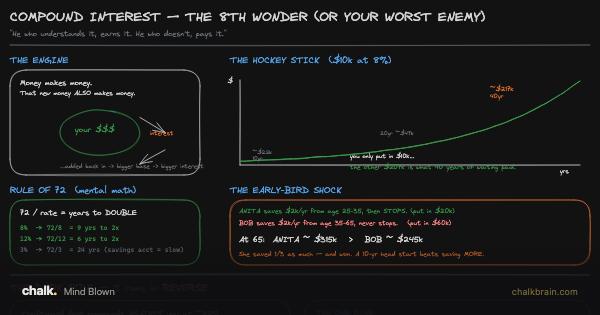 Board: Compound Interest The 8th Wonder →
On a narrow screen the three panels stack below the three dials, and the table scrolls sideways.
try this Drag The yearly fee and How long you hold it, and watch the percentage under The fee took.
$100,000 goes in once. Every year it grows by the return, then the fee takes its percentage of whatever is in the account. Beside it runs the same account with no fee.
Where the no-fee balance went
With no fee: $761,226
Kept is yours. Billed went to the fund. Unearned is the growth that billed money never made.
The fee took
26.0%
of the balance you would have had
A 1% fee took 26.0% of what the account would have reached in 30 years. The statements billed $83,557; the rest of the gap is growth those payments never got to make.
Billed against cost
2.37x
what it cost for every dollar it billed
Billed $83,557. Cost $198,147.
The years, swept
Every year notch at the current fee and return.
| Years | No fee | With the fee | Fees billed | Cost | Share lost |
|---|---|---|---|---|---|
| 5 | $140,255 | $133,381 | $6,023 | $6,874 | 4.9% |
| 10 | $196,715 | $177,906 | $14,057 | $18,809 | 9.6% |
| 15 | $275,903 | $237,293 | $24,773 | $38,610 | 14.0% |
| 20 | $386,968 | $316,504 | $39,066 | $70,464 | 18.2% |
| 25 | $542,743 | $422,157 | $58,130 | $120,586 | 22.2% |
| 30 | $761,226 | $563,079 | $83,557 | $198,147 | 26.0% |
| 35 | $1,067,658 | $751,042 | $117,473 | $316,616 | 29.7% |
| 40 | $1,497,446 | $1,001,749 | $162,710 | $495,697 | 33.1% |
A 1% fee, held for thirty years at 7% growth. What share of the no-fee balance does the fee take?
The fee is charged on the base, every year
A 1% fee is not taken once from the final balance. It is taken every year from the money everything after it multiplies. The dollar that leaves in year one misses thirty years of growth; the dollar that leaves in year thirty misses almost none. That is why the statements and the damage disagree: over thirty years at 7% the fee billed $83,557, and the gap to the no-fee account is $198,147. The difference, $114,589, was never charged to anyone. It is the growth the fees would have made had they stayed in.
Time does the damage, and the return does not save you
Slide the years. The same 1% takes 4.9% over five years and 33.1% over forty. Double the fee to 2% and thirty years takes 45.5%. Now slide the return: at 4% and at 10% the 1% fee takes 26.0% and 26.0%. The share does not move. The fee takes the same fraction of the balance every year whatever the balance did, so after t years you keep (1 - fee) to the power t. A higher return makes the money lost bigger in dollars, never smaller as a share.
Limits of this model
A smooth return. Real markets do not grow 7% every year. Bad years and good years change the dollar amounts, but the fee still takes its fraction each year, so the share lost comes out the same.
Fee taken after growth, once a year. Real funds deduct it in small slices through the year. The lesson also shows a formula that subtracts the fee from the return (7% becomes 6%), which loses 24.55% over thirty years instead of the 26.0% here. Both say about a quarter.
No taxes, no inflation, no new money. One deposit, left alone. Adding money each year shortens the average time each dollar sits under the fee, so the share lost is a little lower.