The heat pump
A fridge, an air conditioner and a heat pump run the same loop. Why does one move barely two joules of heat per joule of electricity and another move four?
A fridge, an air conditioner and a heat pump all run one loop: a refrigerant boils cold, gets squeezed hot, and dumps its heat. The gap between those two temperatures is the hill. The panels show the second law's ceiling, a real machine under it, and the same machine against a plain heater.
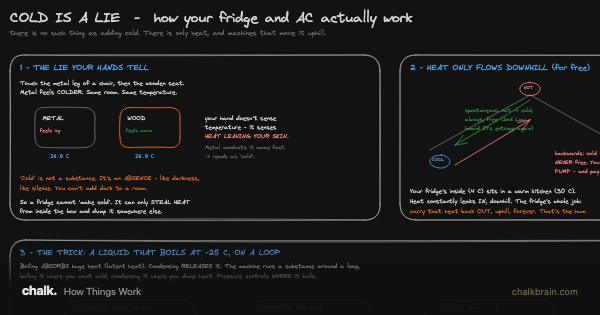 Board: Cold Is a Lie →
On a narrow screen the three panels stack below the dials, and the table scrolls sideways.
try this Drag Where the refrigerant boils from -25 °C up to +5 °C and watch the ceiling double.
The gap between the two temperatures is the hill. The ceiling comes from the second law alone: the cold side's temperature in kelvin, divided by the gap. The lesson's real cycles reach 46% to 57% of it.
The ceiling
3.54
joules moved per joule paid, at most, over a 70 K hill
The real machine
1.77
joules moved per joule, at 50% of the ceiling
A 70 K hill, the size a fridge climbs. Even a perfect machine moves only 3.54 joules per joule.
564 W of electricity pulls 1,000 W of heat out of the cold side.
Against a heater
361 W
to deliver 1,000 W of warmth, run as a heat pump
A plain heater pays 1,000 W for the same warmth. Heating ceiling 4.54, one more than the cooling ceiling, because the hot side receives the heat moved plus the work paid.
The dial, swept
Every evaporator notch at the current condenser temperature and hardware.
| Boils at | Hill | Ceiling | Real machine | W to move 1 kW | W to warm 1 kW |
|---|---|---|---|---|---|
| -30 °C | 75 K | 3.24 | 1.62 | 617 W | 382 W |
| -25 °C | 70 K | 3.54 | 1.77 | 564 W | 361 W |
| -20 °C | 65 K | 3.89 | 1.95 | 514 W | 339 W |
| -15 °C | 60 K | 4.30 | 2.15 | 465 W | 317 W |
| -10 °C | 55 K | 4.78 | 2.39 | 418 W | 295 W |
| -5 °C | 50 K | 5.36 | 2.68 | 373 W | 272 W |
| 0 °C | 45 K | 6.07 | 3.03 | 329 W | 248 W |
| +5 °C | 40 K | 6.95 | 3.48 | 288 W | 223 W |
| +10 °C | 35 K | 8.09 | 4.04 | 247 W | 198 W |
| +15 °C | 30 K | 9.60 | 4.80 | 208 W | 172 W |
The lesson's real cycles, for comparison
Computed in the lesson from real refrigerant data with CoolProp, not by this page. Set the dials to the same temperatures and compare.
| Machine | Boils at | Dumps at | Computed COP | Ceiling | Share |
|---|---|---|---|---|---|
| fridge (R-600a) | -25 °C | +45 °C | 1.66 | 3.54 | 47% |
| room AC (R-410A) | +5 °C | +45 °C | 3.42 | 6.95 | 49% |
| heat pump, heating (R-410A) | -5 °C | +40 °C | 3.94 | 6.96 | 57% |
A fridge boils its refrigerant at -25 °C and dumps heat at +45 °C. An AC uses the same kind of compressor but boils at +5 °C. How does its COP compare?
The hill decides, not the hardware
The fridge lifts heat 70 K and its ceiling is 3.54. The AC lifts it 40 K and its ceiling is 6.95. Nothing about the machine changed. Move the hardware dial and every number scales together, but no setting of it lets the fridge catch the AC. Halve the hill and the ceiling roughly doubles, whatever the machine is made of.
The third panel is the reason heat pumps are replacing heaters. Run the loop backward to warm a house and the hot side receives the heat it pulled from outside plus the electricity it paid. A plain heater turns 1,000 W into 1,000 W of warmth. A heat pump lifting heat from -5 °C to +40 °C, at half its ceiling, delivers the same warmth for 251 W.
Limits of this model
The hardware is one number. A real cycle's COP comes from refrigerant property tables, a compressor's efficiency, and the throttling loss at the valve. This page replaces all of that with one fraction of the ceiling. The lesson's three CoolProp cycles land between 46% and 57%, so the default is 50%.
Loop temperatures, not room temperatures. The evaporator has to be colder than the food or the outdoor air it pulls heat from, and the condenser hotter than the room it warms, usually by 5 to 15 K each side. So the hill a heat pump climbs is wider than the gap between outside and your thermostat.
Steady running only. Defrost cycles, start-up and the fan's own power are left out. On a frosty morning a real heat pump spends some of its time melting ice off its outdoor coil.