Cold Is a Lie - fridge, AC, heat pump
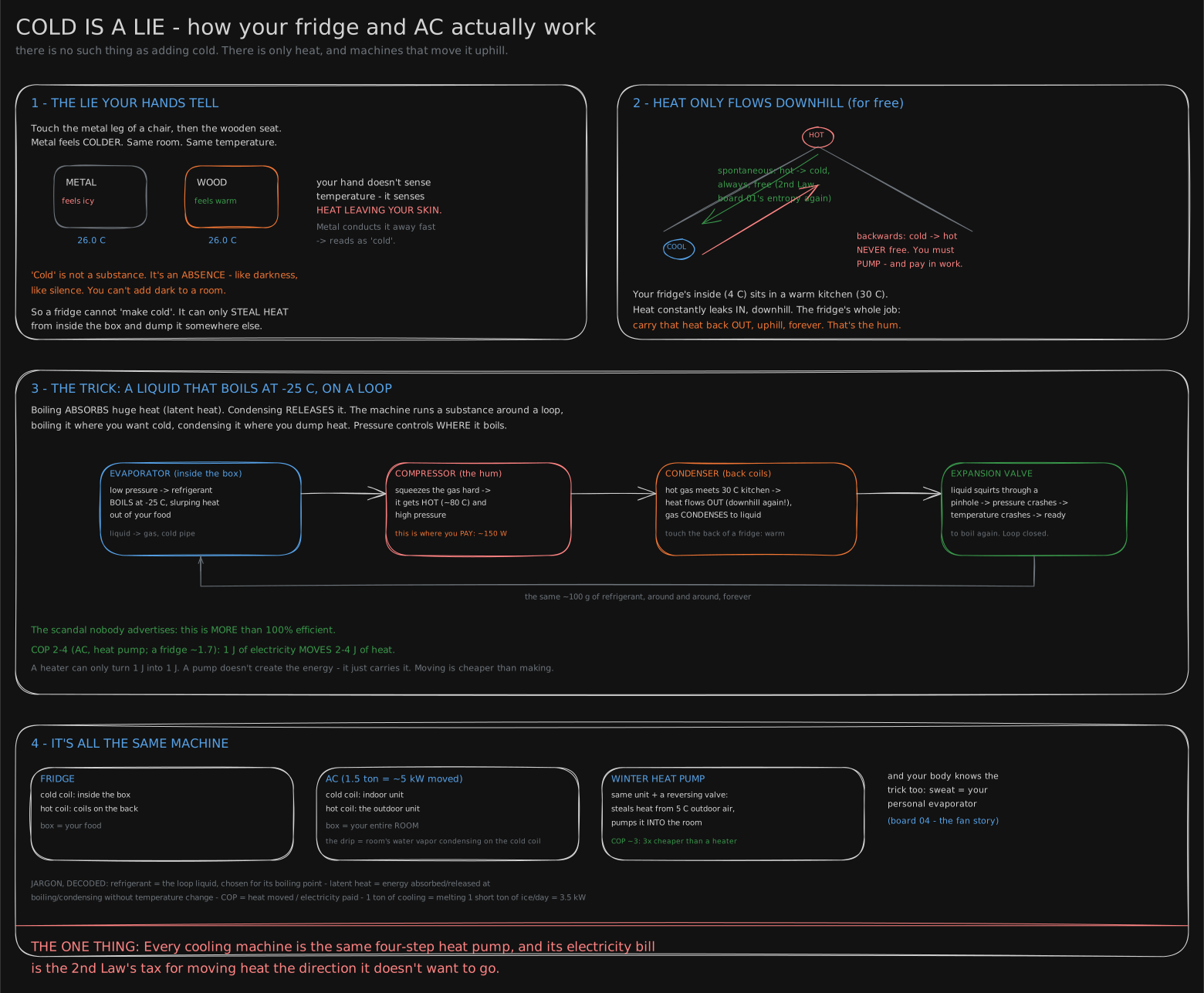
The hill heat refuses to climb by itself, and the four-step loop that pays to push it up anyway.
Before you start. All you need is a fridge, an AC, or a memory of touching a cold metal railing. Entropy - why time only points forward showed that the universe drifts toward whatever arrangement is overwhelmingly more likely, which is a fancy way of saying things spread out and even up on their own; this lesson is about the one machine in your kitchen built to fight that drift, on purpose, for a fee.
The numbers in the second read come from a Python library, CoolProp, which needs pip3 install. You do not need it: the heat-pump lab on this page runs the same ceiling with sliders, no install.
1798: a cannon that never stopped getting hot
Munich, 1798. Benjamin Thompson, an American-born count in the service of the Bavarian army, was overseeing the boring of cannon barrels at the royal arsenal. Every scientist of the day believed heat was a fluid called caloric, packed inside metal like water in a sponge, squeezed out by friction. Squeeze enough out, and the sponge should eventually run dry.
Thompson dunked a blunted boring tool into a cannon barrel already sitting in a tank of water and let the crank turn. Two and a half hours later the water was boiling, and it kept boiling for as long as someone kept cranking. Nothing was running out. A substance stored inside the metal would eventually give up its last drop. It never did, no matter how long the drill ground on.
Thompson’s conclusion, later known by his title, Count Rumford: heat isn’t a substance you drain out of something. It’s motion, the jostling of matter, and grinding metal against metal can stir up an unlimited amount of it. Which means “cold” was never a substance either. You cannot pour coldness into a box - only drag the jostling, the heat, out of it and put it somewhere else.
Heat only rolls downhill, and a fridge is a pump running backward
Heat, left alone, only flows one way: hotter to colder, the way water only runs downhill. A warm can of soda in a cold fridge cools, the air around it warms a touch, and both drift toward the same middle. That never runs in reverse on its own.
A fridge asks for the opposite: keep its inside colder than your kitchen, forever, by constantly shoving heat the wrong way, out of the cold box and into the warm room. Water never runs uphill by itself; someone has to pay to pump it there. Heat is the same, and the pump in your kitchen is called a compressor.
flowchart LR
    Hot["kitchen air: 30 °C"] -->|"heat flows here for free"| Cold["fridge inside: 4 °C"]
    Cold -.->|"backward: only forced, and it costs work"| Hot
This is also why a fridge can sound impossible: it moves several times more heat than the electricity it burns, which looks like getting more energy out than you put in. It isn’t. The compressor never creates heat, it only moves heat that already exists - a bucket brigade moving ten buckets of water for the effort of lifting one pump handle. Moving is cheap. Making is not.
The bill for pushing uphill: the one number that sets the ceiling
How steep is that hill? Entropy - why time only points forward called the universe’s drift toward messier arrangements entropy, a count of how many ways things could be shuffled. Pulling heat out of a fridge’s box makes the box tidier. Dumping that heat into the kitchen makes the kitchen messier. The total count may never shrink, so the kitchen’s gain must beat the box’s loss, and that rule alone sets a hard floor on the work a fridge must pay.
Move 1,000 joules of heat - a joule being the unit energy is counted in - from a fridge at 4 °C into a kitchen at 30 °C. The fridge’s tidiness rises by an amount fixed by those 1,000 joules and its own temperature; the warmer kitchen’s messiness must rise by at least as much, and being warmer, that takes more joules. Working the numbers, the least you can pay to move 1,000 joules out is about 94 joules - heat moved over work paid gives the biggest ratio physics allows here: about 10.7 joules moved per joule spent. That ratio is what engineers call COP, and this is its ceiling.
The ceiling depends on nothing but the gap between the two temperatures: halve it and the ceiling doubles, widen it and the ceiling collapses. That is the whole reason a fridge, dragging heat 70 degrees uphill from deep inside the box to a warm kitchen, is stuck near a COP of 1.6, while an AC or heat pump, dragging heat a much smaller distance, comfortably clears 3 or 4. Same machine, same physics, a smaller hill.
Where the heat actually travels: a loop that changes state, not temperature
So what is the machine paying for that ceiling? A refrigerant, a fluid chosen to boil at a very low pressure and temperature, runs around a sealed loop, and it does the carrying.
flowchart LR
  A[Evaporator: refrigerant boils, absorbs heat] --> B[Compressor: squeezes gas hot, pay here]
  B --> C[Condenser: dumps heat outside]
  C --> D[Expansion valve: pressure crash, cold again]
  D --> A
Inside the fridge the refrigerant sits at a pressure so low it boils around −25 °C, well below the food, so it boils and steals heat as it does. Turning liquid into gas eats a huge amount of heat without the temperature climbing at all - a kettle’s water sits at 100 °C the whole time it turns to steam - and that trick, latent heat, is what lets the evaporator pull heat from a box only a few degrees above freezing. The warmed gas is squeezed by the compressor, the only step that costs electricity, raising both its pressure and temperature past the kitchen’s. Hot gas meeting cooler air at the condenser sends heat downhill again, for free, out into the room - why a fridge left open heats the kitchen: the food’s heat, plus everything the compressor spent, both land in the room. The liquid left behind hits the expansion valve, the pressure crashes, and part of it flash-boils on its own remaining heat, straight back to −25 °C. The loop repeats, the same refrigerant circling forever, for the price of running the compressor alone.
An AC and a heat pump run the identical loop. Point it inward, it’s an AC. Run it backward, stealing heat from cold outdoor air and dumping it inside, it’s a heat pump warming a house in winter. An AC spends over half its work wringing water out of humid air rather than cooling it - the second read has that number.
That is the trick behind every fridge, AC and heat pump you will ever stand next to. It’s also the trick your own body runs in front of a fan, feeling cooler without the room changing temperature at all - the next lesson, Why a Fan Cools You, Not the Room - evaporation & boundary layers.
You now know
- Heat is motion, not a stored substance - proven in 1798 when a blunt drill boiled water for hours without running out of anything to give up, killing the old idea that heat is a fluid trapped inside metal.
- “Cold” isn’t a thing you can add, only the absence of that motion - you can’t pour coldness into a box, only drag heat out of it.
- Heat flows hot to cold for free, the way water runs downhill; a fridge, AC or heat pump forces it the other way, and that reversal is the only thing you ever pay for.
- The most heat such a machine can move per joule of electricity is capped by the temperature gap it’s bridging alone: a small gap is cheap, a big gap is expensive, no matter how good the hardware is.
- A fridge, an air conditioner and a heat pump all run the same four-part loop: a fluid that boils and absorbs heat, gets squeezed hot, dumps that heat outside, then crashes back to cold to repeat.
- A kilogram of water turning to gas soaks up far more heat than a kilogram of air changing temperature by a degree, which is why an air conditioner spends much of its effort drying the air, not just cooling it.
Stop here if you want. What follows is the same fridge in numbers: the exact temperature your skin reaches on metal, the hard ceiling worked out in full, and the real cycle a fridge runs, hour by hour.
Second read: the numbers behind the story
The exact temperature your skin reaches
“Metal feels colder” is a claim about heat flux, not temperature. Two touching surfaces don’t keep their own temperatures - they settle at one shared contact temperature, weighted by thermal effusivity, e = √(k·ρ·c): conductivity times density times specific heat, under a root. It measures how eagerly a material pulls heat from whatever touches it, which conductivity alone does not.
Properties for four materials, and the effusivity worked out from them (columns: conductivity, density, specific heat, then the derived number):
| material | k (W/m·K) | ρ (kg/m³) | c (J/kg·K) | e = √(kρc) |
|---|---|---|---|---|
| mild steel | 50 | 7850 | 490 | 13,868 |
| skin | 0.37 | 1000 | 3600 | 1,154 |
| oak | 0.17 | 700 | 1600 | 436 |
| expanded polystyrene | 0.035 | 20 | 1300 | 30 |
Skin at 33 °C touching two objects that are both genuinely at 26 °C, contact temperature T_c = (e₁T₁ + e₂T₂)/(e₁ + e₂):
steel :  T_c = (1154×33 + 13868×26)/(1154+13868)  =  26.54 °C
oak   :  T_c = (1154×33 +   436×26)/(1154+  436)  =  31.08 °C
EPS   :  T_c = (1154×33 +    30×26)/(1154+   30)  =  32.82 °C
Your nerves aren’t fooled. Skin on steel really sits at 26.5 °C, skin on oak really sits at 31.1 °C - 4.5 degrees of real tissue difference from two objects at the same starting temperature. The flux one second after contact, which is what you actually feel:
steel :  4,208 W/m²
oak   :  1,250 W/m²
EPS   :     116 W/m²
Steel drains you 36 times faster than polystyrene at the same temperature, and effusivity has no preferred direction - it’s also why 60 °C metal burns instantly while 60 °C wood does not.
The ceiling, worked in full
The story’s estimate was rounded; here is the derivation exactly. Move Q = 1000 J from a fridge interior at 4 °C (277.15 K) to a kitchen at 30 °C (303.15 K), paying W joules of work:
1.  the box loses entropy:      ΔS_cold = −1000 / 277.15  =  −3.608 J/K
2.  the kitchen receives Q+W:   ΔS_hot  = (1000 + W) / 303.15
3.  2nd law: total must not fall     (1000 + W)/303.15  ≥  3.608
4.  solve:                      W  ≥  3.608 × 303.15 − 1000  =  93.8 J
5.  so                          COP_max = Q/W = 1000/93.8   =  10.66
And T_cold/(T_hot − T_cold) = 277.15/26 = 10.66 - the same number, falling out of the inequality rather than quoted at you. “Over 100% efficient” is the wrong frame: efficiency asks what fraction of paid energy came back as heat, capped at 1; COP asks how much heat moved per joule paid - no more capped at 1 than “kilometres per litre” is.
The real cycle: four enthalpies, one refrigerant
Put a real refrigerant in the loop and the machine collapses to the difference between four numbers on a property table. Using real data (CoolProp, the open-source reference equations of state) for isobutane (R-600a, what’s actually in a modern domestic fridge) at −25 °C evaporator, 45 °C condenser, 65% compressor efficiency:
state 1  leaving the evaporator, saturated vapour + 5 K   h₁ = 528.4 kJ/kg   at 0.58 bar
state 2  after the compressor                             h₂ = 664.8 kJ/kg   at 6.04 bar, 70 °C
state 3  leaving the condenser, saturated liquid − 3 K     h₃ = 301.4 kJ/kg
state 4  after the expansion valve  (h₄ = h₃ - a valve does no work and adds no heat)

heat absorbed in the box   q  = h₁ − h₄ = 528.4 − 301.4 = 227.0 kJ/kg
work paid at the compressor w  = h₂ − h₁ = 664.8 − 528.4 = 136.4 kJ/kg
heat dumped at the coils   q_c = h₂ − h₃ = 664.8 − 301.4 = 363.4 kJ/kg

check: 363.4 − 227.0 − 136.4 = 0.0     ← energy in = energy out, exactly
COP = q/w = 227.0 / 136.4 = 1.66
The 70 °C discharge is real: the compressor’s outlet pipe is too hot to hold. And 363.4 out against 227.0 in is the story’s proof: an open fridge door heats the kitchen by the food’s heat plus the whole bill.
Run the same arithmetic across machines lifting heat over different gaps (columns: where the loop starts and ends, the computed COP, the ceiling above, and what fraction of that ceiling the real machine reaches):
| machine | evaporator | condenser | computed COP | Carnot ceiling | 2nd-law efficiency |
|---|---|---|---|---|---|
| fridge (R-600a) | −25 °C | 45 °C | 1.66 | 3.54 | 47% |
| fridge (R-134a) | −25 °C | 45 °C | 1.62 | 3.54 | 46% |
| room AC (R-410A) | +5 °C | 45 °C | 3.42 | 6.95 | 49% |
| room AC (R-134a) | +5 °C | 45 °C | 3.72 | 6.95 | 54% |
| heat pump, heating (R-410A) | −5 °C | 40 °C | 3.94 | 6.96 | 57% |
Same hardware, same fluid; the AC scores twice as well purely because its hill is half the height. Every real cycle lands at 46–57% of its own ceiling - the rest is an imperfect compressor plus work the expansion valve throws away that a turbine could recover.
What the AC actually spends its energy on
A 1.5-ton split AC moving 500 m³/h of air, from a room at 30 °C / 60% RH to a coil at 13 °C, near-saturated (columns: temperature and humidity, moisture per kilogram of dry air, and the air’s energy content):
in   30 °C, 60% RH  →  moisture 16.12 g per kg of dry air,  enthalpy 71.4 kJ/kg
out  13 °C, 95% RH  →  moisture  8.90 g per kg of dry air,  enthalpy 35.5 kJ/kg
air mass flow: 500 m³/h ÷ 0.867 m³/kg ÷ 3600 = 0.160 kg/s

total cooling   = 0.160 × (71.4 − 35.5)     =  5.74 kW
sensible (temp) = 0.160 × 1006 × (30 − 13)  =  2.74 kW   ← 48%
latent (water)  = 5.74 − 2.74               =  3.00 kW   ← 52%

water removed = 0.160 kg/s × (16.12 − 8.90) g/kg = 4,165 g/h  ≈  4.2 litres per hour
More than half the output goes into pulling water from the air. That puddle under the outdoor unit is your room’s own humidity, not pipe condensation. It costs so much because condensing a kilogram of water releases ~2,470 kJ against ~1 kJ to cool a kilogram of air by a degree - a small mass of water outweighs a large mass of air, why the same AC feels stronger in a dry climate. (“Ton” is just the AC’s rated size, inherited from the ice trade - a “1.5-ton” unit moves ~5.3 kW.)
Why the fridge hums on and off
A 250-litre cabinet leaks heat at roughly UA = 1.5 W/K, sitting at 4 °C in a 30 °C kitchen:
heat leaking in = UA × ΔT = 1.5 × 26 = 39 W, continuously, foreverThe compressor is a 150 W machine - watts being joules per second - moving 150 × 1.66 = 249 W of heat while it runs, so:
duty cycle = 39 / 249 = 16%
daily energy = 150 W × 24 h × 0.16 = 0.56 kWh/day
About ten minutes running every hour, silent the rest of the time - the hum starting and stopping. Opening the door barely matters (a few seconds of warm air against a 39 W leak running all day) while a failing seal matters enormously, because it changes UA itself, every second of every day.
mass flow = 150 W ÷ 136.4 kJ/kg = 1.10 g/s
a 60 g charge completes a full lap every 55 seconds
The same ~100 g of refrigerant goes around forever, about a minute a lap. Domestic isobutane charges are capped near 150 g by safety standard, since R-600a is flammable - why your fridge’s evaporator is a flat plate rather than a generous coil.
Try it
Predict first. A metal spoon and a wooden spoon from the same drawer: which will feel colder, and will the difference be a degree, a few degrees, or ten?
Touch it. Put a metal spoon and a wooden spoon in the same drawer overnight, so they’re certainly the same temperature, then hold one in each hand. The ~4.5 °C difference is the calculation above, running live on you. Try a book and a tile next - the ordering tracks √(kρc), not what you’d have guessed.
Compute your own cycle. The refrigerant tables above are one pip install away, and changing two temperatures is the whole lesson:
pip3 install CoolProp
python3 -c "
from CoolProp.CoolProp import PropsSI as P
Te, Tc, eta = -25+273.15, 45+273.15, 0.65       # try +5 for Te and watch COP double
Pe, Pc = P('P','T',Te,'Q',1,'IsoButane'), P('P','T',Tc,'Q',0,'IsoButane')
h1 = P('H','T',Te+5,'P',Pe,'IsoButane'); s1 = P('S','T',Te+5,'P',Pe,'IsoButane')
h2 = h1 + (P('H','P',Pc,'S',s1,'IsoButane') - h1)/eta
h3 = P('H','T',Tc-3,'P',Pc,'IsoButane')
print('COP =', round((h1-h3)/(h2-h1), 2), ' discharge T =', round(P('T','P',Pc,'H',h2,'IsoButane')-273.15), 'C')"
Run it once as written (COP = 1.66, discharge 70 °C), then change Te from -25 to +5: same fluid, same compressor, now lifting heat 40 K instead of 70 K, and the answer comes out at 3.82 - more than double for one character of edit.
Go deeper
- Any thermodynamics text on the vapour-compression cycle
- CoolProp, free and scriptable
- Count Rumford on Wikipedia.
Related
- Entropy - why time only points forward is the law this whole lesson’s bill traces back to: why moving heat backward costs work at all.
- Why a Fan Cools You, Not the Room - evaporation & boundary layers is the same “heat only flows downhill for free” idea, run by your own skin instead of a compressor.
- This lesson is drawn on the board Cold Is a Lie.
- Hot Water Can Freeze Faster Than Cold is another case where heat refuses to behave the way intuition expects.
- The Lid That Cooks Faster - boiling point, pressure cookers, tyres and taps is this loop’s boiling-point rule taken into the kitchen: raise the pressure and water boils at 121 °C.
- Every Plug Ends at a Spinning Magnet - power stations, fission and the solar exception runs this same loop forwards in a power station.
- Your Home, Estimated - Fermi problems and a home energy audit turns the heat-pump saving into a line on your own bill.
Retrieval practice
11 questions. Answer each one before you open it.
Why does metal feel colder than wood at the same temperature?
Your hand senses heat flux, not temperature. Metal pulls heat out faster, so the skin touching it settles at a genuinely lower temperature - the nerves aren’t fooled.
Why can a fridge move more heat energy than the electricity it uses, when a heater can never exceed 100% efficiency?
A fridge doesn’t create heat, it moves heat that already exists - several joules moved per joule burned, like a pump moving ten buckets for the cost of one lift. A heater must mint every joule from scratch: moving is cheap, making is not.
Trace the four-step loop and say exactly where the electricity bill lives.
Evaporator: low pressure lets the refrigerant boil around −25 °C, stealing heat from the food. Compressor: squeezes the gas hot, ~70 °C - this step alone costs electricity. Condenser: hot gas meets cooler kitchen air and heat flows downhill, free, out of the loop. Expansion valve: pressure crashes, part of the liquid flash-boils on its own remaining heat, dropping back to cold, ready to repeat.
Why does an AC drip water, and why is a heat pump cheaper to run than a plain electric heater?
Warm humid air hits the cold indoor coil and its water vapour condenses out - dehumidifying is over half the machine’s work. A heat pump is the identical loop run backward, stealing heat from cold outdoor air instead of making it from scratch, moving three or four joules per joule of electricity instead of one.
Where does the fridge’s electricity bill trace back to, in one law?
Heat flows hot to cold for free; forcing it backward costs work, which is what the second law (Entropy - why time only points forward) demands. The compressor’s watts are that payment.
Two objects both genuinely at 26 °C. Work out what temperature your skin actually reaches on each, and say what that settles.
Weighted by thermal effusivity, e = √(kρc): steel 13,868, skin 1,154, oak 436. With skin at 33 °C, T_c = (e₁T₁ + e₂T₂)/(e₁+e₂) gives 26.5 °C on steel and 31.1 °C on oak - 4.5 °C of real tissue difference from two identical-temperature objects. The “lie” is about the object, not your nerves.
Derive the ceiling on a fridge’s COP using only the second law, no refrigerant, no engineering.
Moving Q = 1000 J from 277.15 K to 303.15 K while paying W: the box’s tidiness rises by 1000/277.15 = 3.608 J/K; the kitchen’s messiness must rise by at least that much, so (1000+W)/303.15 ≥ 3.608, giving W ≥ 93.8 J and COP ≤ 1000/93.8 = 10.66 - exactly T_cold/(T_hot−T_cold). Halve the gap and the ceiling doubles. Real machines land at 46–57% of it.
Walk through the four enthalpies of a real fridge cycle and say what each difference means.
Isobutane, −25 °C evaporator, 45 °C condenser: h₁ = 528.4 leaving the evaporator, h₂ = 664.8 after the compressor (70 °C discharge), h₃ = 301.4 leaving the condenser, h₄ = h₃ (a valve changes pressure not heat content, yet the temperature crashes as the liquid flash-boils on its own heat). Stolen from the food: h₁−h₄ = 227.0. Paid: h₂−h₁ = 136.4. Dumped outside: h₂−h₃ = 363.4. They balance to zero, and 363.4 against 227.0 proves an open fridge door heats the kitchen.
The same hardware scores COP 1.7 as a fridge and COP 3.4 as an air conditioner. Why?
COP depends on the gap, not the machine. The fridge lifts heat 70 K, −25 °C to 45 °C, computing to 1.66. The AC lifts it only 40 K, +5 °C to the same 45 °C, computing to 3.42. Identical loop, identical fluid, twice the score for half the climb.
More than half an AC’s electricity does something other than lower the temperature. What, and how do you know?
Dehumidifying the air. For a 1.5-ton unit cooling 500 m³/h from 30 °C/60% RH to a 13 °C coil: of 5.74 kW total cooling, only 2.74 kW (48%) is actual temperature drop, and 3.00 kW (52%) condenses about 4.2 litres of water an hour. It costs so much because condensing a kilogram of water releases ~2,470 kJ, while cooling a kilogram of air by a degree takes ~1 kJ.
Why does a fridge hum on and off, and why does a failing door seal matter more than the door being opened?
A 250-litre cabinet leaks about 1.5 W/K × 26 K = 39 W continuously. The 150 W compressor moves 249 W while running, so its duty cycle is 39/249 = 16%, roughly ten minutes an hour. Opening the door adds a few seconds of warm air against that leak; a failing seal changes the leak itself, all day - why the seal, not the user’s habits, shows up on the bill.