The price war
Two sellers share a market. Does competition between them push the price all the way down to cost?
Two sellers share a market where every unit costs 10 to make. If they choose how much to make, the price settles at 40. If they post prices, it falls to 10. The first panel shows the price buyers pay. Add sellers and watch one way of competing catch up with the other.
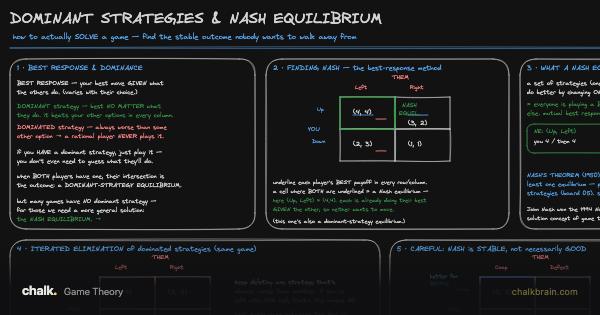 Board: Dominant Strategies and Nash Equilibrium →
One dial and two tabs. Each market is solved exactly, so every number is the same each time you set the dial.
try this Switch between Sellers choose amounts and Sellers post prices, then drag Sellers in the market up to 20.
The price buyers pay
Each seller holds back output to keep the price up. The price is 40, 30 above cost, and it shrinks as sellers join.
Who gains
Each makes 30 units, 60 in all. Buyers gain 1,800 over what they pay.
More sellers
Price under each way of competing. Rows where the two differ are marked.
- 1amounts 55 · prices 55profit each 2,025 · 2,025
- 2amounts 40 · prices 10profit each 900 · 0
- 3amounts 32.50 · prices 10profit each 506.25 · 0
- 5amounts 25 · prices 10profit each 225 · 0
- 10amounts 18.18 · prices 10profit each 66.94 · 0
- 20amounts 14.29 · prices 10profit each 18.37 · 0
Two sellers each post a price, and every buyer goes to the cheaper one. Making a unit costs 10. Where does the price end up?
Why sellers choose amounts matters
Each seller decides how much to make, and the market price is whatever clears everything made. Making one more unit earns its price but pushes down the price of every unit you already sell, so each seller stops short. With more sellers, each one's share of that loss is smaller, so they make more.
The tradeoff: Sellers keep a profit because each one holds back output. Buyers pay for that restraint in a price above cost, until enough sellers arrive that nobody's restraint moves the price much.
Why the same two sellers end at 40 or at 10
Amounts are a soft weapon. With two sellers choosing how much to make, each makes 30 and the price is 40. Neither wants to make more, because the extra units would drag down the price of the 30 it already sells. That is the Nash equilibrium on a number line: each amount is the best reply to the other.
Prices are a sharp one. Switch tabs. A seller who posts one unit below its rival takes every buyer, so any price above cost invites an undercut. Two sellers are enough to reach cost, and adding more changes nothing.
Add sellers to the first tab and it catches up. Drag the dial toward 20. The price under amounts falls as 10 plus 90 over one more than the number of sellers, so each new seller moves it less. It approaches cost, and never reaches it.
Limits of this model
Demand and cost are the lesson's teaching values: a straight demand line and the same cost for every seller. With different costs, the cheapest seller under prices charges just under the next one's cost and keeps a profit.
Selling at cost needs every seller to be able to serve the whole market. A seller with limited capacity cannot take every buyer by undercutting, and prices then stay above cost: that is one way back from the second tab to the first.
The market is played once. Sellers who meet every week can hold a higher price by threatening to undercut anyone who cuts first, which is the repeated game in the lab linked below.