Nineteen and Six - where the water goes
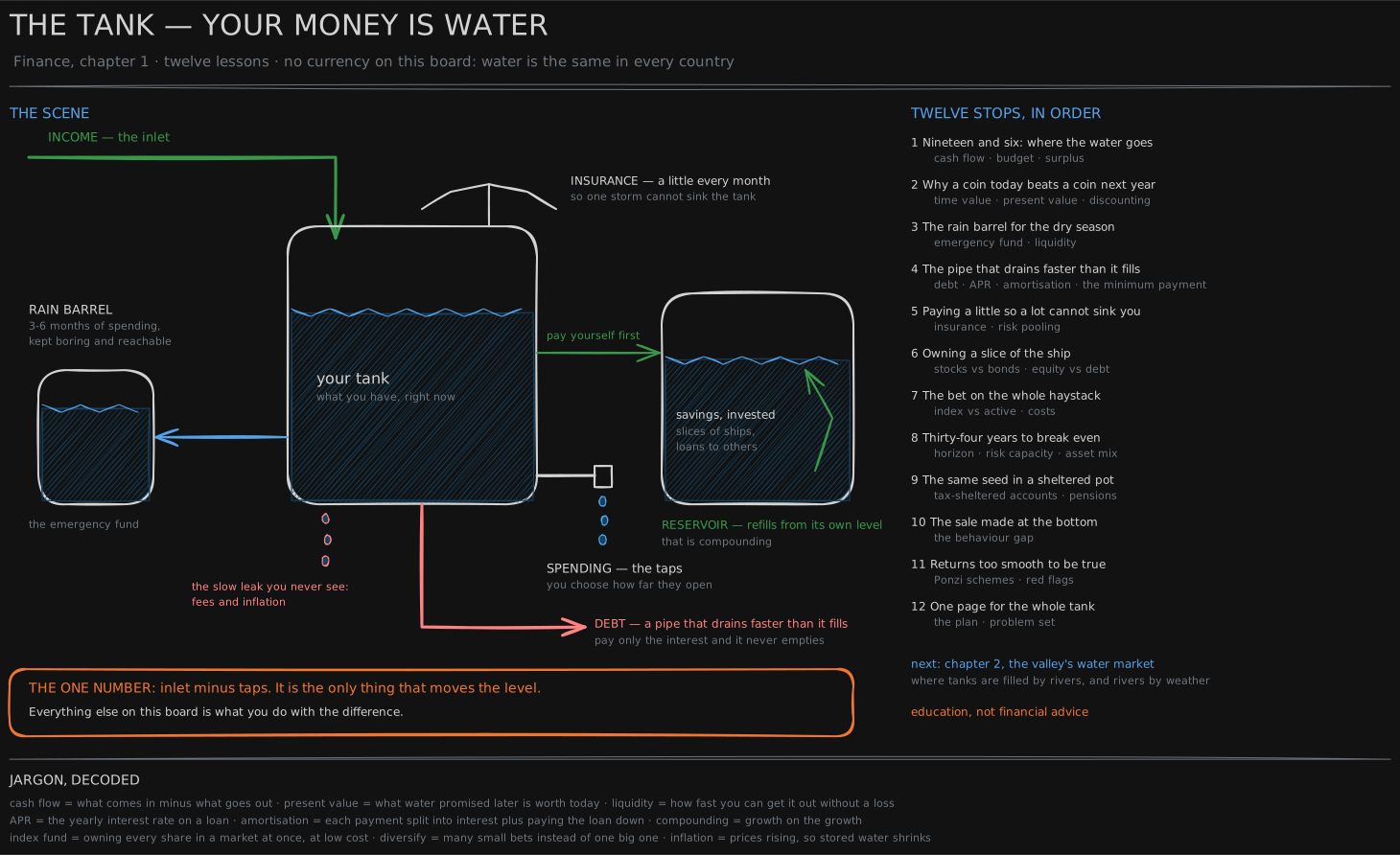
The Tank board draws your money as water: an inlet, taps, a slow leak, a rain barrel, a pipe that drains. This lesson is the one number in the middle of it, inlet minus taps, and why it is the only thing that moves the level.
Before you start. Nothing. You need to be able to subtract one number from another, and that is the whole of the maths here. This is the first lesson of the Finance track, and every lesson after it builds on the tank you meet below.
August 1849: twenty pounds, and sixpence either side
In August 1849 the fourth monthly part of Charles Dickens’s new novel, David Copperfield, went on sale for a shilling. In chapter twelve, a cheerful, permanently broke man called Mr Micawber is about to leave London, having just come out of the King’s Bench, a prison for people who could not pay their debts. He gives young David two pieces of advice. The first is not to put things off. The second is the one people still quote:
“Annual income twenty pounds, annual expenditure nineteen nineteen and six, result happiness. Annual income twenty pounds, annual expenditure twenty pounds ought and six, result misery.”
Dickens knew the subject from the inside. Micawber was modelled on his own father, John Dickens, who was locked in the Marshalsea debtors’ prison in February 1824 over a debt of about forty pounds to a baker. Charles, twelve years old, left school to work in a factory.
Look at the two numbers Micawber picks. Nineteen pounds, nineteen shillings and sixpence is sixpence under twenty pounds. Twenty pounds and sixpence is sixpence over. The whole gap between happiness and misery is one shilling in a year, a quarter of a percent of the income. He is not saying “spend much less than you earn”. He is saying something sharper: the size of the income does not decide which side you are on. Only the sign of one subtraction does.
That subtraction is what this lesson is about. To see why it matters so much, picture money as water.
Cash flow: the inlet minus the taps
Your money is a tank. Water comes in through an inlet: wages, a stipend, a pension, whatever arrives. Water leaves through taps: rent, food, travel, the phone bill. The level in the tank is what you have right now.
Here is the thing the tank makes obvious. The level only moves when the inlet and the taps disagree. A bigger inlet does not raise the level if the taps open wider at the same time. Tighter taps do not help if the inlet shrinks to match. Over any month, the change in the level is exactly what came in minus what went out, and nothing else.
That number, in minus out over some stretch of time, is called cash flow. A positive cash flow means the level rose. A negative one means it fell. Every decision in the rest of this track, saving, investing, borrowing, insuring, is a decision about what to do with the cash flow, or how to survive when it goes negative.
flowchart LR
  I["inlet: 3,000 comes in"] -->|"+3,000"| T["the tank"]
  T -->|"-2,650 out through the taps"| O["rent, food, travel, bills"]
  T --> L["cash flow: 3,000 - 2,650 = +350<br/>the level rises by 350"]
All the numbers here are teaching values, chosen for easy arithmetic and in no currency, because water is the same in every country. The cash flow of 350 is what matters, and it would be the same story at 30,000 in and 26,500 out.
Surplus and deficit: why a shilling is the whole difference
Micawber’s two months have nearly the same spending and opposite results, and now you can see why. In the happy month, cash flow is plus sixpence: the tank ends a little higher than it started. That positive cash flow is a surplus. In the miserable month, cash flow is minus sixpence. That is a deficit, and a deficit has to come from somewhere.
If the tank still has water in it, a deficit drains the level. If the tank is empty, the water has to be borrowed, and borrowed water arrives through a pipe that charges for itself: interest. Next month’s taps now include a repayment, which makes the next deficit more likely, which means more borrowing. That loop is how a sixpence turns into the King’s Bench. The surplus runs the other way: a small positive number, month after month, is water that can start earning instead of costing.
flowchart TD
  M["one month: in minus out"] -->|"+6 pence"| S["surplus: the level rises"]
  M -->|"-6 pence"| D["deficit: the level falls"]
  D -->|"tank empty"| B["borrow: a pipe that charges interest"]
  B -->|"repayment joins next month's taps"| M
  S -->|"water left over"| W["can be saved, then put to work"]
So the sign is the first thing to know about any month. Not the size of the income, not how careful you feel. The sign.
A budget is a meter on the taps, not a diet
How do you find the sign? You measure. Most people know their inlet to the unit, because it arrives as one number on one day. The taps are the hard part: dozens of small flows, some daily, some yearly, some forgotten entirely. Ask someone what they spend and they will usually guess low, because the big taps are remembered and the small ones are not.
Writing down every tap for one month, and grouping them, is a budget. The word sounds like a diet, a list of things you are not allowed. It is better thought of as a meter. A meter does not tell water where to go. It tells you where it went. Here is one made-up month, written down:
flowchart LR
  T["2,650 out in one month"] -->|"1,100"| R["rent"]
  T -->|"520"| F["food"]
  T -->|"405"| E["everything else"]
  T -->|"310"| X["eating out"]
  T -->|"180"| G["transport"]
  T -->|"135"| P["phone, internet, subscriptions"]
Once the budget exists, it answers questions that were guesses before. Is the cash flow positive? Which tap is the biggest? Which small taps add up to a big one? The point is not that eating out is wrong. The point is that 310 is a number you can now choose, instead of one that happened to you.
A budget only measures, though. It does not decide what happens to the surplus, and left alone, a surplus has a way of disappearing.
Pay yourself first: an order, not a willpower test
Here is the most common way a surplus vanishes. Money arrives, the month runs, and whatever is left at the end is saved. Then a surprise lands: a repair, a gift, a doctor. The surprise comes out of the only number that was not fixed, which is the amount left over. Run that month with a plan to spend 2,700 out of 3,000 and a surprise of 250, and the saving that was meant to be 300 comes out at 50.
Now flip the order. On the day the money arrives, move a fixed amount, say 300, into a separate tank before anything else is spent. The surprise still lands. But now the saving is fixed, and the surprise has to be absorbed by the spending: 250 has to be trimmed somewhere else this month. Same income, same surprise, same arithmetic. The only change is which number gets squeezed.
That ordering is called pay yourself first. It is usually sold as discipline. It is better understood as plumbing. Whichever number you fix first is the one that survives the month, and whichever number is “what is left” is the one that takes every shock.
flowchart LR
  P["payday: 3,000"] -->|"save what is left"| A["spend 2,700 + surprise 250"] -->|"leftover"| A2["saved: 50"]
  P -->|"pay yourself first"| B["move 300 to savings first"] -->|"2,700 left to spend"| B2["surprise forces a 250 trim<br/>saved: 300"]
Which leaves the obvious next question. Once there is a surplus sitting in a second tank, is a pile of water today worth the same as the same pile next year? It is not, and that is the next lesson.
You now know
- The level of your money moves only when what comes in and what goes out disagree; that difference over a month is the cash flow.
- A positive cash flow is a surplus, a negative one a deficit, and a deficit has to be paid from savings or borrowed at a cost.
- Micawber’s point was the sign, not the size: one shilling a year separates his “happiness” from his “misery”.
- A budget is a meter, not a diet: a written record of where the water went, which turns guesses into numbers you can choose.
- Pay yourself first is an ordering rule: the number you fix first survives the month, and “whatever is left” takes every surprise.
Stop here if you want. What follows is the same tank in numbers: Micawber’s money in pence, one month metered, and the two orders run side by side.
Second read: the tank in numbers
Micawber in pence
Before 1971, a British pound was 20 shillings and a shilling was 12 pence, so a pound was 240 pence. Here is the arithmetic, run in python3 on 2026-10-17:
income = 20*240
happy = 19*240 + 19*12 + 6
misery = 20*240 + 0*12 + 6
print("income", income, "happy", happy, "misery", misery)
print("gap between them", misery - happy, "pence =", (misery-happy)/12, "shilling")
print("happy surplus", income - happy, "pence =", round((income-happy)/income*100, 3), "% of income")
print("misery deficit", misery - income, "pence")
income 4800 happy 4794 misery 4806
gap between them 12 pence = 1.0 shilling
happy surplus 6 pence = 0.125 % of income
misery deficit 6 penceThe surplus is an eighth of a percent of the income. Micawber’s joke is that the size of the margin is irrelevant to which word you get.
One month, metered
The same made-up month as the story, in a dictionary (teaching values, no currency):
month = {"rent": 1100, "food": 520, "transport": 180, "phone and internet": 60,
         "subscriptions": 75, "eating out": 310, "everything else": 405}
income = 3000
total = sum(month.values())
for k, v in sorted(month.items(), key=lambda kv: -kv[1]):
    print(f"{k:20s} {v:5d}  {v/total*100:5.1f}%")
print(f"{'total out':20s} {total:5d}")
print(f"{'cash flow':20s} {income-total:5d}")
rent 1100 41.5%
food 520 19.6%
everything else 405 15.3%
eating out 310 11.7%
transport 180 6.8%
subscriptions 75 2.8%
phone and internet 60 2.3%
total out 2650
cash flow 350“Everything else” at 15% is the line worth staring at in a real budget: it is the taps nobody named. A first month of metering usually exists to shrink that line by giving its parts names.
Over a year, the sign compounds into the level. The same inlet of 3,000 a month with taps at 2,850 ends the year 1,800 up; with taps at 3,150 it ends 1,800 down. A 300 difference in monthly spending is a 3,600 swing in the level by December, before any interest on the borrowed side.
The two orders
income, plan_spend, surprise = 3000, 2700, 250
left = income - (plan_spend + surprise)
print("spend first: saved", left)
saved = 300
room = income - saved
print("save first: saved", saved, "| room for spending", room, "| plan + surprise", plan_spend + surprise, "| must trim", plan_spend + surprise - room)
spend first: saved 50
save first: saved 300 | room for spending 2700 | plan + surprise 2950 | must trim 250Nothing in the arithmetic is different. In both orders, in = out + saved. What differs is which term is the remainder. A remainder absorbs every error in every other term, which is why the thing you care about most should never be the remainder.
Try it
Meter one real month. For thirty days, write down every outflow, however small, in a note or a sheet with two columns: what, and how much. At the end, group them into six or seven lines like the dictionary above and compute in minus out. Then compare the total to the guess you would have made on day one. The gap between the guess and the meter is the reason budgets exist.
Go deeper
- Charles Dickens, David Copperfield, chapter 12 (free at Project Gutenberg). The advice is near the end of the chapter.
- Wilkins Micawber and John Dickens on Wikipedia, for the father behind the character.
Related
- Why a Coin Today Beats a Coin Next Year - present value and discounting takes the surplus this lesson leaves in a second tank and asks what it is worth next year.
- The Rain Barrel for the Dry Season - emergency funds and liquidity is where the first surplus goes.
- The Pipe That Drains Faster Than It Fills - debt, APR and the minimum-payment trap is the borrowing pipe a deficit opens, in numbers.
- One Page for the Whole Tank - chapter one, put in order puts this lesson’s one number at the top of a one-page plan.
Hint for the next question
Think about which number in “income = spending + saving” is the remainder.
Retrieval practice
7 questions. Answer each one before you open it.
What is cash flow, and why is it the only number that moves the level of the tank?
Cash flow is what came in minus what went out over a stretch of time, such as a month. The level of your money changes by exactly that amount and nothing else: a bigger income with equally bigger spending leaves the level where it was.
Micawber’s “happiness” and “misery” years differ by how much, and what is the point of choosing numbers so close together?
One shilling a year: sixpence under twenty pounds versus sixpence over. The point is that the size of the income or the margin does not decide the outcome. The sign of income minus spending does.
Why does a deficit tend to make the next month’s deficit more likely?
Once the tank is empty, a deficit is covered by borrowing, and borrowed money charges interest. The repayment becomes a new tap next month, so next month needs a bigger surplus just to stand still, and a deficit there means more borrowing.
In what sense is a budget a meter rather than a diet?
A budget records where the money went, grouped into lines, so you can see the sign of the month and the size of each tap. It does not forbid anything. It turns spending that “happened” into numbers you can choose to change.
Same month, income 3,000, planned spending 2,700, a surprise bill of 250. How much is saved if you save what is left, and how much if you pay yourself 300 first?
Saving what is left: 3,000 − 2,950 = 50. Paying yourself first: 300 is saved, and the spending, now 2,950 against 2,700 of room, has to be trimmed by 250.
Why is “pay yourself first” better described as an ordering rule than as willpower?
The arithmetic is identical either way; only the remainder changes. Whatever you fix first survives the month and whatever is “left over” absorbs every surprise, so fixing the saving first moves the shocks onto spending.
What does the “everything else” line in a first budget usually tell you?
It is the outflows nobody named, and in a first month it is often one of the biggest lines. Shrinking it by naming its parts is what a first month of metering is for.