Finance
9 boards, 37 lessons, 272 review questions, in 3 chapters. Read them in order. Each chapter builds on the one before.
Start here → Nineteen and Six - where the water goes
Contents
1Your Money12 lessons
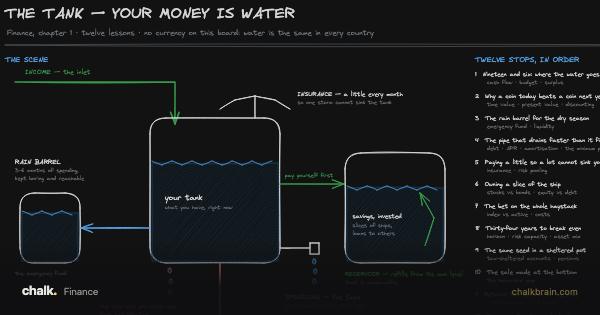
Money as water in a tank: the one number that moves the level, why a coin today beats a coin next year, the rain barrel, debt, insurance, shares and bonds, the index, the horizon, sheltered pots, the sale at the bottom, the scheme too smooth to be true, and a one-page plan.
- 01Nineteen and Six - where the water goes7 Q
- 02Why a Coin Today Beats a Coin Next Year - present value and discounting7 Q
- 03The Rain Barrel for the Dry Season - emergency funds and liquidity7 Q
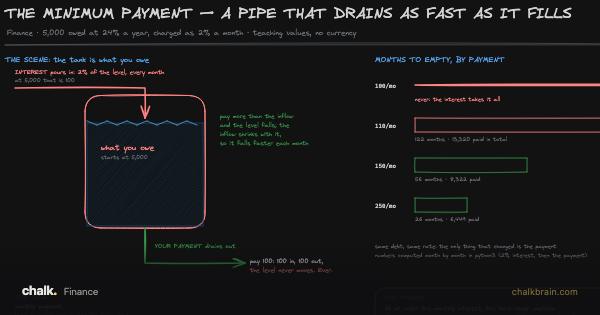
- 04The Pipe That Drains Faster Than It Fills - debt, APR and the minimum-payment trap7 Q
- 05Paying a Little So a Lot Cannot Sink You - insurance and risk pooling8 Q
- 06Owning a Slice of the Ship - shares, bonds, and who gets paid first7 Q
- 07The Bet on the Whole Haystack - index funds, active managers, and costs7 Q
- 08Thirty-Four Years to Break Even - horizon, risk capacity, and the mix7 Q
- 09The Same Seed in a Sheltered Pot - tax now, tax later, or never7 Q
- 10The Sale Made at the Bottom - the behaviour gap7 Q
- 11Returns Too Smooth to Be True - Ponzi schemes and the red flags7 Q
- 12One Page for the Whole Tank - chapter one, put in order7 Q
2Markets14 lessons
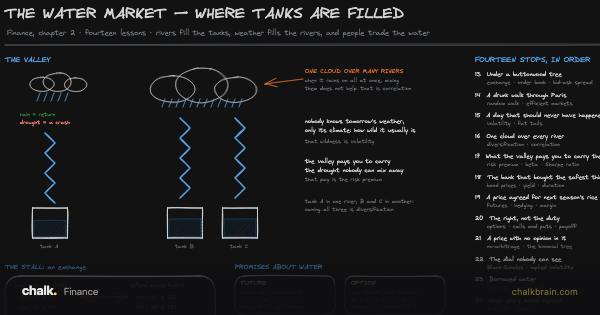
The valley's water market: the order book, the random walk, fat tails, mixing rivers under one cloud, the premium for carrying risk, bonds, futures and options, a price with no opinion in it, Black-Scholes, leverage, the models that all agreed, bubbles, and an honest backtest.
- 01Under a Buttonwood Tree - the exchange, the order book and the spread8 Q
- 02A Drunk Walk Through Paris - the random walk and the efficient market8 Q
- 03A Day That Should Never Have Happened - volatility, the bell curve and fat tails8 Q
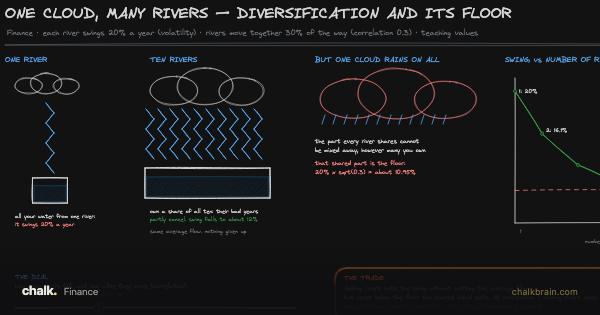
- 04One Cloud Over Every River - diversification, correlation and Markowitz8 Q
- 05What the Valley Pays You to Carry the Drought - risk premium, beta, CAPM and the Sharpe ratio8 Q
- 06The Bank That Bought the Safest Thing - bond prices, yield and duration8 Q
- 07A Price Agreed for Next Season's Rice - forwards, futures, hedging and margin8 Q
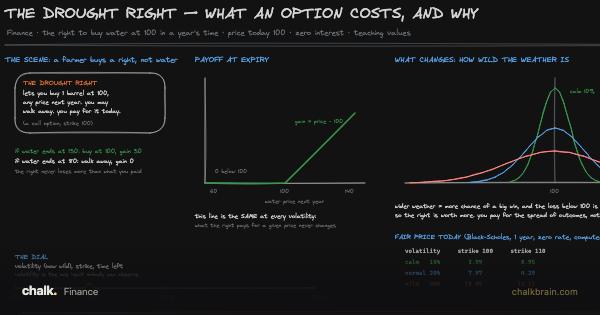
- 08The Right, Not the Duty - options, calls, puts and the payoff8 Q
- 09A Price With No Opinion in It - no-arbitrage, replication and the binomial tree7 Q
- 10The Dial Nobody Can See - Black-Scholes and implied volatility8 Q
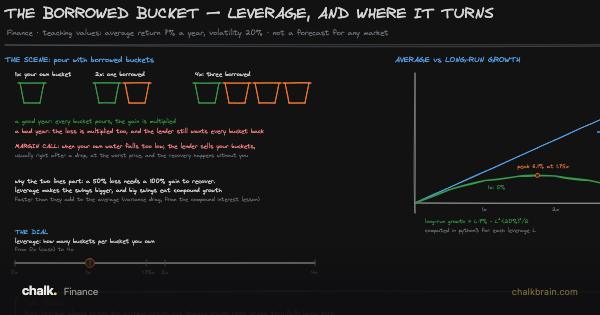
- 11Borrowed Water - leverage, margin calls and the growth-optimal bet7 Q
- 12When Every Model Agreed - tail risk, correlations going to one, and liquidity7 Q
- 13The Website Priced at the Moon - bubbles and the limits to arbitrage7 Q
- 14The Honest Backtest - look-ahead, survivorship and overfitting8 Q
3The Plumbing That Moves Money11 lessons
The pipes under the street: your balance as the bank's debt, double-entry, the book you never erase, money as whole cents, the four parties to a card tap, the hold, push and pull rails, settlement risk and netting, reconciliation, fraud scoring, and a double-entry ledger built in Go.
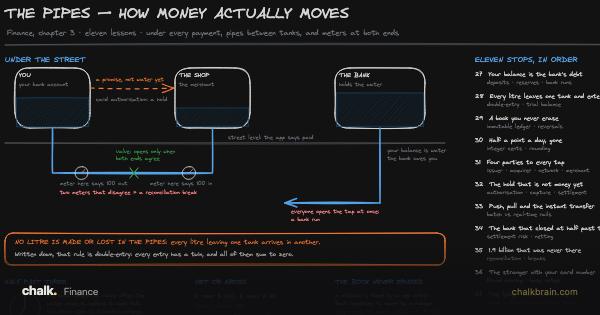
- 01Your Balance Is the Bank's Debt - deposits, reserves and the run7 Q
- 02Every Litre Leaves One Tank and Enters Another - double-entry, normal balances and the trial balance7 Q
- 03A Book You Never Erase - the append-only ledger, reversals and derived balances7 Q
- 04Half a Point a Day, Gone - integer minor units, rounding and currency exponents7 Q
- 05Four Parties to Every Tap - issuer, acquirer, network and interchange7 Q
- 06The Hold That Is Not Money Yet - authorisation, capture, clearing, settlement and chargebacks7 Q
- 07Push, Pull and the Instant Transfer - batch rails, instant rails, and who can be tricked7 Q
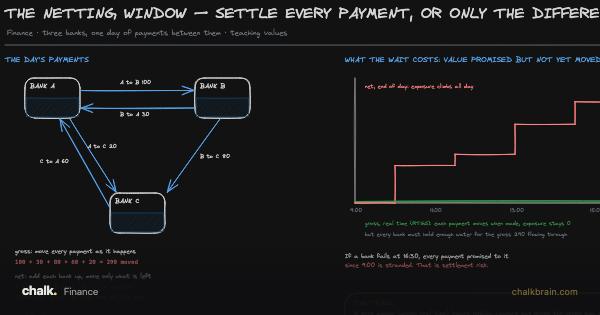
- 08The Bank That Closed at Half Past Three - gross against net, and the risk of waiting to settle8 Q
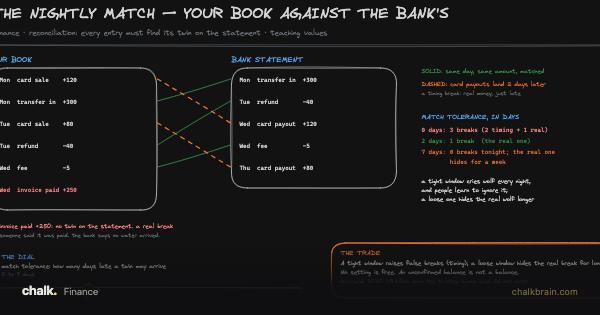
- 09One Point Nine Billion That Was Never There - reconciliation, breaks, and how long to wait for a twin7 Q
- 10The Stranger With Your Card Number - scoring a payment in a moment, and why most alerts are wrong8 Q
- 11The Ledger That Cannot Lie - build a small money ledger in Go and hold it to four promises7 Q
Borrowed from other tracks (14)
You don't need to take those tracks. These are the only lessons this track uses from them, and each is linked where it is needed.
- Compound Interest, the 8th WonderMind Blown · needed for Why a Coin Today Beats a Coin Next Year - present value and discounting
- Fold a Paper to the MoonMind Blown · needed for Why a Coin Today Beats a Coin Next Year - present value and discounting
- Decision-Making Under UncertaintyPsychology · needed for Paying a Little So a Lot Cannot Sink You - insurance and risk pooling
- Cognitive BiasesPsychology · needed for The Sale Made at the Bottom - the behaviour gap
- Mental Models & Decision-Making (thinking about thinking)Personal Development · needed for The Sale Made at the Bottom - the behaviour gap
- Auctions & Mechanism DesignGame Theory · needed for Under a Buttonwood Tree - the exchange, the order book and the spread
- The Maths Floor, Part 2: Probability, Softmax and TemperatureAI · needed for A Drunk Walk Through Paris - the random walk and the efficient market
- The Map Is Not the TerritoryMind Blown · needed for The Honest Backtest - look-ahead, survivorship and overfitting
- Stripe - the case studySystem Design · needed for Every Litre Leaves One Tank and Enters Another - double-entry, normal balances and the trial balance
- The Ledger Everyone Reads (event-driven & the log)System Design · needed for A Book You Never Erase - the append-only ledger, reversals and derived balances
- Kafka 02: The LogFrom Scratch · needed for A Book You Never Erase - the append-only ledger, reversals and derived balances
- Numbers for Real (signed ints, overflow, floating point)How Computers Work · needed for Half a Point a Day, Gone - integer minor units, rounding and currency exponents
- Charged Twice (idempotency & exactly-once)System Design · needed for The Hold That Is Not Money Yet - authorisation, capture, clearing, settlement and chargebacks
- The 99 Percent Test That Is Usually WrongMind Blown · needed for The Stranger With Your Card Number - scoring a payment in a moment, and why most alerts are wrong