The Rain Barrel for the Dry Season - emergency funds and liquidity
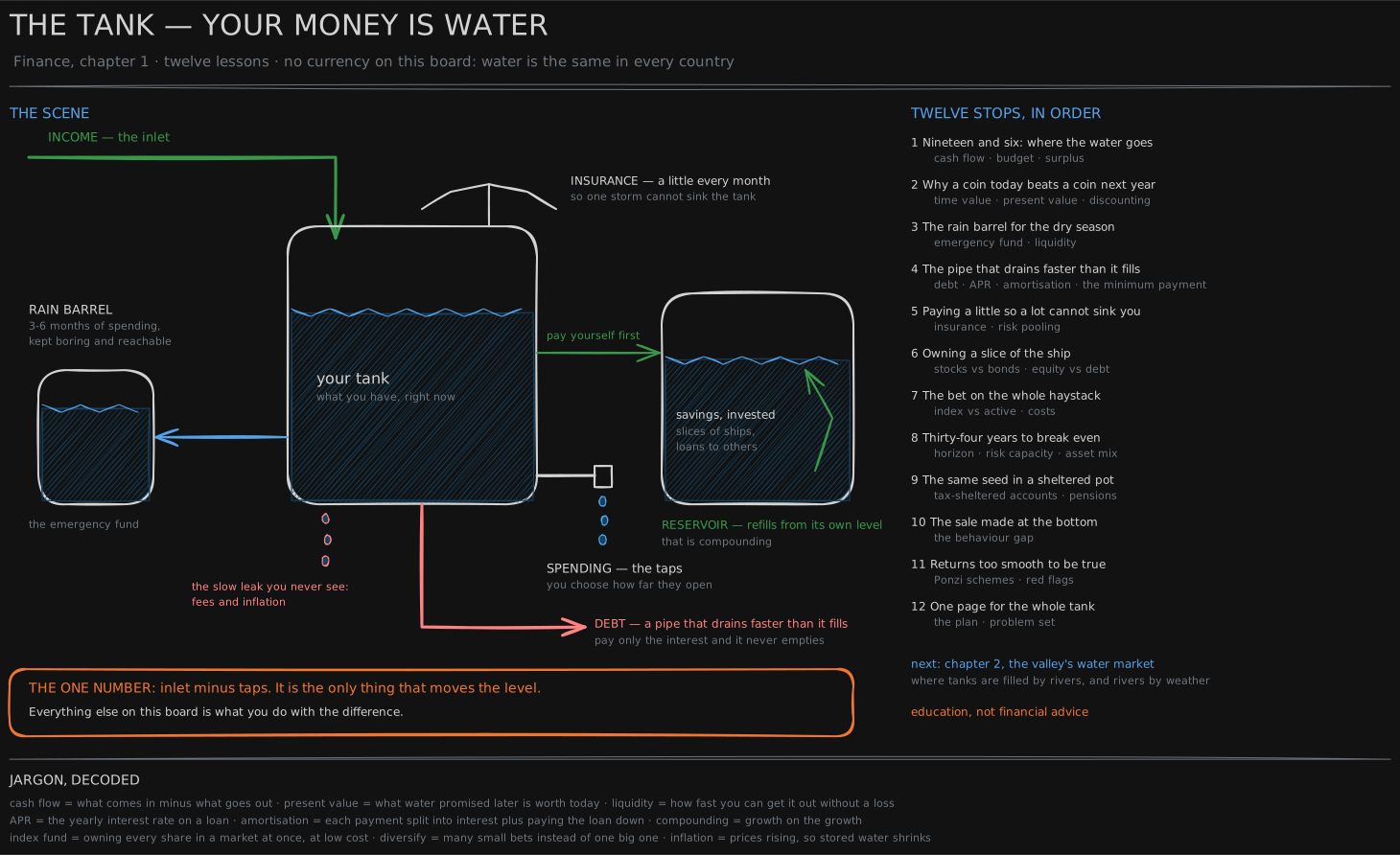
The Tank board draws a rain barrel beside the tank, “3-6 months of spending, kept boring and reachable”. This lesson is why the first water you save goes there, and why it is allowed to earn so little.
Before you start. From Nineteen and Six - where the water goes: cash flow is what comes in minus what goes out, and a deficit has to be covered from savings or borrowed at a cost. From Why a Coin Today Beats a Coin Next Year - present value and discounting: money put to work grows, so money left idle has a price, the growth it gave up. This lesson is about the one pile of money where paying that price is the point.
March 2011: could you find 2,000 in thirty days?
In March 2011, at a conference of the Brookings Institution in Washington (17-18 March), three economists, Annamaria Lusardi, Daniel Schneider and Peter Tufano, presented a paper built on one plain question. Imagine an unexpected bill of $2,000 lands tomorrow: a car repair, a dentist, a flight home. How confident are you that you could come up with it within the next month?
They had put the question to people in eight wealthy countries in 2009, through an online survey run by the research firm TNS, adjusting the amount to a local round number: $2,000 in the United States and Canada, £1,500 in the United Kingdom, €1,500 in France, Germany, Italy, the Netherlands and Portugal. These are real sums from a real survey, so they keep their real currencies.
The American answers were the headline. 27.9% said they could certainly not find the money. Another 22.2% said they probably could not. Put together, about half of working-age Americans in the survey did not think they could cover an ordinary bill, the size of a big car repair, within a month. The United Kingdom and Germany were in the same place, at 50% or more. Portugal was at 46%, France 37%, and the most resilient, Canada, the Netherlands and Italy, at 28%, 27.9% and 20%.
What surprised the authors most was who was in that half. It was not only the poor. In their words, “it seems somewhat unbelievable that nearly a quarter of households making between $100,000 and $150,000” said they could not raise $2,000 in a month. The authors called the condition financial fragility: not being poor, exactly, but being one ordinary surprise away from trouble.
One caution before going on. This was a survey of what people believed about themselves, in 2009, in the middle of a financial crisis, and online, which the authors note may miss the people most at risk. It does not tell you any country today. What it shows is how common it is to have income, a home, even savings for later, and still no water you can reach this month.
The emergency fund: a rain barrel beside the tank
Go back to the tank. Most months the inlet is steady and the taps behave. But some months bring a storm: a broken boiler, a lost job, a medical bill. A storm is a sudden, large tap that you did not plan and cannot close.
If the tank has water, the storm drains it and the level falls. If it does not, the water has to come from somewhere. The Lusardi paper asked people where, and found a ladder they called a “pecking order”: first savings, then family and friends, then credit cards and loans, then extra work hours, then pawning or selling things. 19% of Americans in the survey said they would cover the bill at least partly by pawning, selling possessions or taking a short-term high-interest loan.
So the fix is a separate container kept beside the tank, for storms only. On the Tank board it is the rain barrel: it fills slowly in good months and is drained only when a storm hits. This is an emergency fund: money set aside for the unplanned, and for nothing else.
flowchart LR
  S["storm: a 2,000 bill"] --> Q{"is there a rain barrel?"}
  Q -->|"yes"| B["drain 2,000 from the barrel<br/>refill it over the next months"]
  Q -->|"no"| C["borrow on a card at 24% a year<br/>owe 2,536 after a year"]
  Q -->|"no, and no credit"| D["sell something, or ask family"]
The emergency fund’s job is not to grow. Its job is to be there, the full amount, on the worst day, without anyone’s permission.
Liquidity: how fast water comes out without spilling
That job makes one property more important than any other. Not every container lets water out the same way. Cash in a current account comes out instantly and in full. A savings account might take a day. A fixed-term deposit might charge a penalty for breaking it early. Shares can be sold in days, but at whatever price the market gives that week, which might be 30% below what you paid. A house takes months to sell, and you cannot sell a bedroom.
How fast you can turn something into spendable money, and how much of it you lose doing so, is its liquidity. Cash is perfectly liquid. A house is very illiquid. Everything else sits somewhere between.
flowchart LR
  C["cash: instant, nothing lost"] --> S["savings account: a day, nothing lost"]
  S --> T["fixed deposit: a penalty to break early"]
  T --> SH["shares: days, at whatever price that week"]
  SH --> H["house: months, all or nothing"]
Here is the trap the rain barrel avoids. Storms do not arrive at random times. A lost job is more likely when the economy is bad, and that is exactly when shares are down. Suppose the 2,000 bill arrives in a month when invested savings are 30% below where they were. To raise 2,000 you have to sell shares that were worth 2,857 before the fall. When prices recover, you no longer own them. (A teaching value; real falls are smaller or larger.)
An emergency fund has to be liquid, so it lives at the left end of that line, in plain boring places. That is a deliberate choice, and it has a cost.
Why the barrel is allowed to earn almost nothing
Liquid places pay little. Water in the barrel might earn 2% a year while water put to work in the reservoir might average 6%. On a barrel of 8,000, that gap is 320 a year: the growth you gave up by keeping the water reachable. (Teaching values again: real rates vary by country and year.)
Is 320 a year too much? Compare it with the alternative. The same 2,000 storm, put on a credit card at 24% a year and left for a year, costs 536 in interest. A forced sale in a bad month can lose more than that in one go. And neither number counts the cost the survey could not measure: the stress of being one bill from the pecking order’s lower rungs.
So the barrel is insurance you pay for in lost growth. It is the one place in the tank where earning less is the correct design.
Runway: sizing the barrel in months, not in money
How big should it be? Not a fixed amount, because a fixed amount means different things to different people. 8,000 is a year of safety for one household and three weeks for another. The useful unit is time.
Divide the barrel by what a month costs you, and you get the number of months you could keep going if the inlet stopped. That number is your runway. Take the metered month from the first lesson, 2,650 a month. A barrel of 8,000 is 3.0 months of runway at full spending. But in a real storm you would cut back to essentials, rent, food, transport and the phone, which come to 1,860, and the same barrel stretches to 4.3 months.
The Tank board says 3-6 months of spending. That is a common rule of thumb, not a law. Someone with a steady job, a second earner and no dependants needs less runway than a freelancer with children and an irregular inlet. The principle carries everywhere: size the barrel to how long your inlet could stop and how wide your essential taps are.
flowchart TD
  B["barrel: 8,000"] -->|"divide by full month 2,650"| R1["runway: 3.0 months"]
  B -->|"divide by essentials 1,860"| R2["runway: 4.3 months"]
With a barrel in place, a storm becomes an inconvenience rather than a crisis. The next lesson is what happens without one: the pipe that drains faster than it fills.
You now know
- About half of working-age Americans in a 2009 survey, and similar shares in the UK and Germany, did not think they could raise an ordinary 2,000-sized bill in a month: financial fragility.
- An emergency fund is a separate pile for storms only, so a sudden bill does not fall through to borrowing or selling.
- Liquidity is how fast something turns into spendable money and how much is lost doing it; an emergency fund has to be highly liquid.
- Liquid money earns little, and that lost growth is the price of the barrel, usually smaller than the cost of a storm met with debt or a forced sale.
- The barrel is sized as runway, months of essential spending, not as a fixed sum.
Stop here if you want. What follows is the same barrel in numbers: the survey’s table, the runway sum, and the cost of having one against the cost of not.
Second read: the barrel in numbers
The survey, by country
From Lusardi, Schneider and Tufano (NBER Working Paper 17072, May 2011), 2009 TNS Global Economic Crisis survey, share who said they could certainly or probably not raise the local amount within 30 days:
| country | amount asked | certainly or probably not |
|---|---|---|
| United States | $2,000 | about 50% (27.9% certainly, 22.2% probably) |
| United Kingdom, Germany | £1,500, €1,500 | 50% or more |
| Portugal | €1,500 | 46% |
| France | €1,500 | 37% |
| Canada | C$2,000 | 28% |
| Netherlands | €1,500 | 27.9% |
| Italy | €1,500 | 20% |
The surveys ran between June and September 2009, online, weighted to each country’s population. The authors chose amounts “within 15% of average at USD exchange rates”. The table measures confidence during a crisis year, not bank balances, and it is not a forecast for any country now.
Runway and the two costs
Run in python3 on 2026-10-17, with the metered month from Nineteen and Six - where the water goes and teaching rates (2% for the barrel, 6% for invested water, 24% on a card, a 30% market fall):
month = {"rent": 1100, "food": 520, "transport": 180, "phone and internet": 60,
         "subscriptions": 75, "eating out": 310, "everything else": 405}
full = sum(month.values())
essential = sum(month[k] for k in ("rent", "food", "transport", "phone and internet"))
print("full month", full, "| essential month", essential)
for m in (3, 6):
    print(f"{m} months of full spending: {m*full}")
barrel = 8000
print(f"barrel {barrel}: runway {barrel/full:.1f} months at full spending, {barrel/essential:.1f} at essentials only")
safe, invested = 0.02, 0.06
print(f"kept at 2% instead of 6%: forgo {barrel*(invested-safe):.0f} a year")
shock, card = 2000, 0.24
owed = shock * (1 + card/12)**12
print(f"a 2,000 shock left on a 24% card for a year: owe {owed:.2f}, interest {owed-shock:.2f}")
need = 2000
sell = need / 0.7
print(f"selling invested water down 30% to raise 2,000: sell {sell:.2f} of pre-fall value, {sell-need:.2f} of it gone for good if prices recover")
full month 2650 | essential month 1860
3 months of full spending: 7950
6 months of full spending: 15900
barrel 8000: runway 3.0 months at full spending, 4.3 at essentials only
kept at 2% instead of 6%: forgo 320 a year
a 2,000 shock left on a 24% card for a year: owe 2536.48, interest 536.48
selling invested water down 30% to raise 2,000: sell 2857.14 of pre-fall value, 857.14 of it gone for good if prices recoverRunway in one line: months = barrel / monthly essentials. In English: how many months the barrel could pay the taps you cannot close.
The card line compounds monthly, 2% a month for twelve months, which is why the interest is 536 rather than a flat 480; Compound Interest, the 8th Wonder has that effect in full. The forced-sale line assumes prices later return to where they were, so the 857 is the part of your water that a recovery would have brought back, had you not been made to sell.
Where the barrel stops
A barrel bigger than you need has a cost that grows every year: each extra 1,000 kept at 2% instead of 6% gives up 40 a year, compounding. Past the runway you have chosen, extra water belongs in the reservoir, and the following lessons on shares, bonds and horizon are about that. The barrel is the first container, not the only one.
Try it
Take the budget you metered after the first lesson. Mark each line essential (it continues if your income stops) or not. Add the essentials. Then divide whatever you could reach within a week, without selling anything at a loss, by that number. That is your runway today, in months.
Go deeper
- Annamaria Lusardi, Daniel Schneider and Peter Tufano, “Financially Fragile Households: Evidence and Implications”, NBER Working Paper 17072 (2011), published in Brookings Papers on Economic Activity, Spring 2011. Table 6 is the cross-country comparison.
Related
- The Pipe That Drains Faster Than It Fills - debt, APR and the minimum-payment trap is what a storm costs when there is no barrel.
- Paying a Little So a Lot Cannot Sink You - insurance and risk pooling covers the storms too big for any barrel, the ones you insure.
- Thirty-Four Years to Break Even - horizon, risk capacity, and the mix is why money you may need soon does not belong in shares.
- One Page for the Whole Tank - chapter one, put in order puts runway on the one-page plan.
Hint for the next question
Compare what the barrel gives up each year with what one storm costs without it.
Retrieval practice
7 questions. Answer each one before you open it.
What did the 2009 survey behind “Financially Fragile Households” ask, and roughly what share of Americans said no?
Whether they could come up with $2,000 (or a local equivalent) within 30 days for an unexpected expense. About half of US respondents said they certainly (27.9%) or probably (22.2%) could not.
Why does the survey not tell you how fragile households are today?
It measured what people believed about themselves, online, in 2009, during a financial crisis, and the authors note an online panel may miss those most at risk. It shows how common fragility can be, not a current rate for any country.
What is an emergency fund for, and what is it not for?
It is money kept separate for unplanned storms, a repair, a medical bill, a lost job, so they do not fall through to borrowing or selling. It is not for growth or for planned spending.
What is liquidity, and why must an emergency fund be highly liquid?
How fast something turns into spendable money and how much is lost doing so. Storms need money now and in full; worse, they often arrive when markets are down, so an illiquid or market-priced pile may have to be sold at a loss.
A barrel of 8,000 earns 2% instead of 6%. What does that cost per year, and what does a 2,000 bill left on a 24% card cost over a year?
8,000 × 4% = 320 a year of growth given up. The card, compounding monthly at 2%, grows 2,000 to 2,536.48: 536.48 of interest.
Why is the barrel sized in months of spending rather than as a fixed amount?
A fixed sum means very different safety for different households. Months of runway, barrel divided by essential monthly spending, measures how long you could last if income stopped, which is the thing the barrel is for.
With essential spending of 1,860 and full spending of 2,650, how many months does an 8,000 barrel last each way?
8,000 / 2,650 = 3.0 months at full spending; 8,000 / 1,860 = 4.3 months on essentials only.