Your Remote Throws Invisible Light - the EM spectrum
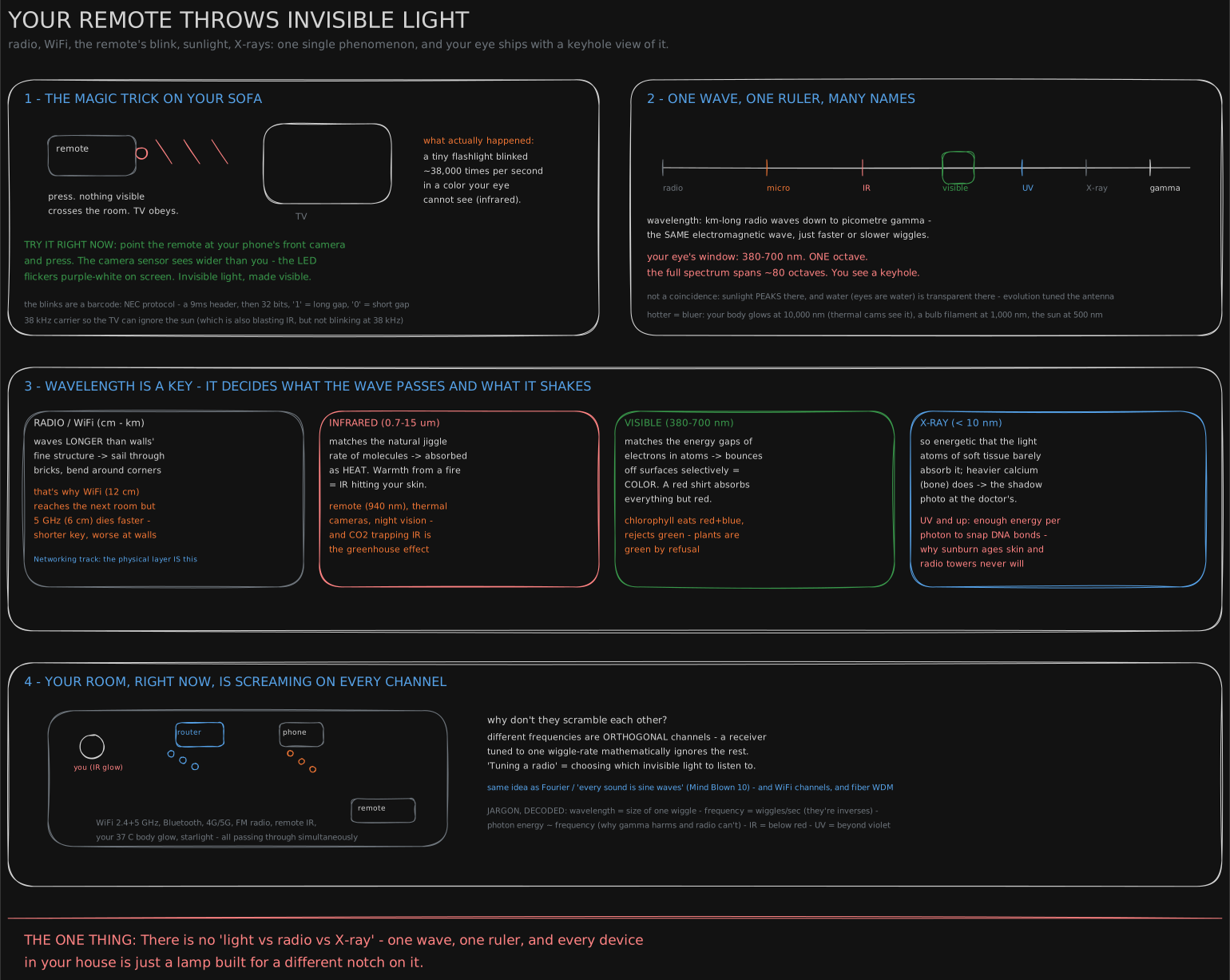
The whole light spectrum drawn as one long measuring tape, with a keyhole marked where your own eyes can see.
Track 13 (How Things Work)
Before you start. You only need to know what a TV remote does and that your eyes can miss things that are still there; nothing about waves, light or radiation is assumed. Every word below, including “wavelength,” is shown doing something before it gets a name.
1800: a thermometer left past the red, and it kept climbing
At his home in Slough, England, William Herschel, the King’s own astronomer, was measuring how much heat each colour of sunlight carried. He split a sunbeam through a glass prism into its familiar rainbow, red to violet, and set a thermometer in each colour to see which warmed fastest. Almost as an afterthought, he set one more thermometer just past the red end, in the dark patch of table where there was no colour left at all. It read the highest temperature of the lot.
No visible light was landing on that thermometer. Something was still arriving there, carrying heat, and it was invisible. Herschel had caught a kind of light no eye had ever seen, sitting one step past red. He called it a calorific ray; today it is called infrared, “below red.”
The dark bump on the front of your TV remote is throwing the exact same invisible light Herschel found on his table two centuries ago. Every time you press a button, it fires unseen, and instead of carrying heat, it carries a message.
The same one wave, on a very long ruler
Radio, WiFi, infrared, the colours you can see, ultraviolet, and X-rays are not six different things. They are the same kind of wave, ripples like the ones on a pond, just squeezed to different sizes. Measure one full wiggle of a wave, tip to tip, and that length is its wavelength. Wavelength is the only thing that changes between a radio station and a dentist’s X-ray machine, and everything else about how a wave behaves follows from that one number.
A WiFi router’s wave is about the width of a dinner plate, 12 centimetres tip to tip. Red light’s wave is about 700 billionths of a metre, so small that two thousand of them would fit across a single human hair. Herschel’s ray, infrared, sits just past red, roughly 700 billionths of a metre to a thousandth of a metre. Put every kind on one ruler and the spread is enormous: 12 centimetres divided by 700 billionths of a metre says one WiFi wave is about 170,000 times longer than one wave of red light.
flowchart LR
  Ra["radio & WiFi<br/>waves as wide as a room"] --> Ir["infrared<br/>your remote's beam"]
  Ir --> Vi["the colours you see<br/>a thin sliver"]
  Vi --> Uv["ultraviolet<br/>sunburn's cause"]
  Uv --> Xr["X-ray & gamma<br/>smaller than an atom"]
Your eyes only open a window onto a narrow stretch of that ruler, roughly a factor of two: violet’s wave is about half the length of red’s. Everything longer than that window, radio, WiFi, infrared, and everything shorter, ultraviolet, X-ray, gamma, is out there doing things, completely dark to you. Herschel did not invent infrared. He was just the first person to catch it with something other than an eye.
Why a radio wave can never hurt you, and an X-ray can
Light does not arrive smoothly, like water from a tap. It arrives in separate little packets, and one packet is a photon. Each photon still belongs to a wave, and how hard it hits whatever it lands on depends entirely on that wave’s wavelength: short wavelength, a hard hit; long wavelength, a soft one.
A chemical bond, the link holding two atoms of your DNA together, takes a hit of around 4 electron-volts (a unit of energy sized for single atoms, not everyday objects) to snap. An ultraviolet photon arrives carrying almost exactly that. One photon, one broken bond, which is the seed of a sunburn turning into something worse. A WiFi photon, by comparison, carries about four hundred thousand times less punch than that: nowhere near enough to snap anything.
Here is the part that makes this a hard rule rather than a rough guess: photon hits do not add up. A million soft hits arriving together do not equal one hard hit, because each photon lands and spends its energy alone. Turn a radio transmitter up as high as you like, and every one of its photons is still exactly as soft as before. You would cook something with the heat long before you broke a single bond.
flowchart LR
  S["short wavelength wave<br/>ultraviolet, X-ray"] --> H["hard hit per photon<br/>enough to snap a bond"]
  L["long wavelength wave<br/>radio, WiFi, infrared"] --> W["soft hit per photon<br/>bounces off, warms at most"]
The remote’s private beat, and why sunlight can’t fake it
Sunlight is already drowning your living room in infrared all day, far more than any remote’s small bulb could ever put out. If your TV simply watched for “any infrared at all,” a sunny afternoon would look exactly like someone leaning on the volume button. The fix is that the remote’s beam does not just glow, it blinks, at one exact rate: 38,000 times every second. How many times a wave repeats each second is its frequency, and the TV’s receiver is built to listen for that one frequency and throw out everything else. Sunlight has no 38,000-times-a-second flicker in it, so the filter rejects it for free, without needing to know anything about the picture in front of it.
Once the TV knows it is hearing the remote and not the sun, the blinking itself carries the message: a long pause means a 1 and a short pause a 0, the only two digits a chip counts in, strung together into a code the chip inside the TV reads as “volume up” or “channel 3.” The invisible ray Herschel found in a dark patch on an astronomer’s table in 1800 is now doing the same job a lamp flashing Morse code would do, just faster than your eye could ever follow.
You now know
- Radio, WiFi, infrared, visible light, ultraviolet and X-rays are the same kind of wave; the only thing that changes between them is wavelength, the length of one wiggle.
- Your eyes catch only a narrow slice of all those wavelengths. Infrared sits just past red, the edge your eyes stop at, invisible but still there and still carrying energy.
- Light arrives in separate packets called photons, and how hard a photon hits depends on its wavelength: short waves hit hard enough to break a chemical bond, long waves don’t.
- Ultraviolet and X-rays can damage a cell and radio and WiFi cannot, at any power, because many soft hits never add up to one hit hard enough to break a bond.
- A TV remote’s beam blinks at one exact rate, its frequency, so the TV can tell it apart from sunlight’s steady glow and read the blinks as a code.
Stop here if you want. What follows is the same ruler with the numbers filled in, for when you want to check them yourself.
Second read: the spectrum, in numbers
The story’s ruler, with real numbers on it. Each row gives one kind of wave’s wavelength, its frequency, and the energy of one of its photons, from E = hc/λ with hc = 1239.84 eV·nm: divide that constant by a wavelength in nanometres and the answer is straight in electron-volts (eV, the unit chemists use for single bonds).
| what | wavelength | frequency | energy per photon |
|---|---|---|---|
| AM radio, 1 MHz | 300 m | 10⁶ Hz | 4.14 × 10⁻⁹ eV |
| FM radio, 100 MHz | 3.0 m | 10⁸ Hz | 4.14 × 10⁻⁷ eV |
| WiFi 2.4 GHz | 12.49 cm | 2.4 × 10⁹ Hz | 9.93 × 10⁻⁶ eV |
| your body’s glow | 9.34 µm | 3.2 × 10¹³ Hz | 0.133 eV |
| CO₂’s absorption band | 15 µm | 2.0 × 10¹³ Hz | 0.083 eV |
| the remote’s LED | 940 nm | 3.19 × 10¹⁴ Hz | 1.32 eV |
| red / violet | 700 / 380 nm | 1.77 / 3.26 eV | |
| UV-B | 300 nm | 10¹⁵ Hz | 4.13 eV |
| soft X-ray | 1 nm | 3.0 × 10¹⁷ Hz | 1,240 eV |
| gamma | 1.24 pm | 2.4 × 10²⁰ Hz | 10⁶ eV |
That column spans fifteen orders of magnitude, which is why “one wave, many names” is not a poetic simplification: every difference in behaviour below comes from that one column.
The ionizing line, exactly. A chemical bond’s dissociation energy, converted from the standard chemistry numbers into energy per bond:
C–C   348 kJ/mol  =  3.61 eV
N–H   391 kJ/mol  =  4.05 eV
C–H   413 kJ/mol  =  4.28 eV
O–H   459 kJ/mol  =  4.76 eV
O=O   498 kJ/mol  =  5.16 eV
An ultraviolet photon at 300 nm carries 4.13 eV: above C–C, above N–H, level with C–H. A WiFi photon carries 0.0000099 eV. The ratio:
UV-B / WiFi     =  4.13 / 9.93e-6      =  416,000×
UV-B / FM radio =  4.13 / 4.14e-7      =  10,000,000×
UV-B / AM radio =  4.13 / 4.14e-9      =  1,000,000,000×
All three are decisive; only one of them is actually billions.
Hotter is bluer, checked. Wien’s law, λ_max = b/T with b = 2.897771955 × 10⁻³ m·K, predicts the colour a warm thing glows brightest at from its temperature alone:
human skin, 307 K       →  2.8978e-3 / 307.15   =   9,434 nm    board says 10,000 nm  ✓
incandescent filament   →  2.8978e-3 / 2700     =   1,073 nm    board says  1,000 nm  ✓
the Sun, 5772 K         →  2.8978e-3 / 5772     =     502 nm    board says    500 nm  ✓
The Sun’s peak, 502 nm, sits almost exactly in the middle of the 380–700 nm window your eyes evolved to catch. The eye was not tuned to “light” in general; it was tuned to this one star.
Three ways a wavelength decides what it passes through. A wave bends around obstacles about its own size, which is why WiFi’s 12 cm wave diffracts around a stud spaced 40 cm apart and a doorway 80 cm wide, while visible light’s 500 nm wave meets a wall millions of wavelengths across and casts a sharp shadow instead. Separately, a wave is absorbed strongly when its photon energy matches something the material can actually do: infrared’s tenth-of-an-eV matches a molecule flexing, felt as heat; visible’s couple of eV matches an electron jumping, seen as colour; ultraviolet’s four eV matches a bond snapping, felt as damage. And penetrating the body is not about wavelength at all, it is about atomic number: calcium (atomic number 20) absorbs 20 to 50 times more of an X-ray per atom than the soft tissue around it (an effective atomic number of about 7.4) does, which is the entire reason bone shows up white on a film and flesh does not.
The remote, timed. Most remotes, including this one, speak a format called NEC: a 9 ms header, then 32 bits sent as long or short pauses, always paired so a message contains exactly sixteen 1s and sixteen 0s no matter which button you press:
header               9.0 ms burst + 4.5 ms gap          = 13.500 ms
32 bits, always 16+16    16 × 2.25 + 16 × 1.125         = 54.000 ms
stop bit                                                 =  0.5625 ms
                                                          ─────────
every frame, regardless of which button                   68.06 ms
Every keypress on every NEC remote takes exactly 68 ms, because that fixed count of 1s and 0s falls out of the checksum. That gives:
raw     32 / 0.06806 s  =   470 bit/s
useful  16 / 0.06806 s  =   235 bit/s      (half the frame is the checksum copy)
Two hundred and thirty-five bits per second, useful. WiFi 6 moves data about 1.3 million times faster, and the remote is still perfectly fine for its job, because “channel 42” is one byte and there is no second byte coming.
One more cost, before any wall gets involved. Moving a router from 2.4 to 5 GHz shrinks its wavelength, and a fixed-size antenna automatically catches less of a shorter wave:
penalty of 5 GHz over 2.4 GHz = 20 · log₁₀(5/2.4) = 6.38 dB = 4.34× less power received6.38 dB is a factor of 4.34 in received power, lost to pure geometry, before the router’s radio ever meets a single wall.
Try it
Predict first. Before you point the remote at your phone: will the camera show nothing, a white light, or a coloured one?
Point any infrared remote at your phone’s front camera and press a button. The beam is invisible to your eyes but shows up on screen as a flickering purple light, because the camera’s sensor catches wavelengths yours can’t.
Record that flicker in slow motion (most phones do 240 frames a second) and count: one full frame lasts 68 ms, about 16 frames at that speed, and holding the button down repeats it roughly 9 times a second. If your remote matches that timing, it’s speaking NEC.
Compute any photon’s energy on the ruler with one line and the one constant worth remembering:
python3 -c "
hc = 1239.84                      # eV·nm
for name, nm in [('WiFi 2.4GHz', 124_900_000), ('remote IR', 940), ('red', 700),
                 ('violet', 380), ('UV-B', 300), ('soft X-ray', 1)]:
    print(f'{name:12s} {hc/nm:12.4g} eV')"
Go deeper
- NIST’s CODATA fundamental constants -
h,cand Wien’sb, at more digits than this lesson needed.
Related
- Cold Is a Lie - fridge, AC, heat pump - the same infrared glow this lesson puts a wavelength on is the heat that machine spends its whole design moving.
- Networking - wavelength is what decides what a wave passes through, and that’s the physical layer underneath every network in your house.
- Three Lights Pretending to Be Every Colour - screens, eyes and cameras explains why the camera sees the remote and you do not, and how a screen fakes the visible keyhole with three lights.
- Why You Can See Through Sand - band gaps, glass, metal and silicon uses this ruler to explain why glass is clear and metal is not.
- Why the Microwave Heats the Food, Not the Plate is a different stretch of the same ruler, put to work in your kitchen.
- Why the Sky Is Blue is what happens to the short end of the visible keyhole in air.
- Every Sound Is Sine Waves is the gentlest introduction to waves on the site, if wavelength still feels slippery.
Retrieval practice
11 questions. Answer each one before you open it.
What does the remote actually send, and how does the TV tell it apart from sunlight?
An infrared beam blinking at a 38,000-times-a-second rate (its frequency), sent in a 9 ms header followed by 32 bits as long or short pauses. Sunlight floods the room with infrared too, but none of it blinks at 38,000 times a second, so the receiver’s filter for that one frequency throws the sun out for free.
Why does WiFi reach the next room but the light from a lamp doesn’t?
WiFi’s 12 cm wave is close in size to a doorway or a stud spacing, so it diffracts, bends around the obstacle, instead of stopping at it. Visible light’s 500-nanometre wave is millions of times smaller than a wall’s features, so it behaves like a ray and is simply blocked, casting a sharp shadow.
Why is infrared felt as heat rather than seen as light?
Its photon energy, around a tenth of an electron-volt, matches how strongly a molecule can flex and vibrate rather than how an electron can jump between levels. Absorbing that photon makes the molecule jiggle harder, which is what heat is at that scale, instead of triggering the kind of jump your eye is built to register as colour.
Why can radio never give you cancer, but ultraviolet can?
A photon’s punch scales with its wavelength: short wavelength, hard punch. Ultraviolet photons carry about 4 electron-volts, enough to snap a chemical bond in one hit. Radio photons carry a billion times less than that, and photon punches do not add together, so no amount of radio power turns into the one hard hit a bond needs to break.
Why don’t all the wireless signals in your house scramble each other?
Each one is tuned to its own frequency, and a receiver built for one frequency mathematically ignores the rest, the same way an ear can pick one voice out of a noisy room. “Tuning a radio” and “choosing a WiFi channel” are the same trick: pick which wiggle rate to listen for.
Why did eyes evolve to catch the 380–700 nanometre window specifically?
Sunlight is brightest right around there, and the water that eyes are mostly made of is unusually clear to light of that length. Evolution built a receiver tuned to the loudest, clearest signal actually available, which was this one star’s light, not light in general.
Give the exact threshold between non-ionizing and ionizing radiation, as two numbers, and say why turning up a transmitter’s power never crosses it.
Compare photon energy to bond energy. E = hc/λ with hc = 1239.84 eV·nm gives a 300 nm ultraviolet photon 4.13 eV, against a C–C bond at 3.61 eV and a C–H bond at 4.28 eV: one photon, one broken bond. A 2.4 GHz WiFi photon carries 9.93 × 10⁻⁶ eV, 416,000 times less. Power never closes that gap because photon energies do not add: each one interacts alone, so a flood of weak photons deposits heat, never one bond-breaking hit.
Why does the remote blink at exactly 38,000 times a second instead of just shining brighter?
Brightness alone can’t be told apart from sunlight, which also floods the room with infrared. A fixed blink rate can: the receiver is a filter tuned to 38,000 cycles a second, and sunlight has no such flicker in it at all, so the filter rejects the sun regardless of how bright the room is.
Why is every NEC remote’s keypress exactly 68 milliseconds long, and how fast is that as data?
NEC sends an address, that address inverted, a command, and that command inverted, so every byte is paired with its opposite and every frame contains exactly sixteen 1s and sixteen 0s no matter the button. At 2.25 ms per 1 and 1.125 ms per 0: 13.5 ms header plus 54 ms of bits plus a 0.5625 ms stop bit is 68.06 ms. That is 235 useful bits per second, about 1.3 million times slower than WiFi 6, which is fine because the whole message is one byte with no second byte coming.
Moving a router from 2.4 GHz to 5 GHz costs signal before any wall is involved. How much, and why?
6.38 dB, a factor of 4.34 in received power. A fixed-size antenna’s effective catching area shrinks with the square of frequency, so 20 · log₁₀(5/2.4) = 6.38 dB is lost to pure geometry, in an open field with no walls at all. Wall attenuation is added on top of that.
Bone and flesh are both made of atoms with similarly sized gaps between them. Why does an X-ray still show one and not the other?
Not because of the gaps: a diagnostic X-ray’s wavelength is already ten times smaller than the spacing between atoms in tissue, so if slipping through gaps were the mechanism, everything would be transparent, including bone. What actually decides it is atomic number: calcium’s atomic number of 20, against soft tissue’s effective 7.4, gives 20 to 50 times more absorption per atom. The shadow on the film is a map of atomic number, not of density.