How Memory Works
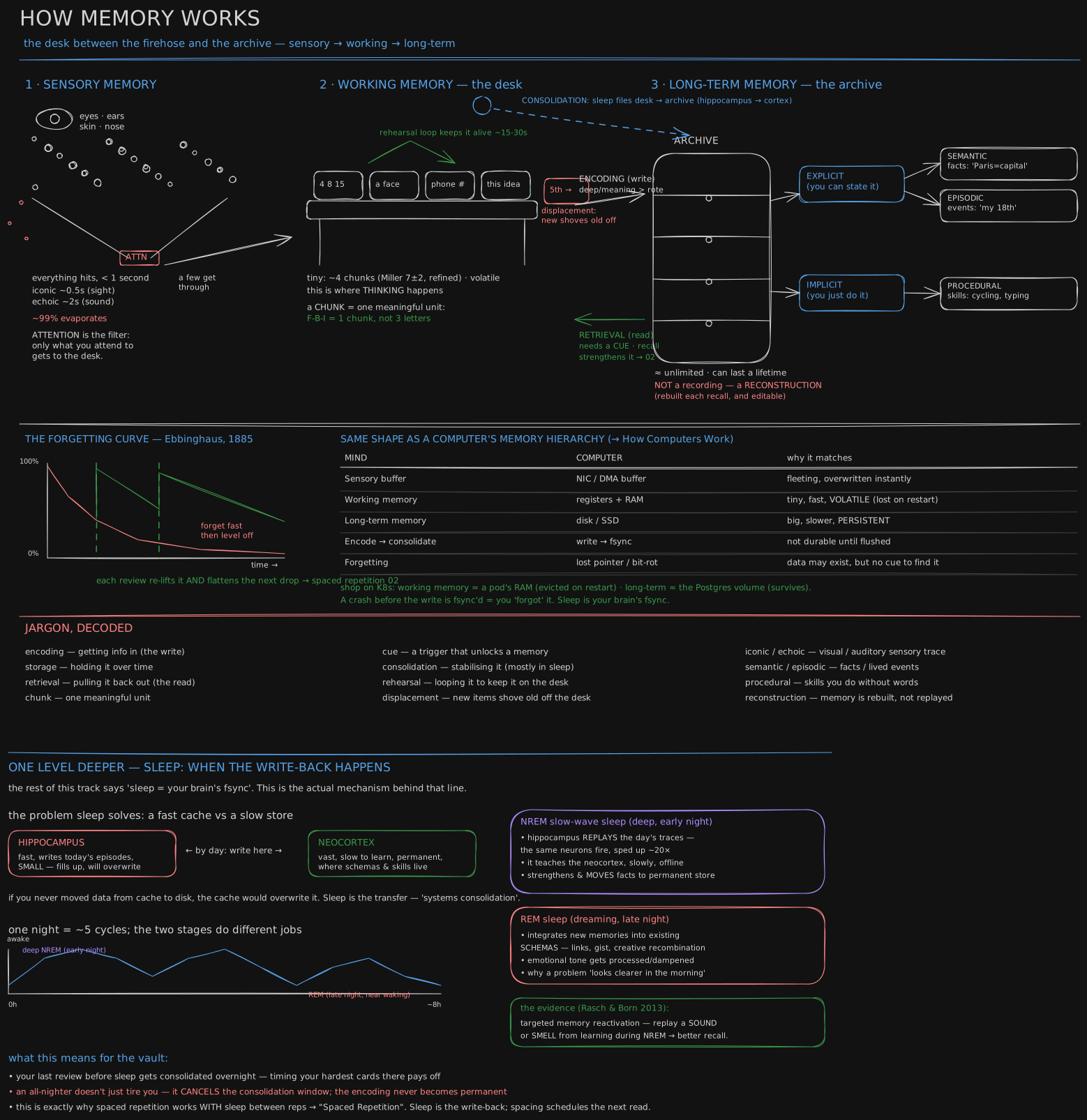
The opening board of the Psychology track, and the manual for the thing you’re using to read it right now. By the end of this lesson you’ll know why you can hold about four things in mind and not five, and why a confident memory and an accurate one are only loosely related.
Before you start. You need nothing but your own memory: the kind of phone number you can repeat back this second and lose in a minute, and an old memory you’d swear is accurate. Both come up in the first two sections, and both are about to work against you on purpose.
1953: the man who kept meeting the same doctor for the first time
Henry Molaison was 27, and seizures had run his life since childhood. On 1 September 1953, at Hartford Hospital, a surgeon named William Beecher Scoville opened his skull and removed tissue from both sides of his brain, hoping to stop them. The seizures did calm down. Something else went missing, and nobody had removed anything like it on purpose before.
A young researcher named Brenda Milner started visiting him soon after. Every visit, for the rest of his life, he greeted her like a stranger. He could hold up a completely normal conversation with her for as long as she stayed in the room: he tracked what she’d just said, replied, joked. The moment she stepped out and came back five minutes later, there was nothing. Not a blurry memory of her. None.
That split is the whole lesson. Whatever lets you carry a conversation was fine. Whatever files a conversation away so you still have it tomorrow was gone, along with the tissue Scoville had removed. Molaison had proven, by accident, that memory is not one thing. It’s at least two, and they live in different places.
An office with three rooms
Picture your memory as a small office. Mail comes in constantly, everything you see and hear, and lands for a fraction of a second in the mailroom: a firehose with no sorting. Almost none of it goes anywhere; it’s overwritten before you notice it arrived. What decides which scrap gets carried through to the desk is attention. That’s why reading a page with your mind elsewhere leaves nothing behind: your eyes registered it, your attention never picked it up.
What survives the mailroom lands on your desk. This is your working memory, the same thing that let Molaison hold his end of a conversation: what you’re actively thinking about right now. Past the desk is the archive room, the size of a lifetime. Hear a new phone number, repeat it once, and still have it a week later: something carried it from the desk to the archive, and that carrying-over step is called encoding. Molaison’s desk worked fine. The clerk who carries paperwork from the desk to the archive overnight did not, because that clerk lived in the tissue Scoville removed.
Read it left to right as one scrap of mail’s trip; the loop on the archive is sleep refiling what is already there.
flowchart LR
  W["Everything arriving at once"] --> S["The mailroom, gone in under a second"]
  S -->|"attention: the filter"| M["Your desk, about four trays, gone in 15-30s"]
  M -->|"encoding: filing it well"| Ar["The archive, holds a lifetime"]
  Ar -->|"a cue finds the file again"| M
  M -->|"a fifth item pushes the oldest tray off"| X["Gone, you never knew it was there"]
  Ar -->|"filed away overnight, while you sleep"| Ar
Look at the two exits, not the boxes: the mailroom door (attention never picked it up) and the edge of the desk (something newer pushed it off). Almost nothing already filed in the archive goes missing on its own.
Four trays, counted
How small is the desk? Try eight letters, read once: K P M R T B J L. Look away and write down what you kept. Most people keep four, usually the last four they read, and assume they just weren’t paying attention to the rest.
Nothing about attention changed. The desk holds about four trays, no more, and a fifth item pushes the oldest one off before you’re aware it happened. Here’s the same eight letters run through a four-tray desk that discards on a fifth arrival, against the same content organized differently:
raw, 8 letters, 4 slots -> T B J L        (4 of 8 items survive)
chunked, same content   -> KPMG RT BJ NBA (4 of 4 items survive)
Read the second line: same fourteen letters, but KPMG, RT, BJ and NBA each already mean something to you, so each fills one tray instead of several. A tray doesn’t hold a letter, it holds a chunk: one meaningful unit, whatever size that unit already is in your head. That’s why an expert doesn’t have a bigger desk than you. A chess player looking at a mid-game board isn’t holding thirty-two pieces; they’re holding four positions they’ve seen before, the same claim Learning & Expertise makes about chess masters.
The clerk works at night
Getting something onto the desk is easy. Getting it filed well, so you can find it again next week, is the hard part, and most of that filing happens while you’re asleep. Deep, early-night sleep is when your brain replays the day’s new material, moving it from a fast, temporary holding area into slower, durable storage. That’s consolidation, and it’s why a review done right before bed gets first claim on that night’s filing, and why an all-nighter is worse than it looks: you crammed the desk full, but a chunk of it never got carried to the archive at all. Later, dream-heavy sleep does a different job, less copying and more cross-referencing: linking tonight’s new file to everything already in the archive, which is closer to why sleep helps you connect ideas, not just hold onto facts.
This is exactly the job Molaison’s missing clerk used to do. His desk still worked every day. Nothing from any single day ever reached the archive, because the piece of brain that does the overnight filing was gone. He is the clearest evidence anyone has that encoding and storage are not the same step.
Finding the file again
A memory going missing is usually not the file being destroyed. It’s the label being lost. You know the feeling of a word sitting right at the edge of your tongue: the file is there, you just can’t find the call number. Finding it again, cue in hand, is called retrieval, and it does something you wouldn’t expect: pulling a memory out strengthens it more than reading it over again does. Testing yourself on a fact you half-remember beats re-reading the same page, because re-reading only rebuilds familiarity with words on a page, and retrieval rebuilds the actual path to the file.
There’s a catch worth knowing. The archive isn’t a video recorder. Every time you pull a file out, you rebuild it from fragments plus a guess at what usually happens, and that rebuilt version is what gets re-filed. A memory recalled ten times has been quietly edited ten times by a brain that fills gaps with expectation, which is exactly the mechanism behind a whole family of predictable errors that Cognitive Biases goes through next.
You now know
- Memory is not one system: what you’re actively using right now is separate from what you keep for good, and one can work while the other fails.
- You can hold about four separate things in mind at once, and each one can be as small as a letter or as large as anything you already understand, so packing more meaning into each spot buys real capacity.
- Getting new material to stick for good is a separate step from merely thinking about it, and most of that step happens while you sleep, which is why an all-nighter loses material you were awake for.
- Actively trying to recall something strengthens it more than reading it again does, which is why testing yourself beats re-reading.
- Every time you remember something you rebuild it from fragments rather than replay a recording, so a confident memory and an accurate one are only loosely related.
Stop here if you want. What follows is the same office in numbers, for when you want to see exactly how much a chunk buys you and how the sleep evidence was gathered.
Second read: the numbers behind the desk
How big is the desk, really? George Miller’s 1956 estimate was seven plus or minus two items. Nelson Cowan’s more careful 2001 count, controlling for people quietly chunking under the researcher’s nose, put pure capacity closer to four. The four-tray desk above is Cowan’s number.
The bits a chunk actually buys you. A tray holds a pointer into the archive, not the content itself, and a pointer’s information depends on how many things it could point at. Pointing at one of 26 letters carries log2(26) bits; one of roughly 20,000 known words carries log2(20000) bits. By hand: 2⁴=16 < 26 < 32=2⁵, so a letter costs 4.7 bits; 2¹⁴=16,384 < 20,000 < 32,768=2¹⁵, so a known word costs 14.3 bits. Four trays of each:
information held, not items held:
  4 slots x 1 letter     = 18.8 bits  (alphabet of 26)
  4 slots x 1 known word = 57.2 bits  (vocabulary of 20,000)
  ratio: 3.0x more information in the same four slots
Same four trays, three times the information, because 14.3 ÷ 4.7 = 3.0. That’s the entire mechanism behind “expertise is a bigger dictionary, not a bigger desk.”
The same effect, with a slope. Run a twelve-digit string through the four-tray desk at different chunk sizes and the gain has a clear ceiling:
digits recalled from a 12-digit string, 4 slots, by chunk size:
  chunk size 1: 12 items in, 4 slots kept,  4 of 12 digits recalled  [6 4 3 1]
  chunk size 2:  6 items in, 4 slots kept,  8 of 12 digits recalled  [72 05 64 31]
  chunk size 3:  4 items in, 4 slots kept, 12 of 12 digits recalled  [839 172 056 431]
  chunk size 4:  3 items in, 3 slots kept, 12 of 12 digits recalled  [8391 7205 6431]
Read the last two rows: at chunk size 3 the whole string exactly fills four trays, so recall maxes out; at chunk size 4 there are only three chunks total, so a tray goes empty and there’s nothing left to gain. That’s the actual reason phone numbers, card numbers and error codes are written in groups: grouping is a 3x change in what a reader carries forward, not decoration.
The forgetting curve. In 1885 Hermann Ebbinghaus measured his own recall of nonsense syllables day by day and found it drops fast, then levels off. Each review re-lifts the curve and flattens the next drop, the entire argument for spacing reviews, which is the subject of the next lesson, Spaced Repetition.
The sleep evidence. Rasch and Born’s 2013 review is the standard source tying replay during deep sleep to next-day recall gains. The cleanest demonstration: play a sound that was present during learning back to someone during their deep sleep, and recall for the material paired with that sound improves over material that wasn’t, about as direct as evidence gets that the brain replays specific files rather than filing in bulk.
Try it
The scripts in this lesson need Node.js (nodejs.org, any recent version): save the code to a file and run the node command shown. No Node? Paste the same code into your browser’s developer console instead.
- Run the desk. Save as
chunk.mjs, runnode chunk.mjs. It prints the letter demo, the bit counts, and the chunk-size table above.
function desk(items, slots = 4) {          // drop the oldest when a fifth arrives
  const held = [];
  for (const it of items) { held.push(it); if (held.length > slots) held.shift(); }
  return held;
}
console.log("raw    ->", desk("KPMRTBJL".split("")).join(" "));
console.log("chunked->", desk(["KPMG","RT","BJ","NBA"]).join(" "));
const bits = n => Math.log2(n);
console.log(`4 letters = ${(4*bits(26)).toFixed(1)} bits, 4 known words = ${(4*bits(20000)).toFixed(1)} bits`);
const digits = "839172056431".split("");
for (const k of [1,2,3,4]) {
  const grouped = [];
  for (let i = 0; i < digits.length; i += k) grouped.push(digits.slice(i, i+k).join(""));
  const kept = desk(grouped);
  console.log(`chunk ${k}: ${kept.join("").length} of ${digits.length} digits kept [${kept.join(" ")}]`);
}- Change one number and watch the model break. Set
slots = 7and rerun. Chunk size 2 now recalls all 12 digits, exactly Miller’s prediction and not Cowan’s. Then try to hold seven unrelated words in your head for thirty seconds; whichever number matches your own experience is the one to trust. - Test the pointer claim on yourself. Read
SQL API TCP JSONonce and look away, thenQLS PIA PCT NOSJonce and look away. Same 13 letters, same four groups. Only the first survives, because only the first is four pointers into things you already know. - Then the paper version below.
A 60-second demo of displacement and chunking, on paper. Read this string once, look away, and write it down:
K P M R T B J LMost people get about 4-5. Now the same eight letters, re-chunked into units you already know:
KPMG RT BJ NBA (a firm, a channel, initials, a league)Suddenly it’s trivial: you didn’t get a bigger desk, you packed each tray with a bigger unit of meaning. That’s chunking, and it’s the whole trick behind memory athletes. Second demo: instead of re-reading this lesson tomorrow, close it and answer the nine callouts above from memory. That single act of retrieval will out-perform three re-reads.
Go deeper
- Miller (1956), The Magical Number Seven, Plus or Minus Two - the original capacity paper.
- Cowan (2001), The magical number 4 in short-term memory - the modern refinement to about four chunks.
- Scoville & Milner (1957), Loss of Recent Memory after Bilateral Hippocampal Lesions - the case report on patient H.M.
- Ebbinghaus (1885), Über das Gedächtnis - the forgetting curve, from self-experiment.
- Roediger & Karpicke (2006), Test-Enhanced Learning - the testing effect, rigorously.
- Rasch & Born (2013), About Sleep’s Role in Memory, Physiological Reviews - the evidence behind overnight consolidation.
Related
- Spaced Repetition takes the forgetting curve above and shows how to exploit it on purpose, which is the science under your own review schedule.
- Cognitive Biases catalogues the family of errors that follow from every recall being a rebuild rather than a replay.
- Attention & Cognitive Load goes deeper on the filter that decides what reaches the desk at all.
- Learning & Expertise is the same claim about chunking, applied to chess masters and other experts.
- The Memory Hierarchy (cache, locality, the memory wall) is the same small-fast-volatile-vs-big-slow-durable shape, built in silicon instead of neurons.
- Fine-tuning & Alignment is where a related idea, reward signals shaping what gets learned, shows up in a machine instead of a brain.
- The Wet Hardware is the brain under this lesson: what the hippocampus is made of, and how a synapse strengthens when something is learned.
- Why You Cannot Remember Being a Baby (Mind Blown) is the archive’s strangest gap: why almost nothing from before age three or four can be found again.
- You Have a Hole in Your Vision (Mind Blown) is the same fill-in-the-gaps habit as reconstructive recall, caught in your eyesight instead of your memory.
- Why You Spend a Third of Life Unconscious (Mind Blown) is the night shift itself: what each stage of sleep is doing while the clerk files.
Retrieval practice
9 questions. Answer each one before you open it.
Why couldn’t Henry Molaison remember meeting Brenda Milner five minutes earlier, when he could hold a normal conversation with her for as long as she was in the room?
A conversation only needs working memory, the desk, which still worked. Filing that conversation durably needed a step his surgery had removed, so nothing from any visit ever carried over to the next one.
What decides whether something makes it from the mailroom (sensory memory) onto the desk (working memory)?
Attention. Sensory memory catches everything for a fraction of a second, but only what you attend to gets carried through before it’s overwritten; the rest is gone before you’re aware it arrived.
Why is “seven plus or minus two” misleading, and what is a chunk?
A more careful count (Cowan, 2001) puts working memory closer to four items, not seven. A chunk is one meaningful unit, not one symbol: KPMG is one chunk if you recognise it, four letters if you don’t, which is why an expert holds more without a bigger desk.
Why is the testing effect the single most useful fact in this lesson?
Because pulling a memory out (retrieval) strengthens it more than reading it again (re-encoding) does. Re-reading builds familiarity with the words on the page; testing yourself rebuilds the actual path to the file, which is the more durable thing.
In what sense is a long-term memory not a recording?
Every recall is a reconstruction, rebuilt from fragments plus expectation, not replayed from a stored file. Memories drift and blend as a result, which is why a confident memory and an accurate one are only loosely related, and why “forgetting” is often a lost label rather than a lost file.
What does Molaison’s case show about where the desk ends and the archive begins?
That the desk and the archive can fail independently. His desk worked every day of his life; his archive never received a single new file after his surgery, because the tissue that carries material from one to the other was gone.
A four-tray desk reads a 12-digit string. How many digits survive at chunk size 1, 2, 3 and 4, and why does the gain stop?
4, 8, 12, 12. One digit per tray keeps 4; pairs keep 8; triples keep all 12 because four trays of three digits is exactly the string. At chunk size 4 the string only makes three chunks, so a tray sits empty and there is nothing left to gain: capacity is fixed in trays, not in digits.
Why does a tray hold as much information for a known word as for a single letter?
Because a tray holds a pointer into the archive, not the content itself. Pointing at one of 26 letters costs log2(26) = 4.7 bits; pointing at one of about 20,000 known words costs log2(20000) = 14.3 bits. Four trays therefore carry 18.8 bits of letters or 57.2 bits of known words, three times as much, which is why expertise looks like a bigger memory and is really a bigger dictionary.
What do deep sleep and dream-heavy sleep each do for a new memory?
Deep, early-night sleep replays the day’s material and files it into durable storage. Dream-heavy sleep later does more cross-referencing than copying, linking the new file to everything already in the archive, which is closer to why it helps with connecting ideas than with raw recall.