RAG Over Your Own Notes
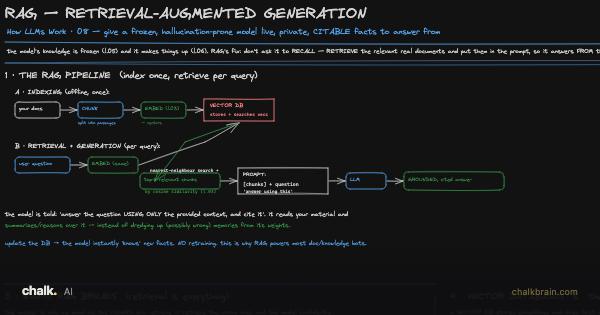
The RAG board draws a question going out to a library before it reaches the model. This lesson builds it over your own notes and measures whether it works.
Before you start. A language model, the AI that writes the answer, only knows what is in the text you hand it. So you cut your notes into chunks of a few paragraphs each. You find the chunks that match the question. You paste them in with “answer only from these”. That recipe is retrieval-augmented generation, RAG, from RAG (Retrieval-Augmented Generation). That lesson found matches by embeddings, lists of numbers where texts about the same thing sit close together; this one uses a simpler word-matching score instead. The first search engines matched words too, as Context Engineering (what goes in the window, and who decides) told. An eval set is a list of questions with the right answer written beside each. A second model call can grade each reply against a written rule, as Evals for Apps (the test suite for a program that is a string) showed.