Context Engineering (what goes in the window, and who decides)
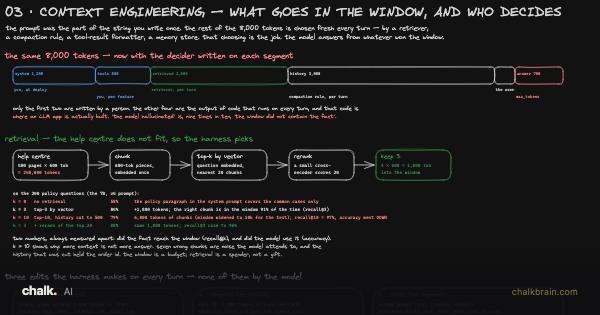
Building with LLMs, the third board of the run. “What the Model Sees” (What the Model Sees (one string, every turn, from the top)) showed the returns desk’s whole string, spent to the last token. “Prompt Engineering” (Prompt Engineering (shaping the next-token distribution)) took the 1,200 tokens a person writes once and made each one earn its place. This board is the other 6,000: a help centre thirty times the window’s size squeezed into three pages, a table where fetching more text made the answers worse, three small edits a harness makes on every turn, and four ways the window goes wrong before the answer does.
Before you start. A token is a word or a piece of one, and the model can see only a fixed number of them at a time: 8,000 for the returns desk. That whole 8,000 is the context window, the single string handed over on one call, and inside it sits the system prompt, the standing instructions a person writes once (What the Model Sees (one string, every turn, from the top), Prompt Engineering (shaping the next-token distribution)). A tool call is the model asking outside code to look something up, with the answer pasted back into the string. Reading the window is fast, writing the reply is slow, and both are paid for one token at a time, so a token spent on the wrong page is one the right page cannot have. Nothing here changes any of that; it only asks who fills the tokens that neither a person nor the customer wrote.