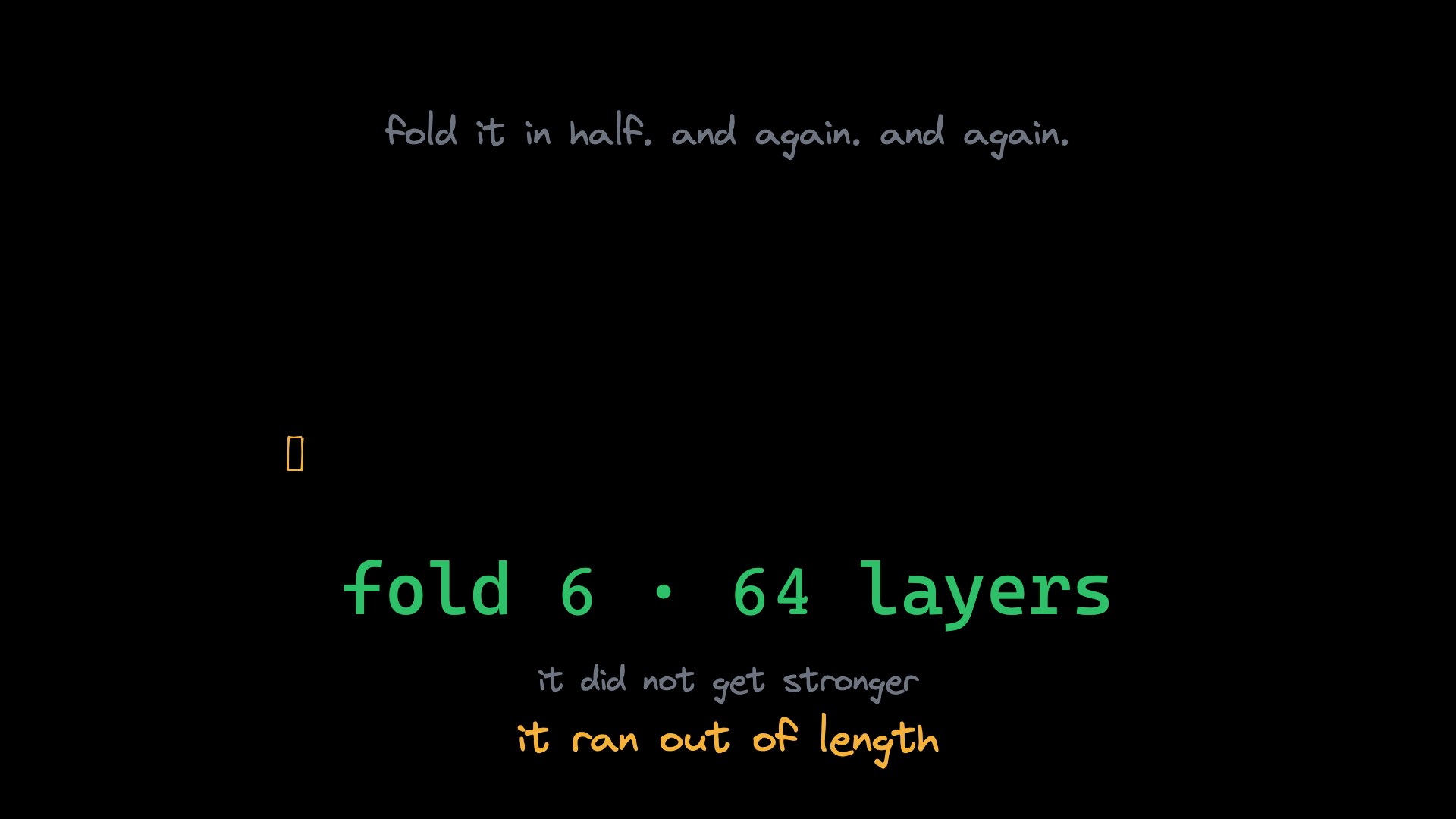
Why You Cannot Fold Paper Past Seven Times
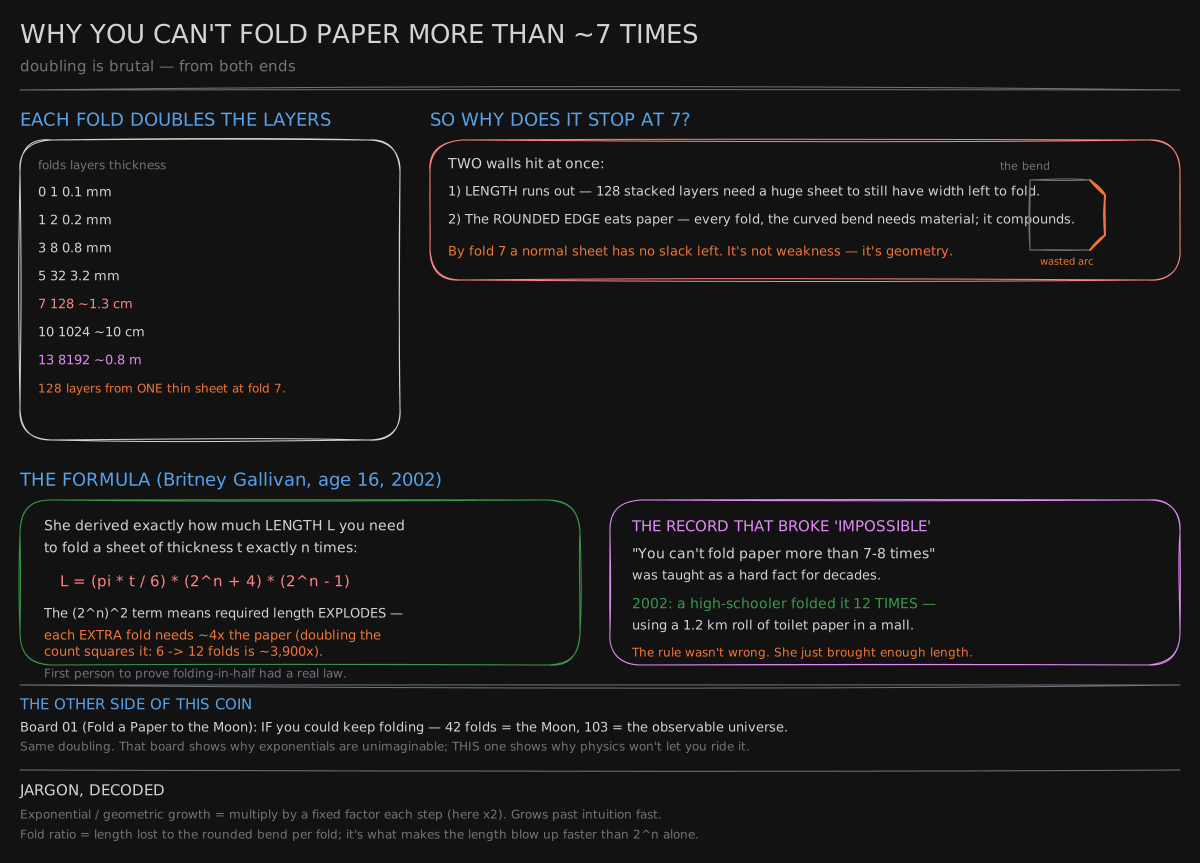
Shows a folded stack of paper from the side: each layer curls tighter around the ones already underneath it, until the outermost layer’s curve reaches further than the sheet has left to give.
Before you start. All you need is that folding something in half doubles its thickness - check it on a folded napkin if that isn’t already obvious. Everything past that is one multiplication at a time, and every number below is one you could check yourself with a calculator.
2001: a teenager doesn’t believe the rule everyone repeats
For decades, the story got repeated as fact: no sheet of paper can be folded in half more than seven or eight times - not because your arms get tired, but because the paper itself runs out of room to bend. Nobody could say exactly why that was the number, or whether it would hold for a different sheet. It was just what people found trying it with a sheet from a printer tray, and once enough people found the same result on the same shape of paper, it hardened into “a fact about paper.”
In December 2001, a high school student in California named Britney Gallivan decided to check whether that was true, or just something a lot of people had all verified on the same rectangle. Instead of folding sheets by hand and counting, she worked out an equation: tell it a sheet’s thickness and its shape, and it predicts exactly how many folds that sheet allows, no experimenting required.
Then, in January 2002, she used her own equation the other way round. She wanted twelve folds, so first she worked out how much material twelve folds would cost. Then she bought a 4,000-foot roll of toilet paper - over three-quarters of a mile of it. She folded it in half twelve times, the same direction each time, and the equation had told her exactly how much paper to buy before she made a single crease. It was right. The limit was never a property of paper. It was a property of the one rectangle everyone happened to be testing.
The belt that runs out of room
Picture folding a stack of paper like wrapping a belt around a growing waist. Every fold has to bend the outermost layer of the stack around all the layers already inside it, and the fatter that inside stack gets, the further around the outer layer has to travel to close the fold. That extra travel has to come from somewhere, and the only place it can come from is the sheet’s own length.
Start with the easy half: doubling. Every single fold doubles the stack’s thickness. One sheet of ordinary printer paper is about a tenth of a millimetre thick, roughly the thickness of a strand of hair. Fold it once and the stack is two hairs thick. Fold it again and it’s four. Keep doubling seven times and the stack is 128 sheets deep. That is 128 tenths of a millimetre: about a centimetre and a quarter, no thicker than a paperback’s spine.
The part that is not simple doubling is how much of the sheet’s length gets used up wrapping around that stack. Take an actual A4 sheet, 297 millimetres along its long edge, and fold it the same direction every time. Working through the numbers: reaching 6 folds this way uses up 224 millimetres of the sheet’s length. The sheet has 297 millimetres to give, so 6 folds fit with room to spare. Reaching 7 folds needs 878 millimetres. That is nearly three A4 sheets laid end to end, from a sheet that only had one to give.
flowchart LR
  A["6 folds need 224 mm"] -->|"297 mm sheet has enough"| B["6 folds: succeeds"]
  C["7 folds need 878 mm"] -->|"297 mm sheet falls short"| D["7 folds: fails - needs 3 sheets' worth"]
Folding a sheet the same direction every time is called single-direction folding, and for an A4 sheet it stops dead at 6.
Most people don’t fold that way. They rotate the sheet a quarter turn between folds, which lets both of the sheet’s edges contribute length to the wrap instead of just one. That style is called alternating folding, and it is how almost everybody actually folds paper by hand. Running the same kind of arithmetic using both of A4’s edges, the sheet survives one fold longer. Seven folds fit, using 161 of the 210 millimetres on A4’s short edge. An eighth fold would need 455 millimetres - more than twice what the sheet has.
flowchart LR
  S["same direction every fold"] --> S1["spends one edge's length"] --> S2["A4 stops at 6 folds"]
  Q["quarter turn between folds"] --> Q1["spends both edges' length"] --> Q2["A4 stops at 7 folds"]
That is where the seven in this lesson’s title comes from, and where the old rule came from too. It is not a law of paper. Seven is what one particular rectangle gives you when folded the way people actually fold paper. Call this the material wall: the sheet runs out of length before the fold can close.
Paper turning into cardboard
There is a second wall, and it has nothing to do with running out of material. Fold the stack once and it isn’t just thicker, it’s far harder to bend - the same way one sheet of paper is floppy but a phone-book-thick stack of the same paper barely bends at all.
The popular explanation says each fold makes the stack exactly eight times stiffer. That number runs too high, for two reasons that matter more than the arithmetic. First, the crease is not a sharp corner. It is a curl, and the curl gets rounder as the stack thickens. A fat, round curl is easier to bend than a tight one, so each fold makes the stack closer to four times harder, not eight. Second, the layers of a folded stack aren’t glued together. They can still slide past each other a little, the way the pages of a phone book slide when you fan it, and sliding layers resist far less than one solid block of the same thickness would.
So the honest range for fold 7, from those two effects, has two ends. On the low end, four times harder for each of seven folds: multiply four by itself seven times and you get about sixteen thousand times harder than folding a single sheet. On the high end, eight times harder for each of seven folds, about two million times harder. Which end it’s closer to depends on how much the accumulated creases have already pinned the layers together by then. Either end is why record attempts reach for rolling pins, steam and a team of people, and not one person’s thumb.
Which wall you hit first depends on the sheet
For an ordinary A4 sheet, the material wall arrives first. You run out of length at fold 6 or 7, long before the stiffness wall would ever have to stop you on its own - nobody has to fight a stack a million times stiffer, because there’s no sheet left to fold into that stack in the first place.
Change the sheet, and the order can flip. Gallivan’s twelve folds needed 879 metres of material by the equation. She used a 1,219-metre roll, so length was never scarce. What made her twelfth fold hard was the other wall: a stack about ten centimetres thick by then, stiff enough that it took a rolling pin and effort, not the length running out.
The trick behind every record
Once you know which wall is which, the strategy for beating either of them falls out for free. Don’t fight the stiffness wall: buy enough length that you never reach it. And get more length out of the same paper by making the sheet narrow and long instead of square, since the wall is written in length but paid for in area.
Take one square metre of paper, cut different ways. As a metre-wide square, folded the alternating way, it survives 8 folds. Cut into a strip a millimetre wide and a kilometre long, the same square metre of paper survives 12 folds. Only its shape changed - what the equation calls the sheet’s aspect ratio, the ratio between its two side lengths. Working out the shape you need, then going and finding or making that shape, is the entire content of Gallivan’s plan.
You now know
- The old rule, “you cannot fold paper more than seven or eight times,” was a report on one shape of paper, never a law about paper itself.
- Folding runs into two separate walls: running out of material to wrap around a growing stack, and the stack getting too stiff to bend.
- For a normal printer sheet, material runs out first: at 6 folds folding the same way each time, or 7 rotating a quarter turn between folds.
- Each additional fold needs roughly four times as much material as the fold before it, so one more fold is a far bigger ask than it looks.
- The way past both walls is shape: a long, thin strip of the same paper survives many more folds than a square of it, because length is what runs out, not area.
Stop here if you want. What follows is the same two walls in numbers, for when you want to see exactly where they bite.
Second read: the numbers behind both walls
The length wall, fold by fold. Folding an A4 sheet the same direction every time, the length needed to complete n folds is governed by Gallivan’s own equation, and it grows far faster than the stack’s thickness does:
L(n) = (π t / 6) (2ⁿ + 4)(2ⁿ − 1)In words: the length needed is the paper’s thickness times a number that roughly quadruples with every fold, because 2ⁿ (2 multiplied by itself once per fold) doubles each fold and it appears twice, multiplied together. Here t is the paper’s thickness and n the number of folds. In a table:
| folds | length needed | A4’s long edge has |
|---|---|---|
| 5 | 58 mm | 297 mm - plenty to spare |
| 6 | 224 mm | 297 mm - just fits |
| 7 | 878 mm | 297 mm - needs 3× the sheet |
| 8 | 3,471 mm | 297 mm - needs nearly 12× |
Each row costs roughly four times the row above it: going from 6 folds to 7 multiplies the requirement by 3.9, and that ratio keeps climbing toward 4 as the fold count grows. Subtracting each row from the next shows the same fact from the other side: the last fold alone eats about three quarters of everything the total needed, at fold 7 it’s 653 of the 878 millimetres, 74%. Whatever length you’re holding, you are always one fold away from needing about four times more.
The stiffness wall, in ratios. The two-effects correction from the story turns “8× per fold” into a bracket rather than one number: a growing crease radius alone gives 4× per fold, and free-sliding, unbonded layers alone give no extra stiffness at all. At fold 7 those bracket the truth between roughly 16,000× and 2,097,000× harder than one sheet. What actually happens sits between the two, because the creases themselves progressively weld the layers together: doubling the sheet count on every fold also means one fewer crease than that count links each new layer to its neighbour, and every layer ends up pinned to one at either end. Trust the shape of that range, not any single number in it: the underlying beam maths assumes paper bends elastically, and a real crease is closer to a permanent, plastic dent than a spring.
The extra travel, computed. The story’s belt picture has an exact number behind it. Folding a stack of thickness s in half, the outer layer’s curve is longer than the inner layer’s by almost exactly three times the stack’s own thickness - that “three” is really π, 3.14159…, the same constant that turns a radius into a circle. At fold 7 the stack is 12.8 mm thick, so the outer layer needs about 40 mm more travel than the inner one. Paper stretches only 1.5 to 3 percent before it tears, so a few tenths of a millimetre of true stretch is all a sheet can supply once it’s that thin at the end; the other 40 mm can only come from layers sliding past each other, which is exactly what the earlier creases have been locking down, one pair of layers at a time.
Cutting the same paper into a different shape. One square metre of 80 gsm paper (paper is sold by weight: 80 grams for each square metre is ordinary printer paper), folded different ways:
| shape of the same 1 m² | folds achievable |
|---|---|
| a metre-wide square, alternating | 8 |
| a 100 mm × 10 m strip | 8 |
| a 10 mm × 100 m strip | 10 |
| a 1 mm × 1 km strip | 12 |
Nothing added, nothing removed - only cut differently. That is the entire design of every record attempt since Gallivan’s.
Thickness is the other lever. Because the length needed scales directly with thickness, halving a sheet’s thickness helps, but not by much: the requirement only moves by a factor of 2, while a single extra fold costs a factor of 4, so it takes more than one halving to buy even one more fold. Gold leaf, at roughly a thousandth of office paper’s thickness, would clear 11 same-direction folds from an A4-sized sheet by the length equation alone - nobody keeps that record, because gold leaf tears rather than creases, a different wall arriving first.
The record, checked. Twelve same-direction folds of 0.1 mm paper need 879 metres by the equation. Gallivan used 1,219 metres of toilet paper, a real margin, consistent with tissue running thicker and loftier than thin office paper.
Try it
No code? Do this. Twenty minutes, two sheets of A4 printer paper, a roll of toilet paper, a long hallway or table, and a pencil.
- Both styles on A4. Fold one sheet in half the same direction every time and count how far you get before the fold will not close. Fold the second sheet with a quarter turn between folds. The arithmetic predicts 6 and 7. Your hands may lose one fold to sloppy creases, but rarely gain one.
- Read the table. Folding the same direction every time, the length a fold count needs is: 5 folds, 58 mm; 6 folds, 224 mm; 7 folds, 878 mm; 8 folds, about 3.5 m; 9 folds, about 13.8 m. Each row is roughly four times the one before. Which row stops a 297 mm A4 sheet?
- Buy length, like Gallivan. Using that table, how much toilet paper do you need for 8 folds in one direction? Unroll a bit more than that along a hallway or table and try it, folding end to end each time and pressing each crease flat. Most people beat the “seven folds” folklore on the first try.
- The stiffness wall. If each fold makes the stack four times harder to bend, how much harder is fold 7 than fold 1? If it is eight times, as the popular version says?
- One more fold for a record. Gallivan’s twelve folds needed 879 m. Using “about four times per fold”, roughly how long a roll would a thirteenth fold need?
Answers
2. Six folds need 224 mm, which fits in 297 mm. Seven need 878 mm, nearly three sheets’ worth: fold 7 stops it, so A4 tops out at 6 in one direction.
3. About 3.5 m for 8 folds. Unroll 4 m and you have room to spare. Nine folds would need nearly 14 m.
4. Four times per fold, seven times over: 4⁷ = 16,384 times, about sixteen thousand. Eight times per fold: 8⁷ = 2,097,152, about two million. Those are the two ends of the story’s bracket.
5. About 4 × 879 m, roughly 3.5 km of paper (the exact formula gives 3,515 m), for one fold more.
With Python, the block below computes both walls for any sheet and shows how shape alone buys extra folds.
import math

t = 0.1                                             # mm, 80 gsm office paper
k = math.pi * t / 6
L = lambda n: k * (2**n + 4) * (2**n - 1)           # single direction, min length
W = lambda n: math.pi * t * 2**(1.5 * (n - 1))      # alternating, min square side

# ---- 1. A4 both ways: geometry alone, no force involved --------------------
print(max(n for n in range(1, 20) if L(n) <= 297))  # 6  along the long edge
print(max(n for n in range(1, 20) if W(n) <= 210))  # 7  alternating, short side binds
print(L(7), W(8))                                   # 877.8 mm, 455.0 mm -- both refused

# ---- 2. every fold eats three quarters of the total -------------------------
for n in range(2, 9):
    d = L(n) - L(n - 1)
    print(f"{n}: total {L(n):10.2f} mm   this fold {d:10.2f}   share {d/L(n):.3f}")
# share -> 0.75.  Delta(n) = (pi*t/2)(4**(n-1) + 2**(n-1)) exactly:
print(all(math.isclose(L(n) - L(n-1), (math.pi*t/2)*(4**(n-1) + 2**(n-1)))
          for n in range(2, 30)))                 # True

# ---- 3. the width parameter is the whole record strategy -------------------
A = 1e6                                             # 1 m^2 of paper, mm^2
print("square, alternating:", max(n for n in range(1, 30) if W(n) <= 1000))
for w in (200, 100, 50, 10, 1):
    print(f"  {w:>4} mm wide:", max(n for n in range(1, 30) if L(n) <= A / w))
# 8 / 8 / 8 / 9 / 10 / 12 -- same paper, four extra folds, bought with shape alone

# ---- 4. area penalty: alternating 8x per fold, single-direction 4x ---------
print(W(7)**2 / W(6)**2, L(10) / L(9))              # 8.000 exactly, and 3.988 -> 4

# ---- 5. the three stiffness models, ratios only ---------------------------
for n in (1, 3, 5, 7, 10):
    print(f"n={n:2d}  free-slip 1x   bonded+radius {4**n:>12,}x   bonded fixed-R {8**n:>15,}x")

# ---- 6. the outer layer has further to go ---------------------------------
for n in (1, 5, 6, 7):
    s = t * 2**n
    print(f"n={n}: stack {s:6.2f} mm | excess arc {math.pi*s:7.2f} mm | "
          f"stretchable source at 2% {math.pi*s/0.02:8.0f} mm | A4 left {297/2**n:6.2f} mm")
# between fold 5 and 6 the arc excess passes the length of the object itself

# ---- 7. minimum non-tearing radius vs the object being folded -------------
for n in (0, 5, 7):
    s = t * 2**n
    print(f"n={n}: R >= 25s = {25*s:7.1f} mm   object = {297/2**n:6.2f} mm")
# fold 7: a 320 mm radius on a 2.3 mm object.  That is a curve, not a fold.

# ---- 8. do the records match the formula? ---------------------------------
for thick, folds, used_km in ((0.1, 12, 1.2192), (0.45, 13, 16.4592)):
    need = (math.pi*thick/6) * (2**folds + 4) * (2**folds - 1) / 1e6
    print(f"t={thick} mm, {folds} folds: formula {need:7.3f} km, used {used_km:7.3f} km")
# 0.879 vs 1.219 (Gallivan);  15.818 vs 16.459 (MIT) -- the thickness is the fix

# ---- 9. thickness is the lever, not strength ------------------------------
for thick in (0.1, 0.05, 0.01, 0.0001):             # office / thin / tracing / gold leaf
    Lk = lambda n, tt=thick: (math.pi*tt/6)*(2**n+4)*(2**n-1)
    print(f"t={thick:>7} mm on 297 mm:", max(n for n in range(1, 40) if Lk(n) <= 297))
# 6 / 6 / 7 / 11 -- same sheet size, same formula, no strength involved.
# Note how flat it is: halving the thickness buys nothing here, because the
# bound moves by a factor of 2 and a fold costs a factor of 4.
Block 3 is the one to sit with. One square metre of paper is one square metre of paper; cutting it into a 1 mm ribbon buys four extra folds without adding a gram, because the wall is written in length and paid for in area.
Go deeper
- Britney Gallivan, How to fold paper in half twelve times - the original derivation, Historical Society of Pomona Valley
- Folding paper in half - both formulas and the record attempts
- ISO 216 and the √2 aspect ratio behind A4.
Related
Related: Fold a Paper to the Moon (works out how many doublings a folded stack would take to reach the Moon, and how absurd the paper requirement gets long before that), Compound Interest, the 8th Wonder (money grows by the same doubling curve - “each step costs about four times more” isn’t unique to paper), Complexity & Big-O and Complexity Theory (when problems are hard) (why a process that grows by four each step eventually outruns one that grows by two, whatever the starting numbers), You Are Empty Space (the same resistance to being squeezed that makes the outer layers of a crease refuse to stretch), Why Ice Floats (another everyday fact whose popular explanation names the right force and stops one step short of the real mechanism), Cognitive Biases and Decision-Making Under Uncertainty (mistaking a property of the one example everyone tested for a property of the whole category), The 99 Percent Test That Is Usually Wrong (asking which wall actually bites first, and what it would cost to move it). The full Mind Blown list is in CURRICULUM.
Retrieval practice
8 questions. Answer each one before you open it.
Which wall does a normal A4 sheet hit first - running out of material, or the stack getting too stiff - and why does the answer flip for Gallivan’s 1,219-metre roll?
A4 hits the material wall first. It runs out of length at fold 6 (same direction) or fold 7 (alternating), long before the stiffness wall would ever have mattered at those small fold counts - nobody has to fight a stack a million times stiffer when there’s no sheet left to fold into one. On the 1,219-metre roll, length was never scarce: 12 folds needed only 879 metres of the 1,219 available. What made the twelfth fold hard instead was the other wall, a stack about ten centimetres thick, stiff enough to need real effort rather than a running-out of paper.
A4’s long edge is 297 millimetres. Folding it the same direction every time, how many folds fit, and what would one more cost?
Six folds fit: they need 224 of the sheet’s 297 millimetres, with room to spare. A seventh fold needs 878 millimetres, nearly three whole A4 sheets laid end to end, out of a sheet that only had one to give. Same-direction folding of A4 tops out at 6.
Why does rotating the sheet a quarter turn between folds (alternating) give A4 one extra fold over folding the same way every time (single-direction)?
Alternating spends both of the sheet’s edges’ length across successive folds instead of only one, so a nearly-square sheet like A4 has more usable length available overall. Alternating permits 7 folds, using 161 of A4’s 210-millimetre short edge; an 8th fold would need 455 millimetres, more than twice what’s there. Single-direction folding, spending only one edge, permits just 6.
The popular claim is that each fold makes the stack exactly eight times stiffer to bend. Why is that number too high, and what’s the honest range at fold 7?
Two effects push it down. The crease has to curve around a radius that grows with the stack, which softens the cubed resistance down to roughly a squared one: about 4 times harder per fold instead of 8. And the layers of a folded stack aren’t glued; they can still slide past each other somewhat, so a stack of loose sheets resists far less than one solid block of the same thickness. Depending how much the accumulated creases have already pinned the layers together, fold 7 sits somewhere between roughly sixteen thousand times harder and about two million times harder than folding one sheet, not a clean eight-times-per-fold.
What is the “extra travel” the outer layer of a fold has to make, and why can’t the paper supply it after a few folds?
Folding a stack of thickness s in half, the outer layer traces a bigger curve than the inner layer, longer by almost exactly π times the stack’s own thickness. By fold 7 the stack is 12.8 millimetres thick, so the outer layer needs roughly 40 millimetres more travel than the inner one. Paper can stretch only 1.5 to 3 percent before it tears, so true stretch can supply only a sliver of that; the rest has to come from layers sliding past each other, which is exactly what the accumulated creases are progressively locking in place.
How does cutting the same amount of paper into a different shape change how many folds it survives?
The wall is written in length but paid for in area, so trading a square for a long, thin strip buys extra folds for free. One square metre of paper folded as a metre-wide square survives 8 alternating folds; the same square metre cut into a strip a millimetre wide and a kilometre long survives 12 - four more folds, with no extra paper at all.
Gallivan derived the equation in December 2001. What did she do with it in January 2002, and did it hold up?
She used it to work out exactly how much material 12 same-direction folds would need, 879 metres by the equation, then bought a 4,000-foot (1,219-metre) roll of toilet paper and folded it 12 times, the same direction each time. The extra 340 metres over the formula’s minimum is consistent with toilet paper being thicker and loftier than the thin office paper the equation assumes; the fold succeeded well inside that margin, which is the confirmation.
Why was “you cannot fold paper more than eight times” wrong as a statement about paper, and what should it have been a statement about?
It was a statement about one shape, tested by enough people on the same shape (a sheet from a printer tray) that the result hardened into a supposed law. It should have been a statement about the sheet’s shape and thickness instead: the same paper gives 6 folds folded one way, 7 folded the other, 8 as a one-metre square, and 12 as a long thin ribbon of the same square metre of material - nothing about the paper changed, only its proportions.