The names a program needs to find
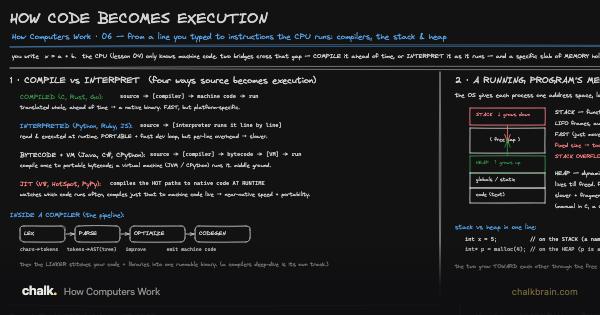
The road from the words you type to the bytes the chip runs. This lesson zooms in on its last two stops: joining the pieces, then loading them.
Before you start. A compiler turns the code you write into the chip’s own instructions, one file at a time, and a running program keeps its short-lived work on the stack and its longer-lived things on the heap (How Code Becomes Execution (compilers, stack & heap)). The kernel starts a program by loading it into a fresh process, the walled-off space a running program lives in (Processes, Threads & the Kernel). Memory is handed out in fixed-size blocks called pages. A file can be mapped into a process’s memory, page by page. When two processes map the same file, they share one copy of those pages (The address book every process carries).