What a Word Points At
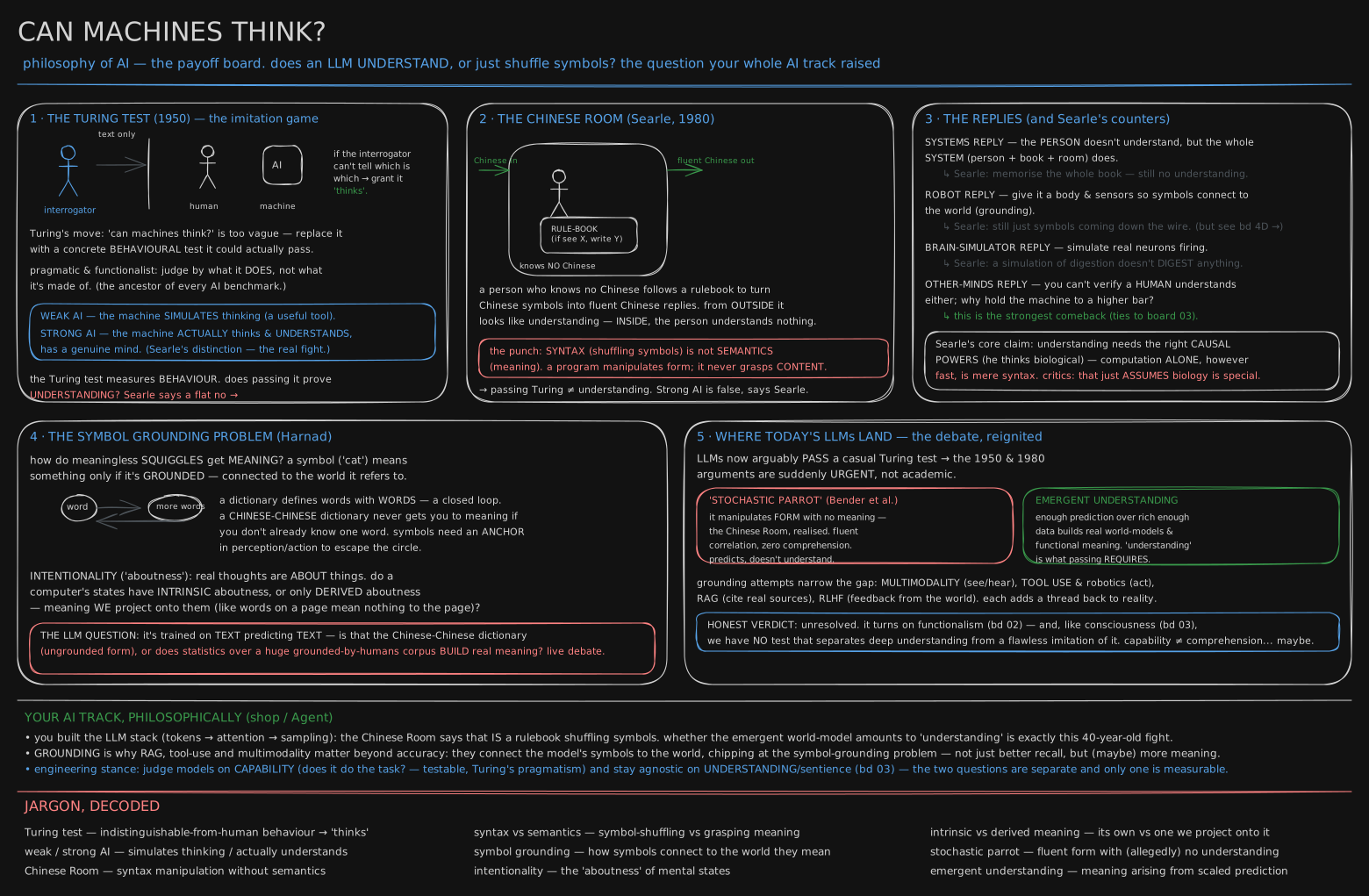
The drawing about whether a machine that shuffles words understands them. Before that question can be asked properly, there is an older one underneath it: what does it take for any word, in anyone’s mouth, to mean something at all?
Before you start. You need nothing but the ordinary sense that a word like “cat” is about cats: it is a sound or a mark that somehow reaches out to a thing in the world. The Mind-Body Problem asked how a lump of brain could be about anything; this lesson asks the same of a word, and later, in Can Machines Think?, the question comes back for machines.
Sixth century BC: two stars that were one
Look west just after sunset, at the right time of year, and there is a very bright point of light low in the sky. Look east just before dawn at another time of year, and there is a bright point there too. The ancient Greeks gave them two names. The evening one was Hesperus. The morning one was Phosphorus, “bearer of light”.
They are the same object. Both are the planet Venus, seen on either side of the Sun. The Roman writer Pliny the Elder credited Pythagoras, in the sixth century BC, with realising it. Another ancient writer gave the credit to Parmenides a little later. Either way, somebody looked up and made a discovery that could be written in four words: Hesperus is Phosphorus.
Keep that sentence. It is about to cause trouble.
1892: Frege’s puzzle, and the gap between reference and sense
Gottlob Frege, a mathematician and logician at Jena, opened a paper in 1892 with a question about the word “is”. Compare two sentences:
- Hesperus is Hesperus.
- Hesperus is Phosphorus.
The first tells you nothing. Nobody ever needed a telescope to learn it. The second was a real discovery about the sky. Yet if the meaning of a name is simply the object it points at, both sentences say exactly the same thing: Venus is Venus. Something is missing.
Frege’s answer was that a name has two sides. One is the thing it points at; Frege called that its reference. Hesperus and Phosphorus have the same reference, the planet. The other side is the way the name picks that thing out, the route it takes to get there: “the bright one in the evening” against “the bright one before dawn”. Frege called that its sense. Two names can share a reference and differ in sense, and that difference is exactly why “Hesperus is Phosphorus” can teach you something.
flowchart LR
  E["Hesperus, the bright light at dusk"] -->|"one route"| V["Venus, the planet"]
  M["Phosphorus, the bright light at dawn"] -->|"another route"| V
Two arrows, one target. The arrows are the senses. The target is the reference.
The best objection: what is a sense, and where does it live? It is not the planet, and Frege insisted it is not a private picture in your head either, since two people can grasp the same sense. That leaves it hanging somewhere strange. And Frege’s picture treats language as mainly a set of labels attached to things. Both points were attacked, from opposite directions, by the next two thinkers.
1953: Wittgenstein’s builders, and meaning as a move in a game
Ludwig Wittgenstein’s Philosophical Investigations was published in 1953, two years after his death. Near its start he asks you to imagine a tiny language. A builder and an assistant have four words: “block”, “pillar”, “slab”, “beam”. The builder calls out “Slab!” and the assistant brings a slab.
Now ask what “Slab!” means. It does not just point at a slab. It does a job. It is closer to “bring me a slab” than to a label stuck on a stone. Learn the word and you have learned how to take part in the activity: hear it, fetch. Wittgenstein called a small activity like this, words woven together with what people do, a language game. Ordinary language is a huge tangle of such games: giving orders, telling jokes, asking, thanking, describing.
From that picture comes his best-known line, in section 43: for a large class of cases, “the meaning of a word is its use in the language.” To know what a word means is to know how to use it: when to say it, what follows from it, what people do in response.
flowchart LR
  B["Builder shouts: Slab!"] --> A["Assistant hears it"]
  A --> F["Assistant fetches a slab"]
  F -->|"the game continues"| B
The best objection: use cannot be the whole story. Two speakers could use a word in exactly the same way, say the same things with it, react the same way to it, and still be talking about different things. That sounds impossible until you meet the next thought experiment.
1975: Twin Earth, where water is not water
Hilary Putnam, a philosopher at Harvard, published “The Meaning of ‘Meaning’” in 1975. Imagine, he said, a planet somewhere exactly like Earth, down to a twin of you. The one difference: the clear liquid in its rivers and rain, which the people there call “water”, is not made of hydrogen and oxygen. It has some other chemical make-up; Putnam wrote it as XYZ. It looks, tastes and behaves just like water.
Now set the clock back to 1750, before anyone on either planet knew any chemistry. You and your twin say “water” in the same situations, picture the same thing, use the word in exactly the same way. Everything in your two heads is the same. Yet your word is about H2O and your twin’s is about XYZ. When you say “water is wet”, you are talking about something your twin has never touched.
So what fixes what “water” refers to is not only what is in the speaker’s head, and not only how the word is used. It is also what the speaker is actually connected to in the world: the stuff around them that the word was first attached to. Putnam’s summary: “‘meanings’ just ain’t in the head.” The view that meaning depends partly on things outside the speaker is called externalism.
flowchart TD
  Y["You, in 1750, say: water"] -->|"same head, same use"| T["Your twin, in 1750, says: water"]
  Y --> H["refers to H2O"]
  T --> X["refers to XYZ"]
Putnam added a second, gentler point. He admitted he could not tell an elm from a beech, yet when he said “elm” he still meant elms. The word works for him because botanists, who can tell them apart, are part of the same language. Meaning is shared out across a community, not stored whole in each speaker.
The best objection: maybe “water”, in 1750, meant any clear drinkable liquid of that kind, so both twins were talking about the same broad stuff. Philosophers including John Searle have argued along those lines. The fight over externalism is still open.
So does a language model mean anything?
A language model is trained on an enormous amount of text and learns to continue it. In Wittgenstein’s terms, it has learned a vast amount about use: which words follow which, what you say back to a question, how a joke is built. If meaning is use, that is a great deal of meaning.
In Putnam’s terms, the worry is sharper. The model’s word “water” was never attached to any water. Its only connection to the stuff runs through people who wrote about it. It may be like Putnam with elms, leaning on the community that does know. Or it may be like a parrot of the community, with no link of its own at all. Which of those it is turns out to be the central question of Can Machines Think?, where it gets a name and a fight of its own.
You now know
- A word can be understood two ways: as the thing it picks out, and as the route by which it picks that thing out; two names can share the first and differ in the second.
- That difference explains why “the morning star is the evening star” was a real discovery even though both names point at the same planet, Venus.
- On another view, a word’s meaning is how it is used: the job it does inside an activity, the way “Slab!” on a building site means “bring me a slab”.
- A thought experiment with a twin planet, where a liquid identical to water has a different chemical make-up, suggests that what a word refers to depends partly on what the speaker is connected to in the world, not only on what is in their head.
- These views pull apart on whether a system trained only on text can mean anything by its words: it has learned use, but its words were never attached to the things they name.
Stop here if you want. What follows is Frege’s idea applied to whole sentences, Russell’s theory of descriptions, and how the three views grade a language model differently.
Second read: sentences, descriptions, and three report cards for a machine
Frege on whole sentences. Frege applied the same split to sentences. The sense of a sentence is the thought it expresses. Its reference, Frege argued, is its truth value: true or false. That gives a test you can run. Swap a name for another with the same reference, and the truth of the sentence should not change. “Hesperus is bright” and “Phosphorus is bright” are both true. But try it inside a belief: “An early sky watcher believed Hesperus appears in the evening” can be true while “An early sky watcher believed Phosphorus appears in the evening” is false, because the watcher did not know they were one object. The swap broke the sentence. Frege’s explanation: inside “believes that”, a name stops pointing at its usual reference and points at its sense instead, because a belief is about the route, not just the target.
Russell’s descriptions. Bertrand Russell, in a 1905 paper in the journal Mind, “On Denoting”, attacked a related puzzle. “The present King of France is bald.” France has no king. So is the sentence true, false, or about nothing? Russell’s answer was that “the present King of France” is not a name at all. The sentence really says three things: there is a present King of France; there is only one; and that one is bald. In words: it is a claim that something exists, plus a claim about it. Since the first part is false, the whole sentence is simply false, and nothing is needed for it to be “about”. This let Russell handle empty names without inventing objects for them to point at.
Three report cards for a language model. Each view in this lesson grades a text-trained model differently, and seeing the three side by side is the useful part.
- Frege. A model can certainly track that “Hesperus” and “Phosphorus” pick out the same planet; that is a fact written down many times in its training text. Whether it grasps a sense, a way of picking the thing out, depends on whether a route through other words counts as a route. Frege gives no clear verdict.
- Wittgenstein. If meaning is use, a model that uses words fluently in the right situations has a large share of their meaning. The hard question is whether a model takes part in any activity at all, or only produces the words that would go with one. The builder’s assistant fetches the slab. The model only writes “here is your slab”.
- Putnam. Reference needs a real connection to the stuff, and the model’s words reach the world only through the people who wrote the text. The division-of-labour point is the model’s best defence: you mean elms without being able to spot one, because botanists can. The model leans on its writers in the same way. Whether that borrowing is enough, or whether it must eventually touch something itself, is the grounding question in Can Machines Think?.
What a model actually holds for each word is a list of numbers, placed so that words used in similar ways sit near each other (Tokens & Embeddings). That is a measurement of use, in Wittgenstein’s sense, made concrete. It is not, on its own, a link to water.
Try it
- Find your own Hesperus. Write two descriptions of one person that someone could know separately without knowing they are the same person (for example, “the person who wrote the note on the fridge” and “my upstairs neighbour”). Write the sentence that joins them. Why would it be news to someone?
- Invent a four-word language. Pick an activity you do with someone else, such as cooking together. Write a four-word language for it, as Wittgenstein did for the builders. For each word, write what it does, not what it names. Which words turned out to be orders, which questions, which warnings?
- Run Twin Earth on a chatbot. This one needs access to any AI chat assistant. Ask it: “In 1750, before chemistry, did the word ‘water’ on Earth refer to H2O?” Then ask: “What does your own word ‘water’ refer to, and how did it get attached to that?” Read the answer as Putnam would: does it describe a connection to the stuff, or only to text about it?
Go deeper
- Frege (1892), “On Sense and Reference” (“Über Sinn und Bedeutung”).
- Russell (1905), “On Denoting,” Mind.
- Wittgenstein (1953), Philosophical Investigations, sections 1-43, from the builders to “meaning is use”.
- Putnam (1975), “The Meaning of ‘Meaning’,” Minnesota Studies in the Philosophy of Science 7.
- Stanford Encyclopedia of Philosophy, “Externalism About the Mind”.
Related
- Can Machines Think? - the grounding problem: whether a machine’s words can connect to anything.
- Tokens & Embeddings - the numbers a model stores for each word, built entirely from how words are used.
- The Mind-Body Problem - the same “how can it be about anything” question, asked of the brain.
- What Is Knowledge? - knowing that Hesperus is Phosphorus is a discovery about the world.
- Logic, Truth & the Limits of Reason - Frege again, and what happened to his logic in 1902.
- The Words You Think In (Psychology) - the other half of the question: how a child learns words at all, and whether the words you have change what you can think.
Retrieval practice
7 questions. Answer each one before you open it.
Why is “Hesperus is Phosphorus” a discovery while “Hesperus is Hesperus” is not, and what problem does that pose?
Hesperus (the evening star) and Phosphorus (the morning star) are both the planet Venus. “Hesperus is Hesperus” tells you nothing; “Hesperus is Phosphorus” was a real astronomical discovery. But if a name’s meaning were only the object it points at, both sentences would say the same thing, so meaning must involve something more than the object.
What is the difference between a word’s sense and its reference, in Frege’s terms?
The reference is the thing the word picks out (for Hesperus and Phosphorus, Venus). The sense is the way, or route, by which it picks that thing out (“the bright light at dusk” against “the bright light at dawn”). Two names can share a reference and differ in sense, which is why identity statements between them can be informative.
What is the builders’ language-game, and what view of meaning does Wittgenstein draw from it?
A builder and an assistant share four words, “block”, “pillar”, “slab”, “beam”; the builder calls one out and the assistant fetches it. “Slab!” works more like an order than a label. Wittgenstein concluded that for many words, meaning is use: to know what a word means is to know how to take part in the activities it belongs to.
Describe Putnam’s Twin Earth case and the conclusion he drew.
A planet just like Earth, with a twin of you, except that its clear drinkable liquid called “water” is not H2O but a different substance he called XYZ. In 1750, before chemistry, you and your twin are identical in your heads and in how you use “water”, yet your word refers to H2O and your twin’s to XYZ. So what a word refers to depends partly on what the speaker is connected to in the world: “‘meanings’ just ain’t in the head”. This view is externalism.
What is Putnam’s elm-and-beech point, and why might it help a language model’s case?
Putnam could not tell an elm from a beech, yet he still meant elms by “elm”, because experts in his language community can tell them apart; meaning is shared across a community. A language model’s words also reach the world only through others (the people who wrote its text), so it might borrow reference the same way, though whether that borrowing is enough is disputed.
How did Russell handle “The present King of France is bald”?
In “On Denoting” (1905) he argued that “the present King of France” is not a name but a hidden claim. The sentence says: there is a present King of France, there is only one, and that one is bald. Since the first claim is false, the whole sentence is false, without needing any object for it to be about.
Grade a text-trained language model under Wittgenstein’s view and under Putnam’s. Where do they disagree?
Under Wittgenstein’s “meaning is use”, a model that uses words fluently has a large share of their meaning, though it may only produce the words of an activity without taking part in it. Under Putnam’s externalism, its words were never connected to the things they name except through human writers, so it may not refer at all, or only by borrowing. They disagree on whether fluent use is enough without a link to the world.