What Is Knowledge?
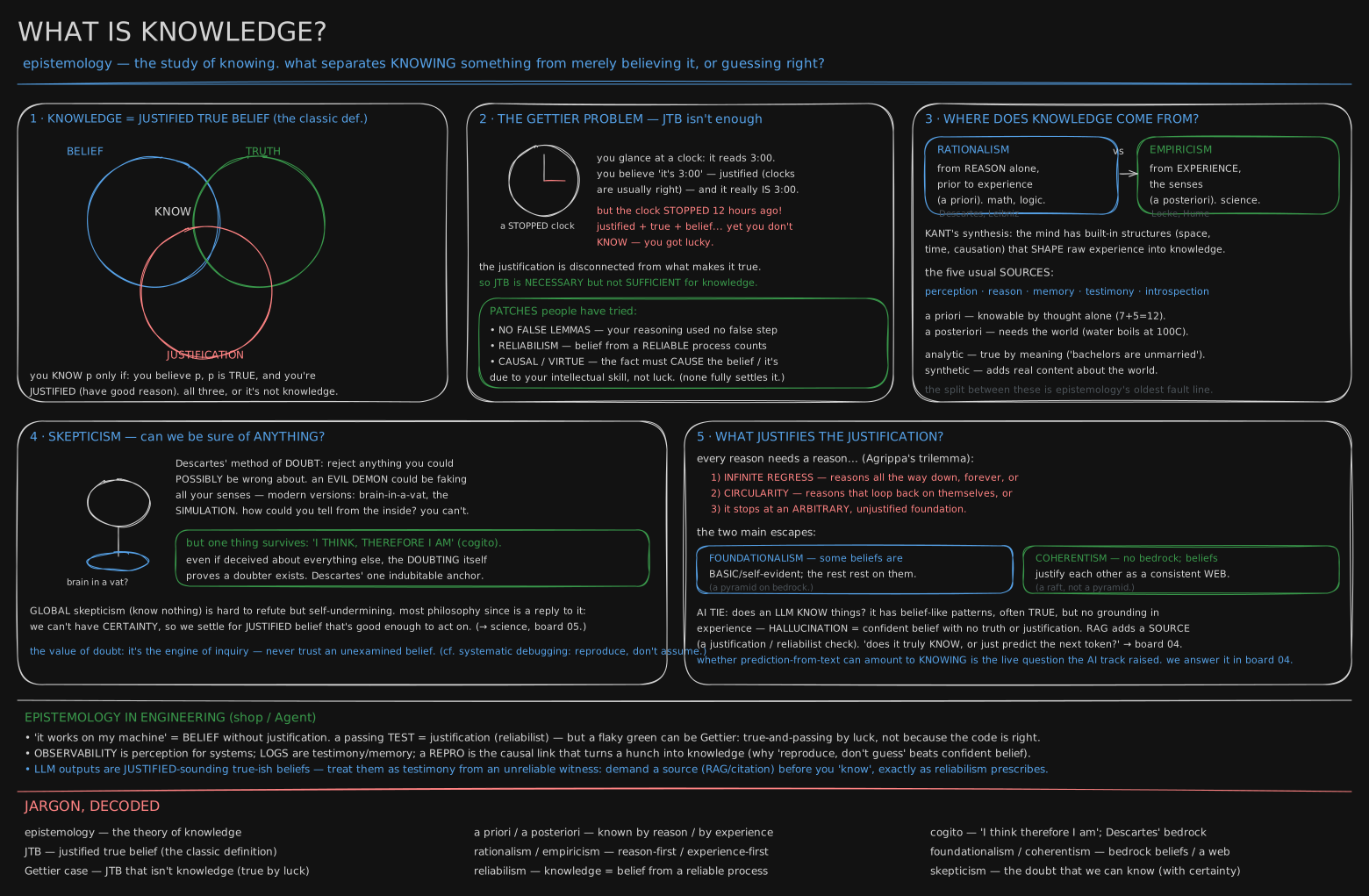
The opening board of the Philosophy track. It draws the line this lesson is about: the difference between believing something, being right about it by luck, and actually knowing it.
Before you start. You don’t need anything from an earlier lesson - this is the first stop in Philosophy. All you need is a habit you already have: trusting a claim because you have a good reason for it, and a willingness to ask what “good reason” really means.
1963: the three-page paper that broke an answer older than Plato
Say you glance at a clock on the wall. It reads three o’clock. You believe it is three o’clock, and - say - it really is three o’clock right now. Is that enough to say you know the time?
Most people say no. Suppose the clock is broken and happened to land on three by pure coincidence: you’d have a true belief, but you wouldn’t really know anything, you’d just have gotten lucky. So there’s a third thing you need besides believing something and it being true: a good reason. If the clock is running and you looked at it properly, you have one, and everyone would call that knowing.
Put the three pieces together - you believe it, it’s true, and you have a good reason - and you have the classical answer to “what is knowledge,” the one philosophers leaned on since Plato. It even has a name for exactly this trio: justified true belief, JTB for short. The field that studies questions like this - what counts as knowing, where knowledge comes from, how sure you can ever be - is called epistemology.
For about two thousand years that was the whole answer. Then, in 1963, a philosophy teacher named Edmund Gettier, at Wayne State University in Detroit, published a paper in the journal Analysis that ran three pages and undid it.
Here’s the clock again, run differently. You glance at it. It reads three o’clock. You believe it, and it really is three o’clock at that instant. But this time the clock stopped running exactly twelve hours ago, at three o’clock the night before, and hasn’t moved since. You believe it, it’s true, and you had every reason to trust it - a working-looking clock on a wall. All three boxes of the classical answer are checked. And yet you don’t know what time it is. You got lucky twice: lucky the clock stopped on the right number, and lucky you happened to glance at it exactly twelve hours later. This kind of case now has a name: a Gettier case, a belief that is justified and true only by an accident that has nothing to do with the reason you gave for it.
flowchart TD
  P["a claim: it is 3 o'clock"] --> B{do you believe it?}
  B -- no --> X1[not knowledge: you do not hold it]
  B -- yes --> T{is it true?}
  T -- no --> X2[not knowledge: a reasonable mistake]
  T -- yes --> J{do you have good reason?}
  J -- no --> X3[not knowledge: a lucky guess]
  J -- yes --> G{does the reason connect to what makes it true?}
  G -- no --> X4["Gettier case: the clock stopped, you got lucky"]
  G -- yes --> K[knowledge]
Follow the diamond at the bottom of that diagram: it’s the one gate the classical answer never knew it needed. Every repair attempted since 1963 is really an attempt to say what that last gate is checking.
The fix that almost works: knowing as a habit that gets it right
The most popular repair changes the question. Instead of asking “do you have a good reason,” it asks: did this belief come from a process that reliably gets things right? A working clock, checked the normal way, is a reliable process - check it a thousand times and it will almost always be correct. Reading a stopped clock is not: check stopped clocks a thousand times and you’re right once, by chance, per rotation of the hands. This repair has a name, reliabilism: a belief counts as knowledge when a reliable process produced it, whether or not you can put the reason into words.
Reliabilism handles the stopped clock cleanly. But it has a hole of its own, and here is how you find it. Ask which “process” produced your belief about the stopped clock. It’s an instance of “looking at a clock,” which is reliable. It’s also an instance of “looking at that particular, currently broken, clock,” which is not reliable at all. It’s also an instance of “looking at a clock on a Tuesday afternoon,” which is neither here nor there. Nothing about the moment itself says which of those descriptions is the real process being graded, and the verdict flips depending on which one you pick. This gap has a name too: the generality problem. Until someone can say how finely to describe a “process,” reliabilism is deciding cases by feel, the same way the classical answer was before Gettier came along.
Where this leaves you
Nobody has closed the gap Gettier found in 1963. The honest state of play, sixty years on: you can usually spot a Gettier case when you see one - a stopped clock, a lucky guess dressed up as reasoning - but nobody has written a rule that catches every such case and only those cases. That’s not a small embarrassment for philosophy; it’s the reason epistemology is still an active field rather than a finished chapter.
It also sets up the next question this track asks. Knowing requires a believer: something that holds beliefs, gets things right or wrong, and can be lucky or careful. What that something actually is - a brain, a mind, something else entirely - is the question The Mind-Body Problem takes up next.
You now know
- Believing something and having it turn out true is not the same as knowing it; the classical answer also demands a good reason, and philosophers call that trio justified true belief.
- In 1963, Edmund Gettier showed a case where all three hold and it still isn’t knowledge, because the reason and the fact that made the belief true came apart by luck. That kind of case is now called a Gettier case.
- The strongest repair says a belief is knowledge when it comes from a process that reliably gets things right, not merely a process you can defend in words. That repair is called reliabilism.
- Reliabilism has its own hole: any single moment is an instance of many different “processes” at once, and nothing says which one to grade it by. That’s the generality problem.
- Nobody has closed the gap Gettier opened; it’s still the live question at the centre of the philosophy of knowledge.
Stop here if you want. What follows is the same question run through a few more centuries of philosophy, one more objection to the fix, and the one place all of this turns into a number you can compute.
Second read: where knowledge comes from, how sure you can be, and the fix’s other hole
Gettier’s puzzle is about checking a belief. A separate, older puzzle asks where beliefs come from at all. Rationalism says some knowledge comes from reason alone, before any experience - mathematics and logic, defended by Descartes and Leibniz. Empiricism says all substantive knowledge starts from the senses - Locke and Hume’s line, later formalised as the method of science. Kant’s answer: neither side alone works. The mind isn’t a blank slate copying the world, and it isn’t pure reason either; it supplies built-in structures - space, time, cause and effect - that shape raw experience into something knowable. Two distinctions ride along, one about how you check a claim and one about what it says.
- How you check it: by thought alone (“seven plus five is twelve”) is a priori; by looking at the world (“water boils at 100°C”) is a posteriori.
- What it says: true just from the meaning of its words (“bachelors are unmarried”) is analytic; adding real information about the world is synthetic.
A third puzzle, just as unresolved: how sure can you be of anything? Descartes’ method of doubt rejects any claim you could possibly be wrong about, even the floor under your feet, because a deceiver clever enough - his own term was an evil demon; today’s versions are the brain in a vat and the simulation - could fake every sense and you would never notice from the inside. One thing survives even the demon: the act of doubting proves a doubter exists, cogito ergo sum, “I think, therefore I am” (Meditations on First Philosophy, 1641). Since certainty beyond that is unreachable, philosophy since has mostly settled for justified belief good enough to act on - exactly what an experiment delivers.
That raises a fourth puzzle: what justifies the justification? Every reason seems to need a further reason, and the chain can only end three ways - a trilemma named for the Greek skeptic Agrippa, who first listed them: it regresses forever, it loops back and justifies itself, or it stops at a claim you simply accept. Foundationalism takes the third option deliberately: some beliefs are basic and self-evident, a pyramid on bedrock. Coherentism rejects bedrock: beliefs justify each other as a consistent web, a raft with no floor, only planks holding each other up.
One more objection, and it pulls against the generality problem rather than with it. Imagine someone genuinely deceived by the demon: every sense faked, yet they reason carefully and believe only what their evidence supports. None of their processes is reliable, but it feels wrong to call them unjustified - they are doing everything right with what they have. This is the new evil demon objection. The generality problem demands an outside view: what a process actually connects to in the world. The new evil demon demands an inside view: how well you reasoned from what you had. Sixty years on, nobody has folded the two into one rule - knowledge may just be the word for when the inside view and the outside view agree, and a Gettier case is where they don’t.
A Gettier case twelve centuries before Gettier
The story above said the classical answer stood for two thousand years until 1963. That is true of the European textbooks, not of philosophy. Around 770 AD the Indian Buddhist philosopher Dharmottara, writing a commentary on Dharmakīrti’s work on how we know things, gave two cases with exactly the stopped clock’s shape.
- The mirage. A desert traveller looking for water sees a shimmering blue expanse in the valley ahead. It is a mirage. But when he reaches the spot, there is water there after all, hidden under a rock. Did he know, standing on the hilltop, that water was ahead?
- The insects. A fire has just been lit to roast meat. It is not smoking yet, but the smell has drawn a cloud of insects. A distant observer sees the dark swarm, takes it for smoke, and says “there’s a fire over there.” There is. Did he know it?
Run both through the diagram at the top of this lesson. Each traveller believes it, it is true, and the reason looks good from where he stands. Each fails the last diamond: the thing he saw (a mirage, a swarm) is not what makes the belief true (the hidden water, the young fire). Indian and Tibetan epistemologists argued about cases like these for centuries, and in the fourteenth century Gaṅgeśa built a detailed causal account of knowledge, close in spirit to the “the reason must connect to the fact” gate. Gettier rediscovered the problem; he did not find it first.
The flaky green, as a number
There is one place this turns into an ordinary number, and it is worth doing once. A passing test is a small Gettier case waiting to happen: it’s a justified true belief (“the code works”) produced by a process (running the test) that usually, but not perfectly, tracks the truth. Suppose before running a test you’d give even odds, 50%, to “the code actually works.” A working build always passes. A broken build still passes some of the time by luck; call that its flake rate - near zero for a strict test, high for a flaky one. Bayes’ rule (the arithmetic for updating a belief on new evidence; Decision-Making Under Uncertainty works through it) says: of every green run you could see, some come from working code, which always passes, and some come from broken code that happened to get lucky. Divide those apart and you get P(works | green) = 0.5 / (0.5 + 0.5 × flake), which is the same thing as 1 / (1 + flake) at even odds.
// green.mjs - how much does one green test run tell you the code works?
// prior: before the run, you give "the code works" 50%. A working build always
// passes. A broken build passes with probability `flake` (a flaky test passes
// by luck; a deterministic test almost never does). Bayes: P(works | green).
const prior = 0.5;
for (const flake of [0.9, 0.5, 0.1, 0.01, 0]) {
  const green = prior * 1 + (1 - prior) * flake;          // P(green)
  const post = prior / green;                              // P(works | green)
  console.log(`broken code passes ${String((flake * 100).toFixed(0)).padStart(3)}% of the time -> one green means "works" with ${(post * 100).toFixed(1)}%`);
}
// and three greens in a row from the 90% flake:
const f = 0.9, n = 3;
console.log(`three greens from the 90% flake: ${(100 * prior / (prior + (1 - prior) * f ** n)).toFixed(1)}%   (0.9^3 = ${(f ** n).toFixed(3)})`);
broken code passes 90% of the time -> one green means "works" with 52.6%
broken code passes 50% of the time -> one green means "works" with 66.7%
broken code passes 10% of the time -> one green means "works" with 90.9%
broken code passes 1% of the time -> one green means "works" with 99.0%
broken code passes 0% of the time -> one green means "works" with 100.0%
three greens from the 90% flake: 57.8% (0.9^3 = 0.729)The first line is the stopped clock made numeric. A test that still passes 90% of the time on broken code moves you from 50% to only 52.6%, barely anywhere, because the process (this test) is nearly as disconnected from the truth as reading a broken clock is. The last line is worse than it looks: rerunning a 90%-flaky test three times and seeing three greens only gets you to 57.8%, so “it passed three times” is not the fix people assume it is. The 1% line is what a genuinely deterministic test buys - 99% from a single green - and the 0% line is the only case where a passing test is knowledge in the strict, Gettier-proof sense.
Try it
Take three things you’d say you “know” about your system - “the cache is warm,” “this endpoint is idempotent,” “the migration is safe” - and run each through JTB. Do you believe it, is it true, and what’s your justification? Then hunt for the Gettier risk: is any of them true only by luck - a test that passes for the wrong reason, a metric that’s green because nothing is exercising the code path? The exercise reliably surfaces confident beliefs that aren’t actually knowledge, which is the whole practical point of epistemology.
If you don’t work on software, run the same check on three beliefs from ordinary life: “the milk is still good” (it smelled fine yesterday), “the train is on time” (the board said so ten minutes ago), “my friend got my message” (it shows as delivered). Each is a justified belief that is usually true; the Gettier question is whether, the one time it turns out true, it was true for the reason you gave.
The commands below assume Node.js is installed (from nodejs.org). Without it, paste the quoted part of each node -e line into your browser’s console (F12, then the Console tab) and it prints the same thing.
Then put a number on the one that worried you most. Estimate how often its “evidence” would look the same if the claim were false - that’s the flake - and run it:
node green.mjs                                                   # the table in "The flaky green, as a number"
node -e 'for (const f of [0.9,0.5,0.1,0.01]) console.log(f, (100/(1+f)).toFixed(1)+"%")'    # 1/(1+flake), even prior odds
node -e 'const f=0.9; for (const n of [1,3,10,30]) console.log(n+" greens:", (100*0.5/(0.5+0.5*f**n)).toFixed(1)+"%")'   # how many reruns a 90% flake needs
The third line says a 90% flake needs about thirty consecutive greens before you’re at 95% - the same evidence a deterministic test gives you in one. Fixing the flake is cheaper than the reruns.
Go deeper
- Gettier (1963), Is Justified True Belief Knowledge? - the three pages that broke JTB.
- Descartes (1641), Meditations on First Philosophy - the method of doubt; the Latin cogito ergo sum is from his Principles (1644).
- Hume (1748), An Enquiry Concerning Human Understanding - empiricism and the limits of reason.
- Plato, Theaetetus - the original “what is knowledge?” dialogue.
Related
- The Mind-Body Problem - the next question: what is the thing doing the knowing?
- Can Machines Think? - whether an LLM’s justified-sounding output can be knowledge at all.
- Logic, Truth & the Limits of Reason - the problem of induction: why even a reliable process cannot be proven reliable from the inside.
- How Memory Works - the machinery that holds beliefs, and why a memory is testimony from your past self.
- Cognitive Biases - confirmation bias is the everyday way justification comes apart from truth; calibration is the everyday measure of it.
- Decision-Making Under Uncertainty - Bayes’ rule and base rates, the arithmetic the flaky-green section uses.
- The 99 Percent Test That Is Usually Wrong - the same updating arithmetic on a medical test, where a “99% accurate” positive turns out to mean far less than 99%.
- The Less You Know, the More Sure You Feel - a famous chart of confidence against skill that turned out to be made by the method of looking, not by the people looked at, so a belief many people held for good-looking reasons rested on a reason that never connected to the fact.
- The Map Is Not the Territory - every justification is a map; Gettier cases are where the map was wrong and the territory happened to match.
- When the Evidence Can't Decide - what happens to justification when the evidence fits two rival theories equally well.
- Argue It Yourself - the track’s capstone: reconstruct Gettier’s argument as premises and pick the one you would deny.
Retrieval practice
9 questions. Answer each one before you open it.
State the classical definition of knowledge and say why each of its three parts is needed.
Justified True Belief: you must believe the claim, it must be true, and you must be justified - have a good reason. Drop belief and you don’t hold the claim at all; drop truth and it’s a false belief, not knowledge; drop justification and it’s a lucky guess. All three were thought jointly sufficient - until Gettier.
Use the stopped clock to explain a Gettier case.
You glance at a stopped clock reading three o’clock, believe it’s three (justified - it looks like a working clock), and it happens to really be three right then. That’s a justified true belief, yet you don’t know the time - the clock stopped twelve hours earlier, so your belief is true only by luck. A Gettier case is exactly this: JTB satisfied, knowledge absent, because the reason and the fact that makes it true came apart.
What do rationalism and empiricism each claim about where knowledge comes from, and how does Kant combine them?
Rationalism: some knowledge comes from reason alone, a priori - mathematics, logic. Empiricism: substantive knowledge comes from experience, a posteriori - the method of science. Kant: the mind supplies built-in structures - space, time, causation - that organise raw sensory input, so knowledge is neither pure reason nor pure experience but experience shaped by the mind.
What is Descartes’ method of doubt, and what does the cogito survive it to prove?
Reject anything you could possibly be wrong about - even an evil demon faking every one of your senses, the ancestor of the brain-in-a-vat and simulation ideas. Descartes found one thing the demon can’t touch: the very act of doubting proves a doubter exists - cogito ergo sum, “I think, therefore I am” - one indubitable anchor for everything else.
State Agrippa’s trilemma and the two main ways out.
Any chain of justification must either regress infinitely, be circular, or stop at an arbitrary foundation. Foundationalism accepts some basic, self-evident beliefs as bedrock, a pyramid. Coherentism rejects bedrock: beliefs justify one another as a consistent web, a raft.
What does reliabilism say knowledge is, and why does it correctly rule out the stopped clock?
A belief is knowledge if it was produced by a reliable process - one that gets things right almost all the time - whether or not you can state the reason. Reading a working clock is reliable; reading a stopped clock is not, since checking stopped clocks gets you the right answer only once per rotation, by chance. So reliabilism denies the stopped-clock case counts as knowledge, unlike plain JTB.
What is the generality problem, applied to the stopped clock?
Any single glance at the stopped clock is an instance of many processes at once: “looking at a clock” (reliable), “looking at that broken clock” (not reliable), “looking at a clock on a Tuesday” (neither here nor there). Nothing about the moment says which description is the real process being graded, and the verdict flips depending on which you choose.
What is the new evil demon objection, and which direction does it pull relative to the generality problem?
Someone deceived by the demon has senses that are all faked, so none of their processes is reliable, yet they reason carefully and believe only what their evidence supports - it seems wrong to call them unjustified. So justification also seems to need an inside view (how well you reasoned). The generality problem pulls the other way, demanding an outside view (what the process actually connects to). Knowledge is the word for the case where the two views agree; a Gettier case is where they don’t.
At even prior odds, a flaky test passes 90% of the time on broken code. What does one green tell you, what do three greens tell you, and what is the general formula?
One green: P(works | green) = 0.5 / (0.5 + 0.5 × 0.9) = 52.6%. Three greens: 0.5 / (0.5 + 0.5 × 0.729) = 57.8%, because a 90% flake passes three times in a row 72.9% of the time on broken code. In general, at even prior odds a green gives you 1 / (1 + flake), so a 1% flake gives 99% and only a 0% flake makes a green count as knowledge in the strict sense.