The Mind-Body Problem
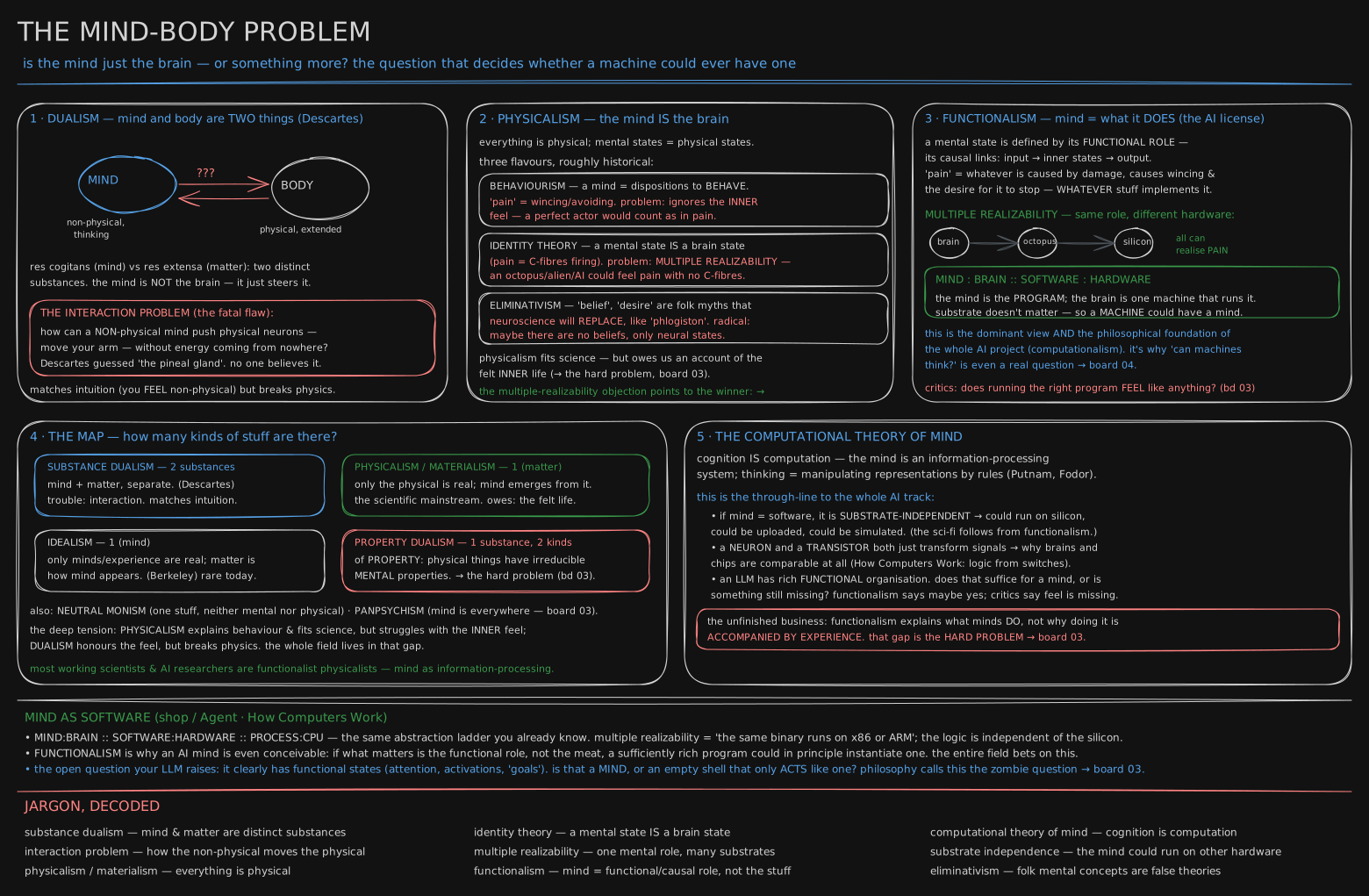
The question every conversation with a machine quietly assumes an answer to: is a mind a special kind of stuff, or just a special kind of pattern?
Before you start. What Is Knowledge? asked how sure you can ever be that you know something; this lesson asks a different question about the same “you” - not what you can know, but what you even are. You need nothing beyond a body and a train of thought, both of which you already have.
1643: a princess’s question Descartes could not answer
Elisabeth grew up expecting to be a queen. Her father was crowned King of Bohemia in 1619 and driven out of the country within a year, and by 1643 the family was living in exile at The Hague, in the Netherlands, on the charity of allies. She read philosophy to pass the time, including René Descartes’s Meditations, published two years before. Descartes argued that you are really two things stitched together: a body, which takes up space and can be measured, and a mind, which thinks but takes up no space at all. Two different kinds of stuff is the whole of the claim, and philosophers call it dualism.
On 16 May 1643 Elisabeth wrote to Descartes with one plain question, and nobody has closed it since. If your mind takes up no space and weighs nothing, how does it push your arm around at all? In her own words, she asked him to explain “how the soul of a human being … can determine the bodily spirits and so bring about voluntary actions.” A hand has to touch a door to open it. What does a thing with no size, no weight and no location touch, to turn a body that has all three?
Descartes’s answer was a gland the size of a pea near the centre of the brain, the pineal gland, where he said the mind and the body met. It satisfied nobody, least of all Elisabeth, who kept pressing him on it for years. Every physical event, right down to your arm rising, already has a physical cause: a nerve fires, a muscle contracts.
flowchart LR
  N["a nerve fires"] --> M["a muscle contracts"] --> A["your arm rises"]
  D["a mind: no size, no weight, no place"] -.->|"pushes how?"| N
Add a mind that is not made of matter into that chain and there are only two bad options. Either the mind changes nothing, a passenger on a ride it never steers. Or something with no mass is adding force to the world, which nothing else in physics is allowed to do. Philosophers now call the gap Elisabeth found the interaction problem, and it is the reason dualism has been losing ground for three hundred years.
No ghost, only the body
If a mind made of nothing cannot push on matter, the obvious fix is to say there is no separate mind-stuff at all. That answer is physicalism: everything that exists, thoughts and feelings included, is physical. In 1959 the philosopher J.J.C. Smart put the strongest version of it in one line: a feeling of pain does not merely travel alongside a pattern of nerve cells firing, it simply is that firing, the way “the evening star” turned out simply to be the planet Venus once astronomers looked closely enough.
That claim breaks on a simple question, which the philosopher Hilary Putnam asked, at Harvard, by 1967. If pain has to be one exact pattern of human nerve cells, then nothing without those exact cells could ever feel it: not a dog, not an octopus, not a machine, however much it winces. That looks wrong the moment you picture a dog in pain. Putnam called this multiple realizability - the same feeling, built out of different material in different creatures - and it is why almost nobody still holds Smart’s exact line.
Functionalism: a mind is what it does
Putnam’s fix keeps physicalism’s big idea, that there is no separate soul-stuff, and drops the other one, that a feeling has to be one particular kind of material. Functionalism says a mental state is defined by its job, not its parts: what causes it, and what it in turn causes. Pain is whatever gets caused by damage, causes wincing and pulling away, and makes you want it to stop. Run that same job on a different animal’s nerves, or in principle on a wholly different material, and by this definition you have pain again, wherever it runs.
This is the view almost every AI researcher is quietly betting on, whether they have read a page of philosophy or not. It is the reason “could a machine think?” is a real question and not an obvious no: if the material never mattered, silicon running the right job would count the same as neurons do.
The strongest reply, from the philosopher Ned Block in 1978, asks you to run that same job absurdly large. Take the firing rule for every neuron in a brain and hand it out on cards to the population of a country the size of China, one person per neuron, each one taking a signal over a two-way radio and relaying it on exactly as the rule on their card says. Wire the country’s combined output to a body. By functionalism’s own definition, that country now has your exact mental states, pain included, the moment the body is pinched. Almost everyone’s gut says a billion people relaying phone calls is not a thing that hurts, whatever the wiring diagram says. If your gut agrees, then having the right job is not enough for feeling, and functionalism has left something out. There is no easy middle ground either: the only reason it let silicon in was that material never matters, and that same reason lets the country in too.
Where this leaves the thing you are talking to
Read that last argument again the next time you talk to a language model. It plainly does a job: takes an input, changes state, produces an output shaped like a reply. Functionalism says a job like that could, in principle, be a mind. What it cannot yet tell you is whether doing the job is accompanied by anything it is like to be that thing from the inside, which is a different question, asked next in Consciousness & the Hard Problem.
You now know
- Dualism says the mind and the body are two different kinds of thing; Elisabeth’s 1643 letter to Descartes pointed out that nobody has ever explained how something with no size or weight could push something that has both - the interaction problem.
- Physicalism denies there are two kinds of thing at all: on this view, a feeling of pain is nothing more than a particular pattern of nerve cells firing.
- That answer runs into multiple realizability: if pain had to be that one exact pattern of material, no other animal, and no machine, could ever feel it - which seems wrong.
- Functionalism keeps physicalism’s “no separate soul” but says a mental state is defined by what causes it and what it causes, not by what it is made of.
- That is why “could a machine think?” is a real question and not an obvious no: if only the job matters, a machine running the right job would qualify.
- Its best objection, the China brain, imagines a whole country’s population running that exact job by relaying radio signals; most people’s gut says that is not a thing that hurts, and if so, the job cannot be all there is to feeling.
Stop here if you want. What follows maps every position philosophers have taken on this question, including the ones the story above skipped, and spells the interaction problem out as a numbered argument.
Second read: the whole map, and the positions the story skipped
The story picked three positions out of a longer argument. Philosophers sort every answer to the mind-body question by how many kinds of stuff it needs.
- Substance dualism (Descartes): two kinds, mind and matter. Matches how thinking feels from the inside; breaks on the interaction problem.
- Physicalism, Smart’s identity theory among its versions: one kind, matter. Fits science; still owes an account of why any of it feels like something.
- Functionalism: also one kind of stuff, but defines a mental state by its causal role rather than its material, which is why the story spent the most time here.
- Property dualism: one substance, physical, but says some physical things carry an extra, irreducible mental property that a role-description alone does not capture. This is the doorway to the hard problem, in Consciousness & the Hard Problem.
- Idealism (Berkeley): one kind, mind; matter is how mind appears. Rare today.
- Also neutral monism (one stuff, neither mental nor physical by itself) and panpsychism (mind is fundamental and everywhere), both minority positions revisited in Consciousness & the Hard Problem.
- Behaviourism, a physicalist position the story skipped: a mind is nothing but dispositions to behave, wincing and avoiding for pain. Objection: a perfect actor who fakes every wince would then count as being in pain.
- Eliminative materialism, the most radical physicalism: words like “belief” and “desire” are a folk theory neuroscience will eventually replace outright, the way chemists replaced phlogiston - the substance they thought escaped from anything as it burned - with oxygen.
Every position is told apart from its neighbours by the one thing it refuses to accept. Read the dotted arrows below as “no”:
graph TD
  Q["how do thoughts relate to matter?"]
  Q --> D["substance dualism: two kinds of stuff"]
  Q --> P["physicalism: matter only"]
  Q --> I["idealism: mind only"]
  P --> B["behaviourism: mind is behaviour"]
  P --> T["identity theory: mind is this brain state"]
  P --> F["functionalism: mind is the role, any substrate"]
  P --> PD["property dualism: one stuff, two kinds of property"]
  D -. denies .-> X1["that physics is causally closed"]
  B -. denies .-> X2["that the inner feel is real over and above the behaviour"]
  T -. denies .-> X3["that an octopus or a chip could have the same pain"]
  F -. denies .-> X4["that what it is made of matters at all"]
  PD -. denies .-> X5["that the feel reduces to function"]
Identity theory and functionalism are both physicalist, and their whole quarrel is the third dotted arrow against the fourth: whether an octopus or a chip could share your exact pain. When someone says “the mind is just the brain,” ask which of the five denials they are actually making; most people have never had to pick.
Elisabeth’s objection, spelled out. The interaction problem, in the shape philosophers actually argue it:
- Every physical event has a sufficient physical cause. This is the causal closure of the physical world, the working assumption behind every lab.
- Your arm rising is a physical event.
- So it already has a physical cause: a motor neuron fired.
- The dualist adds that a non-physical mind also caused it.
- Then either the arm was caused twice over, once physically and once by a mind that changed nothing, or line 1 is false and physics is missing something.
Denying line 1 means owing a physics where force appears from nowhere. Accepting it turns the mind into a passenger that is caused but never causes anything, a position called epiphenomenalism that almost nobody actually wants to hold - and this argument is what keeps producing it.
Computation as the third way out. Putnam’s functionalism, and Jerry Fodor’s version of it, together make the computational theory of mind: thinking simply is computation, manipulating patterns by rule. The payoff line, already implicit in the story:
mind : brain :: software : hardware
A mind is the program; a brain is one machine that happens to run it, the way an x86 chip and an ARM chip can run the identical binary. If that is right, substrate never mattered. The reason a neuron and a transistor are even comparable this way is the same idea one floor down in Logic From Switches (transistors → gates → adder → memory): both just turn signals into other signals.
The unfinished business, and the hinge into the next lesson: functionalism explains what a mind does, not why doing it is accompanied by an experience at all. That gap is Consciousness & the Hard Problem. The psychology track’s own use of the software idea, as a model of memory rather than a metaphysics, is How Memory Works.
Try it
Run the substrate test on your own intuitions. Imagine your brain’s neurons replaced one at a time by functionally identical silicon chips - same inputs, same outputs, same behaviour. At what point (if any) does “you” stop being there, and does the experience fade even though the behaviour is unchanged? (This is Chalmers’s “fading qualia” thought experiment.) Whether you answer “nothing changes” (functionalism) or “something is lost” (the feel isn’t functional) reveals which side of the mind-body divide your intuitions sit on - and it’s the exact intuition that governs whether you think an AI could ever have a mind.
The node commands below assume Node.js is installed (from nodejs.org). Without it, the third line is the one that matters: paste the quoted part of it into your browser’s console (F12, then the Console tab) and it prints the same thing. The first two only name the hardware and have no console version.
Multiple realizability is also something you can watch on the machine in front of you. A “pain” defined only by its role - caused by damage, causing avoidance - runs identically on whatever hardware you have:
uname -m                                   # the substrate: this machine reported arm64
node -p 'process.arch + " " + process.platform'      # arm64 darwin
node -e 'const pain = (damage) => damage > 3 ? "wince, want it to stop" : "fine"; console.log([1, 5].map(pain).join(" | "))'
fine | wince, want it to stopCopy the third line to an x86 machine, or run it under a browser’s engine instead of node, and the output does not change, because the function was never about the transistors. That is the whole of functionalism’s positive claim, in one line of code. The China brain is the question of whether the analogy stops there.
Go deeper
- Descartes (1641), Meditations - substance dualism from the source.
- Ryle (1949), The Concept of Mind - the “ghost in the machine” critique of dualism.
- Putnam (1967) & Fodor - functionalism and the computational theory of mind.
- Nagel (1974), What Is It Like to Be a Bat? - the setup for Consciousness & the Hard Problem.
- Churchland (1981) - eliminative materialism.
Related
- Consciousness & the Hard Problem - the debt every physicalist view above still owes: why the role is accompanied by a feel.
- Can Machines Think? - the cash value of functionalism, and Searle’s room as the China brain with one person inside.
- Free Will, Identity & the Self - the same replacement puzzle (the Ship of Theseus, Parfit’s teletransporter) asked about identity instead of experience: is the silicon you still you?
- What Is Knowledge? - Descartes again, whose method of doubt is where his dualism comes from.
- How Memory Works - the psychology track’s computer analogy for memory, used as a model rather than a metaphysics.
- Logic From Switches (transistors → gates → adder → memory) - why a neuron and a transistor are comparable at all.
- No One Is in Charge - emergence: a flock with no leader and an ant trail with no plan, the clearest case of a whole doing what no part does, which is the physicalist’s bet about minds.
- What a Word Points At - the next question in the track’s order: whether the words a functional system produces point at anything.
- Argue It Yourself - the track’s capstone, where the zombie argument against functionalism is rebuilt as premises.
Retrieval practice
9 questions. Answer each one before you open it.
What did Princess Elisabeth ask Descartes in 1643, and why has nobody closed the gap she found?
She asked how a mind with no size or weight could push a body that has both, given Descartes’s claim that mind and body are two entirely different kinds of thing. The gap, the interaction problem, is that every physical event already has a physical cause, so a non-physical mind as a second cause either changes nothing or breaks the rule that force never appears from nowhere.
What is physicalism, and what is its strongest early version?
Physicalism denies dualism’s second kind of stuff: everything, thoughts and feelings included, is physical. J.J.C. Smart’s 1959 identity theory is the strongest early version: a feeling of pain does not just accompany a pattern of nerve firing, it simply is that firing.
What is multiple realizability, and why does it sink identity theory?
The same mental state can be built out of different physical material in different creatures or machines. If pain has to be one exact pattern of human nerve cells, no other animal or machine could ever feel it, which seems false the moment you picture a dog in pain. Putnam’s objection is what pushes physicalists toward functionalism instead.
What does functionalism say a mental state is, and why is it the philosophical license for AI?
A mental state is defined by its causal role - what causes it and what it causes - not by its material. Pain is whatever damage causes, that causes wincing and avoidance. Since substrate never matters on this view, a machine running the right role would count as having pain, or a mind, in exactly the sense a person does.
Tell the China brain argument and say what it is meant to show.
Hand out the firing rule of every neuron in a brain to the population of a country the size of China, one person per neuron, relaying signals by phone, and wire the country’s output to a body. By functionalism’s own definition, the country now has your exact mental states, pain included, when the body is pinched. Most people’s gut says that is not a thing that hurts; if the intuition is right, having the right causal role is not enough for feeling, and functionalism has left something out.
Why is there no easy middle ground between accepting silicon and rejecting the China brain?
Functionalism’s only reason for admitting a silicon mind is that material never matters, only the role does. That exact reason admits the country of note-passers too. Excluding the country while keeping the chip needs a principled fact about materials that functionalism denies exists.
Sort the positions on the map by how many kinds of stuff they need, and name one the story skipped.
Substance dualism needs two (mind, matter). Physicalism, idealism and functionalism each need one, though they disagree which. Property dualism needs one substance but two kinds of property. Behaviourism - “mind is nothing but dispositions to behave” - is a physicalist position the story’s three sections skipped.
Spell out the interaction problem as a numbered argument, and say what each side of it has to give up.
(1) Every physical event has a sufficient physical cause. (2) An arm rising is a physical event. (3) So it already has one: a nerve fired. (4) The dualist adds a non-physical cause too. (5) Either the arm was caused twice, or step 1 is false. Denying step 1 owes a physics where force appears from nowhere; accepting it makes the mind a cause of nothing, a position called epiphenomenalism.
What is the computational theory of mind, and what does it leave unexplained?
Putnam and Fodor’s view that thinking simply is computation, which makes the mind a program and the brain the machine running it, substrate-independent the way a binary runs on different chips. It explains what a mind does, not why doing it is accompanied by any experience at all - the gap the next lesson calls the hard problem.