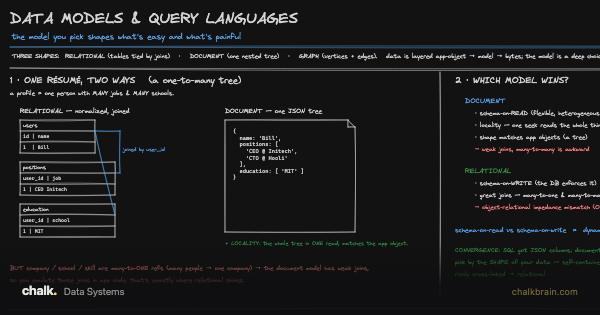
The same board that shows a bolt stored once instead of copied under every engine. Normalisation is that rule applied to tables: each fact written down exactly once, and everything else points at it.
Before you start. A table is rows sharing the same columns, and a key is the column (or the few columns together) that names one row and no other. The previous lesson, Which column names the row: keys, gave you primary keys, candidate keys, composite keys and foreign keys. Here you use them to decide where each fact lives.
Lesson 5 of 17 in Data Systems
The rest of this lesson is part of a plan.
A plan opens every lesson, board, video, lab and paper on chalk. Yearly is $39/year, or $19.50 for your first year with LAUNCH50, ends 1 Nov, 18:30 UTC.
Or start free: a free account opens lessons 2 and 3 of every track.
In this lesson
The shop’s order book, where one fact lives in five places
1971: Codd’s rules for where a fact may live
First normal form: one value per cell, no repeating groups
Second normal form: nothing may depend on half the key
Third normal form: no column may depend on another ordinary column
BCNF: when 3NF still lets a copy through
The other direction: when you copy on purpose
Terms it explains: update anomaly, insert anomaly, delete anomaly, anomaly, normal form, Normalisation, functional dependency, First normal form (1NF), Second normal form (2NF), transitive dependency, Third normal form (3NF), join, Boyce-Codd normal form (BCNF), denormalise, declarative, impedance mismatch, imperative, locality, many-to-one / many-to-many, normalization, one-to-many, property graph, relation/tuple, schema-on-read, schema-on-write, triple-store, vertex/edge.