Index

Free, with Google

Keep going, free.

A free account opens lessons 2 and 3 of every track, 33 more lessons, and keeps your progress and review cards on every device.

Start free with Google

Launch price

Open everything on chalk.

Every lesson, board, video, lab and paper, and the full review decks. Yearly is $39/year, or $19.50 for your first year with LAUNCH50, ends 1 Nov, 18:30 UTC.

See plansStart free instead

Module 01 · Data Systems · Data on one machine

Which column names the row: keys

Data Models and Query Languages
Data Models and Query Languages · Open board

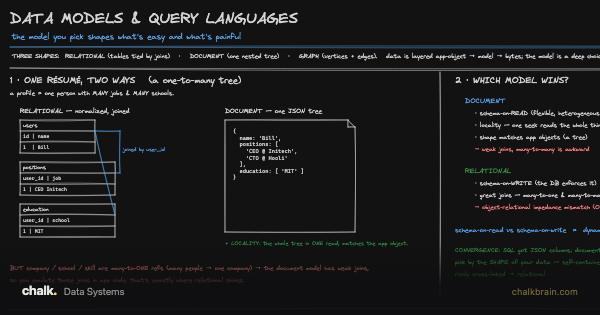
The board shows records that point at each other, and the relational table that replaced them, where nothing points. This lesson is how a row gets a name it can be found by: a key.

Before you start. A table is a grid. A row is one record, like one student. A column is one fact about every record, like the class they sit in. Data Models and Query Languages gave you the relational model, tables of rows that share columns, with no pointers between them. This lesson is about how a row gets found when nothing points at it.

Lesson 4 of 17 in Data Systems

The rest of this lesson is part of a plan.

A plan opens every lesson, board, video, lab and paper on chalk. Yearly is $39/year, or $19.50 for your first year with LAUNCH50, ends 1 Nov, 18:30 UTC.
See plansAlready a member? Sign in

Or start free: a free account opens lessons 2 and 3 of every track.

In this lesson

  • The school office, and the two Priya Sharmas
  • Super key: any columns that never repeat
  • Candidate key: a super key with nothing spare
  • Primary key and alternate key: pick one, keep the rest as rules
  • Natural or surrogate: use what exists, or invent a number
  • Foreign key: a second table that quotes the first

Terms it explains: super key, candidate key, primary key, alternate keys, composite key, natural key, surrogate key, foreign key, referential integrity, declarative, impedance mismatch, imperative, locality, many-to-one / many-to-many, normalization, one-to-many, property graph, relation/tuple, schema-on-read, schema-on-write, triple-store, vertex/edge.

Related papers

Review Data Systems