Deep Work & Attention (focus is the scarce resource)
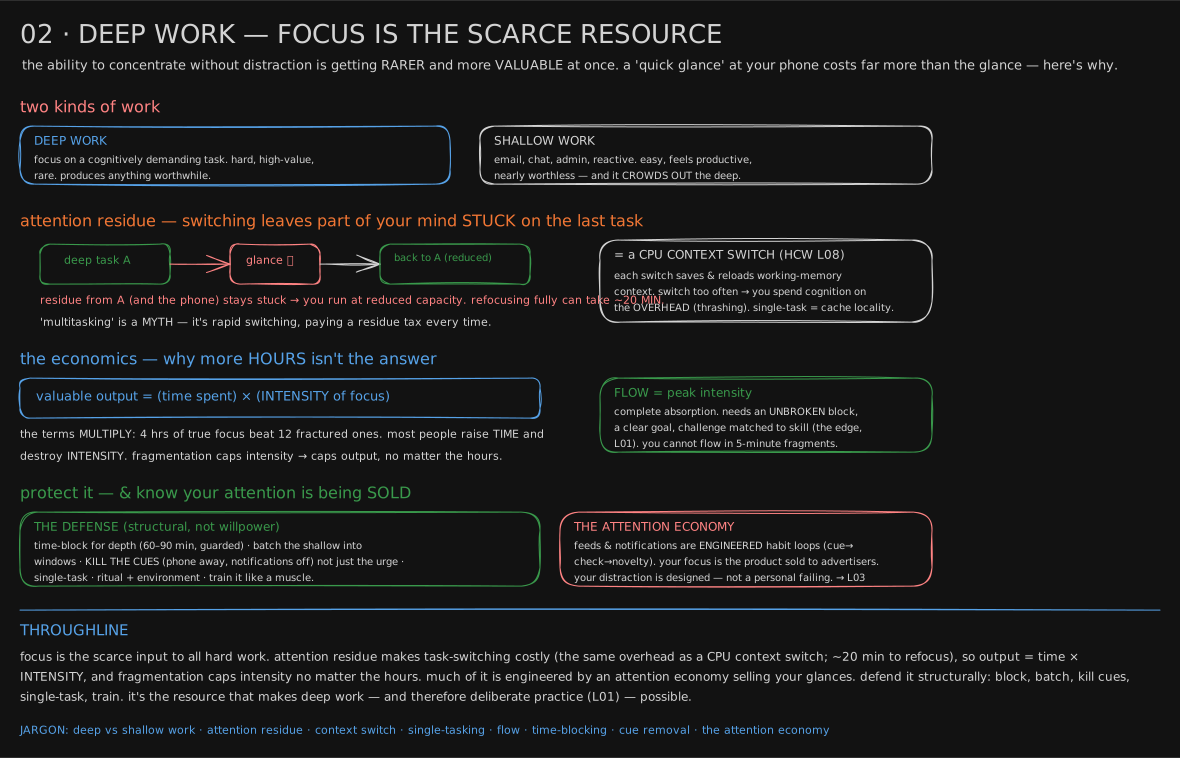
The price of one glance at your phone, and why it is nowhere near what it feels like. Deliberate Practice (how expertise is actually built) already showed you that skill only grows at the ragged edge of what you can do, and finding that edge takes total concentration - which is exactly the thing about to get destroyed.
Before you start. Deliberate Practice (how expertise is actually built) told you that skill grows only when you are working right at the edge of what you can do, pushed by real feedback. None of that is possible if your attention keeps leaving the task and coming back - so this lesson is about the one resource deliberate practice was quietly assuming you had: unbroken focus.
700 hours with a stopwatch, and 24 people who never noticed how much they lost
Gloria Mark, a researcher at the University of California, Irvine, set out to answer a question nobody had actually measured: how long does a real office worker stay on one thing before moving to the next? Over thirteen months she and two colleagues sat inside a real outsourcing company beside twenty-four office workers, about three working days each, timing the exact second each person switched what they were doing. The paper, published in 2005, counts over seven hundred hours of observation in all.
The numbers, when they added them up, were startling for how ordinary they felt. On average, people stayed on one thing for 11 minutes and 4 seconds before switching or being pulled away. More than half of those switches, 57%, were not the person’s choice - somebody or something interrupted them. And when a person was pulled off a task and came back to it the same day, the task had waited, on average, 25 minutes and 26 seconds - and in between they had drifted through more than two other unrelated things.
Twenty-five minutes is longer than a whole “quick check” of your phone feels like it should cost. That gap is the entire subject of this lesson.
2008: paid to answer email, interrupted on purpose
Mark went further. With two psychologists from Humboldt University in Berlin, Daniela Gudith and Ulrich Klocke, she ran a lab experiment: 48 people, mostly German students, paid 12 euros each, played an HR manager and answered three batches of 12 emails as fast and as correctly as they could. One batch they did undisturbed. During the other two, a “supervisor” in another room phoned or messaged them with a question every two minutes, on purpose.
The obvious guess is that the interrupted batches took longer. They didn’t. Interrupted, people finished a batch a little faster - about 20 and a half minutes, against almost 23 minutes left alone. If you stopped reading here, you’d conclude interruptions are free.
They are not. When the researchers asked people how stressed, rushed and frustrated they felt, and how much effort it took, the interrupted batches scored higher on every one - and the emails in them were shorter, though no less polite and no more full of typos. The interrupted batches hadn’t avoided a cost. It was paid somewhere the stopwatch couldn’t see: in how hard the work felt, and in how much went into each reply.
Why the finished job still cost something
A few years later, a researcher named Sophie Leroy worked out why. When you switch from one task to the next, your attention does not switch cleanly with you. A piece of it stays behind, still turning over the thing you just left. Leroy called this attention residue, and it explains both of Mark’s results at once: during the interrupted batches people weren’t fully present on any single email, because part of them was still handling the interruption from two minutes before. They finished faster because they wrote less on each one - and they felt worse doing it, because a piece of their mind never got to rest.
Drawn out, one interruption and the climb back from it look like this:
flowchart LR
  A["working on task A"] -->|"buzz - switch to B"| B["handle the interruption"]
  B -->|"a piece of attention stays on A"| C["back to A, only partly there"]
  C -->|"a slow climb back"| D["back to full intensity"]
A computer has the same problem
A computer’s processor, the chip that actually runs programs, works on one program at a time. To move to another, it has to save everything about the first - where it was, what it was holding - and load the second’s. That swap is called a context switch (the machine side is in Concurrency & the Hardware). Do it too often and the machine spends its time swapping instead of running anything. Your brain does the same thing with working memory, the handful of things you can hold in mind at once. Every switch saves and reloads that working memory, and the reload is not instant. Attention residue is what a slow, incomplete reload feels like from the inside.
2016: a professor who barely checks email gives the two states names
Cal Newport, an assistant professor of computer science at Georgetown University, published a book in 2016 called Deep Work built on one distinction. Some work demands your full, undivided concentration on something hard - writing, designing, actually thinking something through. Newport called this deep work. The rest - answering messages, sitting in a status meeting, clearing an inbox - is logistical and easy, and he called it shallow work. Shallow work feels productive because you are always doing something. It rarely produces anything that matters.
Newport’s claim is a simple multiplication:
valuable output = (time spent) × (intensity of focus)Most people try to raise the first number - work more hours - while attention residue is quietly crushing the second. Four genuinely focused hours beat twelve fragmented ones, because the terms multiply: fragment the intensity toward zero and no number of hours saves you.
The cost of a glance, and why it is a 120× markup
Put a number on one glance. A notification takes five seconds to look at, but it starts a reload: your attention needs time to fully come back, and while it does you work at reduced intensity, not zero. The area under that slow climb back comes out to roughly ten minutes of lost work - six hundred seconds - for a five-second look. Six hundred divided by five is a hundred and twenty. You never feel that multiplier, because it arrives as work that is quietly a bit worse for the next ten minutes - exactly the kind of cost Mark’s 2008 stopwatch missed.
Your attention is being sold
None of this fragmentation is only self-inflicted. Much of the digital world is built to capture it: infinite feeds, badges, notifications tuned for novelty. In the attention economy, your focus is the product being sold to advertisers, not a side effect. These are deliberate cue-routine-reward loops - a buzz, a check, a small hit of something new - the same shape Habits & Behaviour Change (the loop that runs you) covers from the habit side. Seeing that the loop is engineered, not a personal failing, is most of what it takes to start defending against it.
How to protect it
- Time-block for depth. Book 60-90 minute stretches for the work that actually matters, and guard them like a meeting nobody can move.
- Batch the shallow. Handle messages and admin in a few set windows instead of continuously, so they stop shredding the blocks that matter.
- Remove the cue, don’t just resist it. Phone in another room, notifications off. It is far cheaper to remove a trigger once than to win the same small fight all day.
- Single-task on purpose. One thing to a stopping point before the next, so the same working memory stays loaded and the reload cost never gets charged.
- Build a start-up ritual. A consistent place and routine lowers how much it takes to drop into depth in the first place.
You now know
- A 700-hour field study of office workers found they switched tasks every 11 minutes on average, and an interrupted task waited over 25 minutes before they came back to it.
- The cost can hide entirely: a real experiment found interrupted work finished faster, while the people doing it felt more stressed and wrote shorter replies.
- Part of your attention gets stuck on whatever you just left, which is why the very next task gets less of you than it should.
- Every switch means putting down what you were holding in mind and picking the new task’s details back up, and that pick-up is never instant.
- Deep, undivided focus and easy, reactive work are two different modes, and only one of them produces anything hard.
- Because output is time multiplied by intensity, protecting unbroken blocks matters more than adding hours.
Stop here if you want. What follows is the same cost, worked out in the numbers that measured it.
Second read: the reload, measured and modeled
The story already gave you two real numbers: 11 minutes 4 seconds before a switch, and 25 minutes 26 seconds before an interrupted task was picked back up. Quoting a number is one thing; seeing what it does to a whole day takes a small model. Assume the simplest honest shape: after every interruption your intensity climbs back from zero to full over a straight line, then stays at full until the next one. The model below assumes 20 minutes for that climb. That is a guess, not a measurement: Mark’s 25:26 is how long an interrupted task waited, not how long the climb back took, which is why Try it has you time your own. An 8-hour day is 480 minutes. Interrupted every gap minutes, you get 480 / gap blocks, and in each block you lose the triangle under the ramp - half of it, so 10 minutes of full-intensity work per interruption.
// switch.mjs - deep-hours left in an 8h day, interrupted every `gap` minutes,
// each interruption followed by a 20-minute straight-line climb back to full focus
const DAY = 480, RAMP = 20;
function deepMinutes(gap) {
  const blocks = DAY / gap;
  const ramp = Math.min(RAMP, gap);
  const perBlock = ramp / 2 + (gap - ramp);   // triangle under the ramp, then flat
  return blocks * perBlock;
}
for (const gap of [15, 30, 60, 90, 120, 480]) {
  const m = deepMinutes(gap);
  console.log(`every ${gap} min -> ${(m / 60).toFixed(2)} deep-hours of 8  (${(100 * m / DAY).toFixed(0)}%)`);
}
every 15 min -> 4.00 deep-hours of 8 (50%)
every 30 min -> 5.33 deep-hours of 8 (67%)
every 60 min -> 6.67 deep-hours of 8 (83%)
every 90 min -> 7.11 deep-hours of 8 (89%)
every 120 min -> 7.33 deep-hours of 8 (92%)
every 480 min -> 7.83 deep-hours of 8 (98%)The table by hand, without the script. During a 20-minute straight-line climb you average half intensity, so a full ramp costs 20 ÷ 2 = 10 minutes of deep work per interruption; a gap shorter than 20 never finishes the ramp and costs half of itself instead. Then it is one multiplication:
 every 30 min   480 ÷ 30 = 16 switches × 10 min lost  = 160 min gone  → 320 min = 5.33 h  (67%)
 every 60 min   480 ÷ 60 =  8 switches × 10 min lost  =  80 min gone  → 400 min = 6.67 h  (83%)
 every 15 min   480 ÷ 15 = 32 switches × 7.5 min lost = 240 min gone  → 240 min = 4.00 h  (50%)
A five-second glance that costs 10 minutes is a 120× multiplier (600 s ÷ 5 s), the number the story already gave you, now derived rather than asserted.
Three things to read off that table. First, a day interrupted every 15 minutes is a half day. Below a 20-minute gap the numbers stop moving: you never reach full intensity once, and the ramp is the whole day. Second, the gain from 60 to 90 minutes is small (83% to 89%), which is why advice lands on 60-90 minute blocks and not on heroics: past 90 you’re chasing the last few points. Third, forty notifications a day - one every twelve minutes (480 ÷ 40), a quiet day for most phones - is 40 × 6 = 240 of the day’s 480 minutes lost: the reload never finishes before the next buzz, so it lands on the same 50% as the 15-minute row.
The board’s title is not a metaphor. The cost is the glance.
The economics, laid out two ways. The same eight hours, using the table above:
flowchart LR
  subgraph F["Fragmented day: 8 h, interrupted every 15 min, 4.0 deep-hours"]
    direction LR
    f1[mail] --> f2[work 15 min] --> f3[chat] --> f4[work 15 min] --> f5[buzz] --> f6[... x32]
  end
  subgraph B["Blocked day: 8 h, four deep blocks of 90 min plus 2 h of batched shallow work"]
    direction LR
    b1[deep 90] --> b2[shallow 30] --> b3[deep 90] --> b4[shallow 60] --> b5[deep 90] --> b6[shallow 30] --> b7[deep 90]
  end
Same hours, same person, same tasks. The top row reloads thirty-two times, 4.0 deep-hours. The bottom row reloads four times: 6 hours of deep time minus 4 × 10 minutes of ramp is 5.3 deep-hours - a third more - and the shallow work still got its own two hours. It was batched, not abolished.
Try it
Measure your own switching cost for one work session:
 1. Pick one demanding task (write, code, study). Set a 60-minute block.
 2. Rules: phone in another room, notifications off, ONE tab/task at a time.
 3. Keep a tally sheet: every time you feel the urge to switch, mark it - but don't switch.
 4. Note how long it takes to feel "dropped in" (usually 10–20 min - that's the refocus cost).
 5. Compare to a normal, notifications-on hour: how much did you actually produce in each?
Most people are startled by two things: how many switch-urges fire in an hour, and how much more they produce in the protected block despite it feeling harder to start.
Then put your own numbers into the model from the second read. Save the switch.mjs listing and run it with your real interruption gap - count the buzzes in one ordinary hour first:
node switch.mjs                      # the table above
# then edit RAMP to the minutes it took YOU to feel "dropped in" (step 4)
# and the gap list to your measured buzz interval, and run it again
No Node on your computer? Skip the commands. The second read above already printed the main table, and the paper half of this Try it is the part that changes your week.
Two edits and one run, and the table is about your day rather than a study.
Go deeper
- Cal Newport - Deep Work (the book that named the two states)
- Gloria Mark, Victor Gonzalez & Justin Harris - “No Task Left Behind?” (the 700-hour field study)
- Mark, Gudith & Klocke - “The Cost of Interrupted Work” (the 2008 experiment)
- Sophie Leroy - “Why is it so hard to do my work?” (the attention-residue paper)
- Tristan Harris / Center for Humane Technology - the attention economy
- ties to Concurrency & the Hardware (context switch) and Deliberate Practice (how expertise is actually built).
Related
- Deliberate Practice (how expertise is actually built) - the practice this lesson’s focus makes possible.
- Habits & Behaviour Change (the loop that runs you) - the cue-routine-reward loop from the habit side, and how to remove the cue instead of resisting the urge.
- Attention & Cognitive Load - the psychology side of the same fact: attention is one narrow channel.
- Motivation & Habit - why the glance fires at all, from the other track’s angle.
- Concurrency & the Hardware - the context switch, on the machine that named it.
The full Personal Development list is in CURRICULUM.
Retrieval practice
10 questions. Answer each one before you open it.
What did Gloria Mark’s UC Irvine field study actually measure, and what number surprised people most?
Over 700 hours across 24 real office workers, timed to the second with a stopwatch over thirteen months. The average was only 11 minutes 4 seconds on one thing before switching, 57% of switches were interruptions, and an interrupted task waited an average of 25 minutes 26 seconds before being picked back up, with more than two other things in between - far longer than a “quick glance” feels like it should cost.
In the 2008 interruption experiment, why is it wrong to conclude “interruptions are free” just because the interrupted group finished faster?
Interrupted people did finish about two and a half minutes faster than the undisturbed group, but they paid for it elsewhere: significantly higher self-reported stress, frustration, time pressure and effort, and shorter emails (though no less polite and no more error-filled). The cost didn’t vanish - it moved from the clock into the work’s quality and the person’s effort.
What is attention residue, and how does it explain both of Mark’s results at once?
When you switch tasks, part of your attention stays behind on the one you just left (Leroy, 2009). It explains why interrupted work came out shorter - you’re never fully present on the new task - and why it felt harder, since part of the mind never gets to rest between switches.
How is a task switch literally the same thing as a CPU context switch?
A CPU has to save one program’s entire state before it can load the next; do this too often and it spends its time swapping states rather than running any of them (thrashing). Working memory works the same way: every switch saves and reloads it, and the reload isn’t instant - which is what attention residue feels like from the inside.
What is the difference between deep work and shallow work, and why does Newport say one is becoming both rarer and more valuable at once?
Deep work is undivided concentration on something cognitively demanding; shallow work is logistical, reactive, low-stakes activity that feels busy but rarely matters. It’s becoming rarer because constant fragmentation makes it harder to sustain, and more valuable because it’s the only mode that produces anything hard - the two trends run in opposite directions at once.
Why is a five-second glance at a notification roughly a 120× markup?
The glance itself costs five seconds, but it starts a slow reload; in the model’s 20-minute ramp the area lost under the climb back to full intensity comes out to about ten minutes, 600 seconds, of reduced-intensity work. 600 divided by 5 is 120 - a cost you never feel because it arrives as slightly worse work, not a delay.
In the worked model, how many deep-hours does an 8-hour day interrupted every 30 minutes yield, and which of its numbers is a guess rather than a measurement?
480 ÷ 30 = 16 blocks, each losing 10 minutes to the ramp, so 480 - 16 × 10 = 320 minutes = 5.33 deep-hours (67%). The 20-minute ramp is the guess: Mark’s 25 minutes 26 seconds measured how long an interrupted task waited, not how long the climb back took, so the honest move is to time your own.
Explain “output = time × intensity” and why raising only the hours fails.
Valuable output is time spent multiplied by the intensity of focus during that time. Because the terms multiply, letting intensity collapse toward zero through fragmentation caps output no matter how many hours you add - four genuinely focused hours can beat twelve fragmented ones.
Why is removing a distraction’s cue more effective than resisting the urge each time it fires?
Distraction runs on a cue-routine-reward loop engineered to be irresistible - the attention economy sells your focus to advertisers. Resisting the urge every time it fires is expensive and unreliable, while removing the cue (phone in another room, notifications off) stops the urge from firing much at all, which is far cheaper than winning the same fight repeatedly.
How does protecting deep work connect back to deliberate practice?
Deliberate Practice (how expertise is actually built) requires sustained, undistracted effort at the edge of your ability, and that is impossible while task-switching. The capacity for deep work this lesson protects is the precondition for that kind of practice, not an add-on to it.