Deliberate Practice (how expertise is actually built)
A climber’s hand reaching for a hold just out of reach, above a ledge that’s wide, comfortable, and going nowhere. That is the whole lesson in one picture: staying on the ledge feels like practice, and isn’t.
Before you start. The first read needs no maths beyond a percentage; the second adds an exponent and a logarithm, each explained where it appears. You need nothing from an earlier lesson - this is the first in the track. All you need going in is the honest memory of a time you got “fine” at driving or typing, and then stopped getting any better for years.
1993: the violinists who logged 10,000 hours - not yet deliberate practice
K. Anders Ericsson, a psychologist who went on to spend his career at Florida State University studying what makes experts different from everyone else, published a study in 1993 with two colleagues, Ralf Krampe and Clemens Tesch-Römer, built on something nobody had bothered to do before: they had violin students keep a diary of every hour they practiced, for years. By age twenty, the students in the study had logged an average of 10,000 hours. That is the number Malcolm Gladwell would later turn into a bestseller’s title rule. But Ericsson’s own paper said something the popular version dropped: those same violinists, ten thousand hours in, “were nowhere near masters.” When the 10,000-hour rule made Gladwell famous, Ericsson wrote back that “this rule … is wrong in several ways” - the hours needed vary hugely by field, and worse, Gladwell never separated hours spent at the edge of your ability from hours spent repeating what you can already do. That split is the part that actually explains anything.
Twenty years of driving the same commute teaches you almost nothing after the first few months. Twenty years of a specific, narrower kind of practice - deliberate practice - is what actually builds skill, and it looks nothing like just doing the thing for a long time.
The ledge everyone stops on: automaticity
Climb far enough up any rock face and you eventually reach a ledge wide enough to stand on without effort. Most climbers rest there. The trouble is that most people, learning a skill, find their ledge in the first few months and then stay on it for decades, mistaking the standing-still for progress.
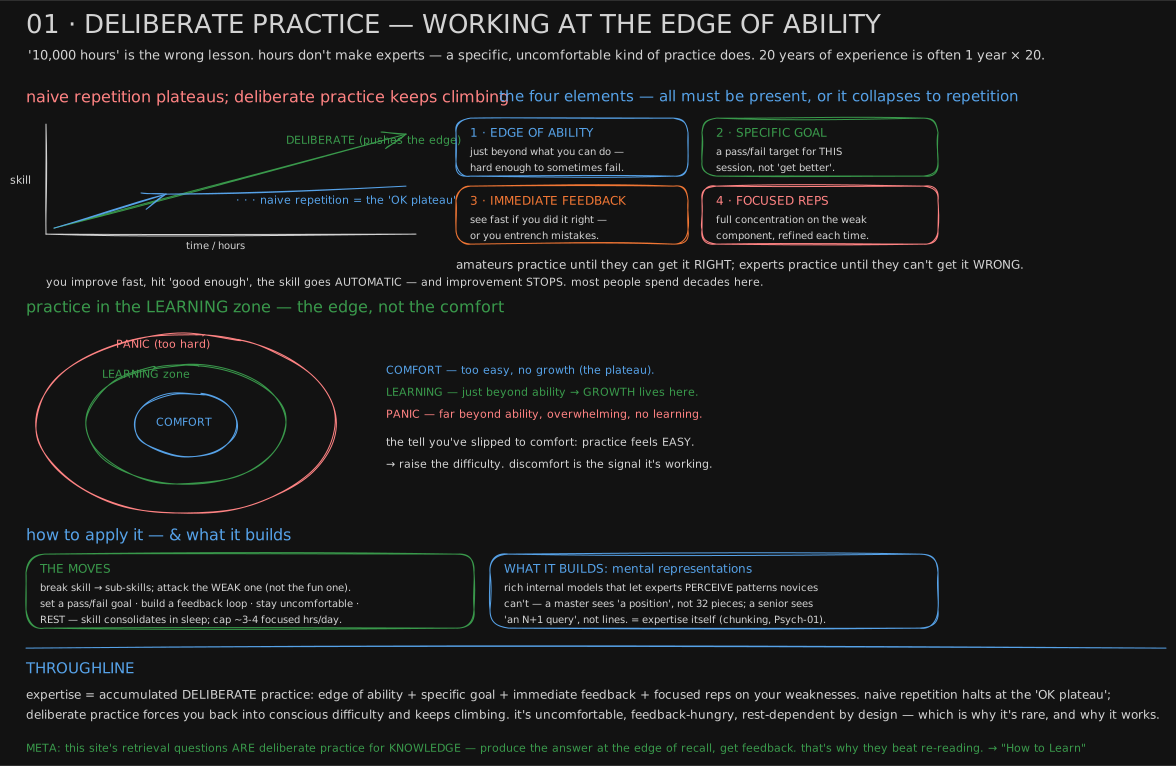
Here is why it happens. While a skill is new, every part of it takes conscious effort. Once it feels easy, your brain hands it off to run without you thinking about how - call this automaticity, and it is genuinely useful, because it frees your attention for something else. But it is also where the improving stops: you are no longer practicing the skill, you are just performing it. People call the flat stretch that follows the “OK plateau,” and most of a lifetime of “experience” is spent there. The sketch below plots skill against time for both kinds of practice.
 skill
   │            ╭──────── deliberate practice (keeps pushing the edge)
   │        ╭───╯
   │    ╭───╯   · · · · · · · · · · naive repetition (the "OK plateau")
   │╭───╯
   └──────────────────────────────► time
The dotted line climbs fast, then goes flat forever. The solid line never rests, because it keeps looking for the next hold.
The learning zone: hard enough to fail sometimes
Back on the rock face, there are three kinds of moves. Standing on the ledge is easy and teaches you nothing. Lunging for a hold way beyond your reach is how you fall, and panic teaches you nothing either. The move that actually improves you is a hold just barely out of reach - hard enough that you miss it sometimes. Call that middle ground the learning zone: past comfort, short of panic.
Deliberate practice happens only in that zone, and only when three more things are true alongside it. You need a target you can clearly pass or fail - not “get better at the violin,” but “play this sixteen-bar passage from memory, in tempo, with the right fingering.” You need to find out fast whether you hit it: a coach, or a recording you play back immediately. And you need to spend the attempt on the specific part that is actually failing, not the whole piece end to end. The loop below puts those steps in order.
flowchart TD
  A["Pick the weakest part"] --> B["Set a pass or fail target"]
  B --> C["Attempt it in the learning zone"]
  C --> D{"Did it work?"}
  D -- no --> E["Find the exact error, adjust"]
  E --> C
  D -- yes --> F{"Did it feel easy?"}
  F -- yes --> G["Move the target up"]
  G --> A
  F -- no --> H["Rest, then pick the next target"]
  H --> A
Pick, attempt, find out, adjust, attempt again. The right-hand branch is the plateau alarm. “Yes, and it felt easy” does not mean stop - it means you just found your ledge again, and the fix is to raise the difficulty, not enjoy the win.
Why a chess master sees a position, not 32 pieces
Two things happen inside someone doing this for real. First, they stop rehearsing what they can already do - that part is comfortable, and comfortable is where nothing changes - and instead isolate the exact passage or line of code they keep getting wrong. Second, over hundreds of these attempts, their mind builds richer, more organised mental representations: patterns that let an expert perceive things a beginner can’t. A chess master looks at a board and sees one shape, “a weak king,” not thirty-two separate pieces. An experienced climber looks at a blank rock face and reads a route up it; a first-timer sees only bumps. Neither is thinking faster. Both have simply built a better-organised picture of the same information, one failed attempt at a time.
The climbing comparison holds for almost the whole lesson, but it breaks in one place worth naming out loud: a climber gets feedback from gravity, for free, the instant a foot slips. Nobody has to build that. Learning a language or an instrument gives you no such thing automatically - you have to build your own catch, a coach or a recording, because most skills simply do not punish a wrong move on the spot.
You now know
- Doing something for a long time does not make you better at it once it starts to feel automatic - your attention moves on, and improvement stops with it.
- Deliberate practice is a specific kind of practice: at the edge of what you can currently do, aimed at a clear pass-or-fail target, with fast feedback on whether it worked.
- The zone that grows a skill sits between “too easy” and “too hard” - staying too long in either teaches you nothing.
- Experts don’t rehearse what they’re already good at; they isolate the exact part that is failing and drill only that.
- What years of deliberate practice actually build is a richer, better-organised picture of the skill, so the right move looks obvious instead of hidden.
- How fast feedback arrives changes how long a skill takes to learn far more than how many hours you put in.
Stop here if you want. What follows is the same idea in hours - the arithmetic behind why fast feedback beats more practice, worked out from scratch.
Second read: how much feedback speed is worth, in hours
Here is a small model that turns “fast feedback” into a number. Say you currently get something wrong half the time, and you want that down to one time in twenty. Each hour of practice fixes some fraction of the errors you still make - but only the ones you actually find out about. Call that fraction f. The table below gives the hours for four values of f; the working follows it.
| how much of the remaining error one hour fixes | hours from 50% wrong to 5% wrong |
|---|---|
| 30% (a test suite, a coach, a recording reviewed at once) | 7 |
| 10% | 22 |
| 5% (feedback arrives days later, most errors go unnoticed) | 45 |
| 1% (no real feedback: you only notice the errors that hurt) | 230 |
The two rows that matter are the first and third: same skill, same target, same hours of effort per week - and one person gets there in seven hours, the other needs forty-five, purely because of how quickly each mistake came back to them. This is a model, not a study of real people, and the fractions are invented; the shape is what to take from it. Halving the delay before you find out you were wrong does more for your rate of improvement than doubling the hours you put in, and it is usually the cheaper of the two to fix.
The formula, in three lines. Each hour you keep a fraction 1 − f of the errors you still have, so after h hours the error is 0.5 × (1 − f)^h. Set that to 0.05, so (1 − f)^h = 0.1, and solve for the exponent h. That is what a logarithm is for: ln x is the power you raise 2.718 to to get x, and it turns a power into a multiplication, ln((1 − f)^h) = h × ln(1 − f). So h = ln 0.1 ÷ ln(1 − f). Check the 30% row: keeping 70% an hour, two hours keep 0.7 × 0.7 ≈ 0.49 - the error roughly halves every two hours - and 50% to 5% is a tenth, about 3.3 halvings, so 7 hours (exact 6.4). The 5% row keeps 95% an hour, about fourteen hours per halving, times the same 3.3, giving 45 (exact 44.9). The same division gives 21.9 for 10%, so 22, and 229.1 for 1%, rounded up to 230.
The plateau from the story has the same shape, run the other way. If each hour of naive repetition teaches 10% less than the hour before - because more of what you’re doing is already automatic - the first hour teaches one “unit”, the next 0.9, and so on, a total that never passes 1 ÷ 0.1 = 10. After n hours you have 10 × (1 − 0.9^n): 4.1 by hour five, since 0.9^5 ≈ 0.59. By hour twenty 0.9^20 ≈ 0.12, so 8.8. Past the twentieth hour there is almost nothing left to collect from doing it the same way again, which is exactly the flat line the sketch drew earlier.
Applying this is short enough to be one list: find the specific weak part and target only that, not the whole skill. Set a session goal you can pass or fail - vague practice is comfortable and wasted. Build a feedback loop on purpose: a metric, or a rubric you grade yourself against, the same move Evaluating Models (how do you *know* it's good?) calls “build your own eval,” aimed at yourself instead of a model. Stay in the discomfort, and raise the difficulty the moment it feels easy. Then rest - skill is cemented during recovery and sleep (see How Memory Works), which is also why experts cap deliberate practice at three to four focused hours a day; full concentration runs out (see Deep Work & Attention (focus is the scarce resource)).
This loop already runs in one place hiding in plain sight: this site’s own retrieval questions force you to produce an answer from memory before revealing whether you were right - deliberate practice applied to knowledge, and why retrieval beats re-reading (see How to Learn (the highest-leverage skill)).
Feedback from a person: how to ask, and what to do with it
Most of this lesson’s feedback comes from a test, a timer or a metric. The richest feedback usually comes from a person who is better at the skill than you, and it fails more often than people expect. In 1996 Avraham Kluger and Angelo DeNisi pooled 607 effect sizes from feedback studies going back to 1905. On average feedback helped (an effect size of 0.41). But in more than a third of the cases it made performance worse. Their explanation: feedback helps when it points attention at the task (“your third paragraph has no claim in it”), and hurts when it points attention at the person (“you are not a natural writer”).
That gives you three rules for asking:
- Ask about one part, not the whole. “What is the weakest thing about how I open a talk?” gets a task answer. “What did you think?” gets a verdict about you.
- Ask for the next step, not a grade. “What one change would make the biggest difference next time?” is something you can practise this week.
- Turn vague feedback into a test. If you hear “it felt flat”, ask “where did it first feel flat?” and “what would not-flat look like there?” If they cannot say, treat it as a feeling about you, not information about the task.
A mentor is just this done regularly by the same person: someone further along who sees your attempts often enough to spot the pattern you cannot. You do not need a formal arrangement. One person, a fixed rhythm (a monthly look at one piece of work), and the three questions above are most of it.
“I’m about to be found out”: the impostor feeling
Practising at the edge means you will feel out of your depth most of the time, and many people read that feeling as proof they do not belong. In 1978 the psychologists Pauline Clance and Suzanne Imes named it the impostor phenomenon, after working with more than 150 high-achieving women who believed their success was luck and that they would soon be exposed. Their paper was based on clinical observation, not a controlled study, and later work has found the feeling widely in men and women alike. It is a pattern of thinking, not a diagnosis.
For a learner it helps to see what the feeling is measuring. At the edge of your ability you fail often, by design: that is the learning zone this lesson describes. The impostor feeling counts those failures as evidence about you. Deliberate practice counts them as evidence about the next thing to practise. Two habits help: keep a short log of what you could not do three months ago and can do now (the evidence the feeling leaves out), and say the feeling out loud to someone further along. It is usually met with “me too”.
Try it
Pick one skill you actually want to improve - a coding technique, writing, a language, an instrument - and design a single deliberate-practice session:
 1. SUB-SKILL:   name the specific component you're weakest at (not the whole skill).
 2. SESSION GOAL: a concrete pass/fail target for the next 45 min
                  (e.g. "implement quicksort from scratch, no reference, correct on 3 random inputs").
 3. FEEDBACK:    how will you KNOW if you succeeded? (tests, a timer, a recording, a rubric)
 4. EDGE CHECK:  if it feels comfortable, it's too easy - make it harder.
 5. AFTER:       write one line - what failed, and what you'll target next session.
Run it once. The discomfort, and the line you write afterward, are the signs you did it right.
Then put your own numbers into the feedback model, thirty seconds in a terminal:
cat > hours.mjs <<'EOF'
const hours = f => Math.ceil(Math.log(0.05 / 0.5) / Math.log(1 - f))
for (const f of [0.3, 0.1, 0.05]) console.log(`fix ${f * 100}% of remaining errors per hour: ${hours(f)} hours from 50% error to 5%`)
EOF
node hours.mjs
No Node on your computer? Skip the commands. The second read above already printed the main table, and the paper half of this Try it is the part that changes your week.
What it prints:
fix 30% of remaining errors per hour: 7 hours from 50% error to 5%
fix 10% of remaining errors per hour: 22 hours from 50% error to 5%
fix 5% of remaining errors per hour: 45 hours from 50% error to 5%
Change 0.05 to 0.01 and every row grows by about the same factor. Then swap in your own honest guess for the skill you picked above, once for the feedback loop you designed in step 3, and once without it.
Go deeper
- Anders Ericsson & Robert Pool - Peak: Secrets from the New Science of Expertise (the primary source)
- Ericsson et al. - the original deliberate-practice paper (1993)
- James Clear - the beginner’s guide to deliberate practice
- The “OK plateau” (Josh Foer, Moonwalking with Einstein).
Related
- Learning & Expertise - the psychology track’s view of the same research: how experts perceive, and what transfers.
- Spaced Repetition - the feedback loop for knowledge, scheduled.
- Deep Work & Attention (focus is the scarce resource) - the focus that focused repetition assumes.
- How to Learn (the highest-leverage skill) - retrieval over re-reading, the knowledge version of this loop.
- The Alarm That Won't Switch Off (stress after failure) - what to do with the stress of failing at the edge.
- How to Read a Self-Help Claim (effect sizes, replication, and testing it on yourself) - the 10,000-hour rule as a worked exercise in judging a claim.
The full Personal Development list is in CURRICULUM.
Retrieval practice
9 questions. Answer each one before you open it.
Why is “10,000 hours” misleading, and what actually predicts expertise?
The number comes from Ericsson’s 1993 violin study, but the violinists who had logged those hours by age twenty “were nowhere near masters,” in Ericsson’s own words. What predicts expertise is not the hour count but deliberate practice: focused work at the edge of current ability, aimed at a specific target, with fast feedback, targeting weaknesses. Equal hours can yield very different skill.
What is the “OK plateau,” and why do most people stay on it for years?
Learning a skill improves you quickly at first, then reaches a “good enough” level where the skill runs automatically - you can do it without consciously thinking about how. That automaticity is efficient but is also where improvement stops, because you’re now performing the skill instead of practicing it. Escaping the plateau means deliberately stepping back out of automaticity, which is effortful and uncomfortable, so most people never do it.
Name the parts of deliberate practice, and why does dropping any one of them collapse it back into naive repetition?
Practice in the learning zone (past comfort, short of panic), a specific pass-or-fail target for the session, fast feedback on whether it worked, and focused attention on the exact weak part rather than the whole skill. Drop any one: no learning zone means no growth, no target means no direction, no feedback means no correction, and no focus means the weak part never gets isolated.
What are the three zones on the rock face, and which one is deliberate practice trying to keep you in?
The comfort zone (a task you can already do easily - no growth), the learning zone (just past current ability, hard enough to fail sometimes - where growth happens), and the panic zone (far beyond ability - overwhelming, no learning either). Deliberate practice deliberately holds you in the learning zone; feeling like a task is easy again is the sign you’ve slipped back to comfort, and the fix is to raise the difficulty.
Why do experts drill their weaknesses instead of what they’re already good at, and what are “mental representations”?
Rehearsing a strength is comfortable but produces almost no gain, since the improvement lives in the specific part still failing - so experts isolate exactly that and drill it. Doing this repeatedly builds mental representations: richer, better-organised internal patterns that let an expert perceive things a beginner can’t, the way a chess master sees “a weak king” rather than thirty-two pieces, or an experienced climber reads a whole route up a blank rock face.
How is this site’s own retrieval-callout format an example of deliberate practice?
The callouts hide the answer, forcing you to produce it from memory at the edge of recall, then reveal the correct answer so you get immediate feedback on whether you were right - the learning-zone-plus-feedback core of deliberate practice, applied to knowledge instead of a physical skill. Re-reading feels like knowing without testing it; retrieval exposes what you don’t know yet.
Why can’t deliberate practice run for many hours a day, and what role does rest play?
It demands full concentration at the edge of current ability, which is exhausting, so elite performers sustain only about three to four focused hours a day. Rest matters twice: within a day, quality collapses once concentration runs out; between sessions, the skill is consolidated during recovery and sleep.
In the feedback-speed model, what separates seven hours from forty-five, and which is the cheaper lever to pull: more hours, or faster feedback?
Only how much of the remaining error each hour fixes - 30% with fast feedback, 5% when feedback arrives late and most errors go unnoticed. Faster feedback multiplied the rate by roughly six and a half; doubling the hours only doubles it. Shortening a feedback loop is usually the cheaper change to make.
The practice loop has two exits back to the top. What are they, and which one is the plateau alarm?
“It failed: find the exact error, adjust, attempt again” and “it worked: did it feel easy?” The second is the alarm - answering yes means you have drifted back to the comfort zone and should raise the difficulty rather than enjoy the win; answering no means rest, then pick the next target.