Module 10 · System Design · Six more low-level rounds
Design snake and ladder (a game you can test)
Design Snake and Ladder · Open board
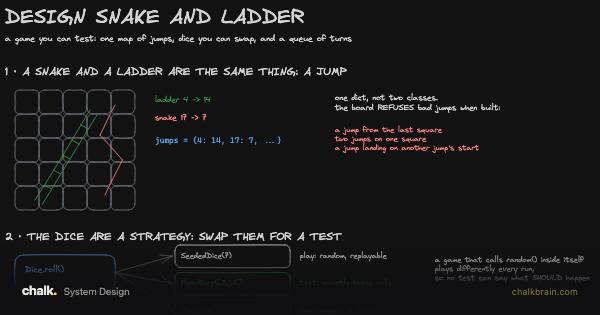
One map of jumps, dice you can swap for a test, turns in a queue with the exact-roll rule, and the network follow-up.
Before you start. You need two lessons. Swap the rule, keep the class (Strategy and Factory) showed a strategy: one job with several interchangeable rules, each in its own class, all answering the same method call, so the owner can be handed a different one. Design a parking lot (the first whole round) ran a whole interview round: ask questions first, circle the nouns, give every rule to one class, and name the follow-up before you type. A class is a blueprint for objects, and an object’s state is the values it holds right now. This lesson runs the same round on a children’s game, and the point is a game whose every run you can replay.
Lesson 50 of 73 in System Design
The rest of this lesson is part of a plan.
A plan opens every lesson, board, video, lab and paper on chalk. Yearly is $39/year, or $19.50 for your first year with LAUNCH50, ends 1 Nov, 18:30 UTC.
Or start free: a free account opens lessons 2 and 3 of every track.
In this lesson
Moksha Patam: a board where snakes and ladders are the same thing
Rules the board must refuse: checking the jumps when the board is built
Dice as a strategy: the die is the part you swap
Seeded randomness: random that repeats on purpose
Turn order: a queue where the front player moves and goes to the back
The game loop, and the rule that you must land exactly
Terms it explains: strategy, class, state, map, jump, dice, dependency injection, seed, queue, turn order, game loop, owner, board as a map, dice as a strategy, seeded randomness.